I wont give up his home
– What are you doing here?
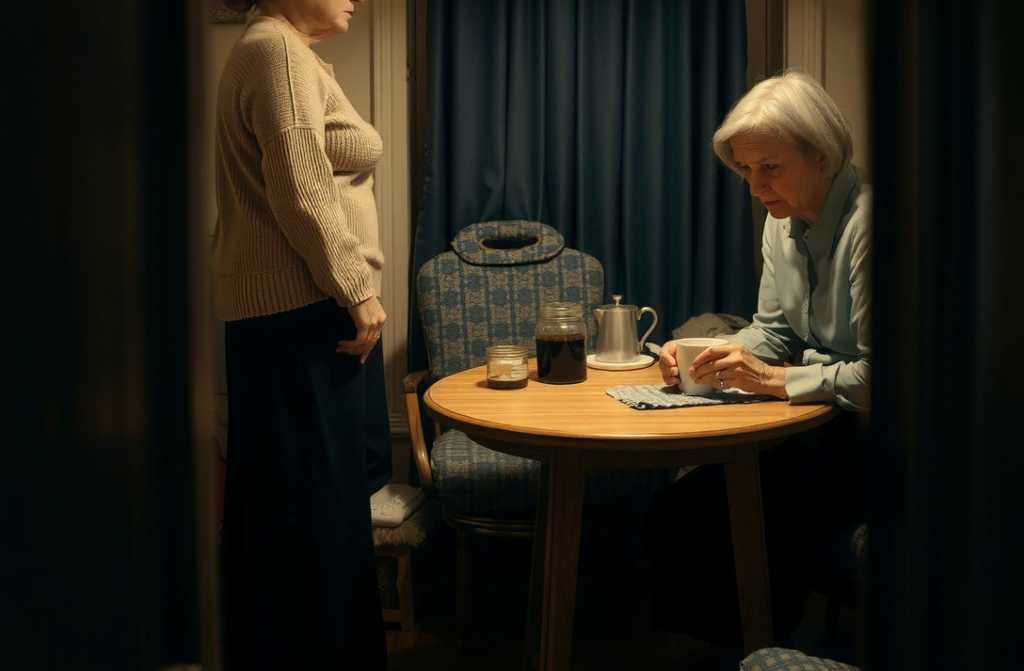
Valerie stood in the doorway, solid as a sentry. Her hands clasped each side of the frame, blocking not just the room but entry into her life.
– Hello, Mrs. Stevenson.
– I asked you why youre here.
I hesitated, eyes lingering at the threshold. The old doormat was still there, the blue one with white edges. Id picked it up years ago at a market near Angel station. It was fraying now, but not discarded.
– May I come in?
A pauselong, thick as November mist. Valerie stood her ground, then wordlessly stepped aside and disappeared into the kitchen. A kind of invitation, if I was generous.
I slipped off my coat, closed the door softly behind me. The air had a changed smellfamiliar but not. No longer the tang of Peters tobacco from the peacoat that always hung from the left peg. Now there was only a faded flannel dressing gown and an old knitted hat.
Valerie was already rattling the kettle, though clearly she had no intention of offering a brewshe just needed to keep her hands busy.
– I saw the light on, I said. I was passing.
– At ten oclock in the evening?
– The bus was delayed. I waited at the stop.
She set the kettle down, turned to face me. I felt her gaze on me as if she could see all my doubts. Someone you stopped counting on long ago but still cant let go.
– Well, take your coat off, she said at last. Since youve come all this way.
I hung my coat, not on the left peg, but switched it over to the right.
We sat, as if across trenches, at the small kitchen table. Valerie poured tea, not asking if I wanted it, just setting a mug before me. She nudged the sugar bowl my way, still keeping her eyes averted. Patterns, her body knew better than her headguest at the table, do the movements first, think about it later.
– How are you? I asked, soft.
– All right. As ever.
Her hands, cradling her mug, were old and honest. Bent fingers, liver spots and all. But the grip was too tight for all right, too knotted for as ever.
– I wanted to talk, I tried.
– About what?
– A bit of everything.
– About the paperwork?
I hesitated.
– Not just that.
She sipped her tea, set the cup down with a quiet clack. Could be nothing, could mean everything.
– Paperworks for the solicitor, she said. Ive said my bit.
– I know.
– So why repeat yourself?
It wasnt a question. I didnt answer as if it was. I tried the tea, too hot, set it back down.
Outside, rain whispered against the windowthe fine autumn drizzle that hovers in the air more than it falls. The lamp posts flickered over the estates drive, shadow dancing on the windowsill.
I knew this kitchen well. Knew that the left drawer was full of string and old batteriesPeter never threw them away, just in case. Knew that a bucket sat under the sink when the pipe dripped, as it always did in October. Knew there was a gap behind the fridge where a ten-pence piece had rolled and, years ago, wed spent half an hour fishing it out with a ruler. Peter laughed. And Michael giggled. And so did I.
Michael. Three months gone.
– I brought some blackberry jam, I said. Left it by the door, wasnt sure if you saw.
Valeries eyes flicked to the hallway, then back.
– I saw.
– You always liked it.
– Liked. – Pause – Like.
That slip sounded truer than any speech. Valerie herself seemed thrownunsure of which tense was real.
I understood that. Half my sentences about Peter had started in the present tense lately, and then Id have to stop, silence pooling thick and awkward.
– I heard you were planning to go to Norfolk, to see Teresa? I asked.
– Planned. Didn’t get round to it.
– Whats stopping you?
– Oh, you know… things.
I looked right at her. We both knew there were no things. Just the flat, the prospect of leaving it all alone, the quiet, and maybe fear. Teresas a good soul, but pity is like vinegar to Valerie.
– Mrs. Stevenson I let my voice warm, gentle, serious — I didnt come for paperwork, honestly.
– Honestly, she echoed, and I couldnt guess if she believed me or simply repeated my word.
– I know youre cross with me.
– Im not cross.
– All right.
– I just dont understand, Valerie said then. Her voice finally slipped out from under armourquiet, less stern, real. I dont understand how you can. Half a years passed. Youve moved on. Im still here.
I didnt say youre wrong or youre not thinking straight. I just sat.
– I saw you, Valerie went on. Lizzie, the neighbour, saw you tooshe told me. You were at the café on Highgate Hill in August. With someone.
– That was a colleague. We were working on a project.
– Colleague, she echoed again.
– Yes.
Valerie rose, looked through the window at the rain, at the flickering streetlight.
– Peter loved you, she said, facing away. Maybe more than you realised.
– I knew.
– Im not sure you did.
My hand closed round my mug. Something inside shifted, like that flicker of light from the lamp. I kept quiet; anything I said wouldve been wrong.
– Im not saying youre a bad person, Valerie said, still to the window. Youre youngforty-two. Your lifes ahead of you. Im sixty-eight. I had one son.
– I know.
– And now hes gone. And you come with blackberry jam.
It wouldve sounded cruel, if it hadnt been so exact. I felt something close to gratitude for her honesty, though I couldnt have explained why.
– I dont know another way, I said. Im not good with words. I have to come, somehow say something. With jam, because coming empty-handed wouldve been worse.
She turned, looking me over with quiet study.
– Youd been crying before you rang the bell? she asked.
– A bit.
– On the stairs?
– Yes.
Her face shifted; just a little. She came back to the table, sat down again.
– Silly, both of us, she said. It was the first thing all evening without double meaning.
We sat in silence for a bit. The rain grew louder, now hitting properly, all the quiet corners filling up.
– Tell me, I said. About the will. What actually hurt you. Not through a solicitor, but from you.
She looked at me, surprise flickering, as if no one had ever just asked her straight before.
– Theres the flat, she said. His flat. We bought it for him, Robert and I, saved up for years. Nearly eight. He was so young, and we wanted him to have his own. He lived there, you lived there. I dont mind that. But it was his, and now… on paper…
– On paper, it comes to me, I said.
– You werent married.
– We lived together six years.
– I know. Valerie folded her hands. But I feel I feel as if hed want me to have a say. He wouldnt want me left outside.
– Peter wrote the will himself, Mrs. Stevenson.
– I know. Maybe its right. Maybe. I was so angry at first. Im not now. I just dont get it.
– Dont get what?
– Why keep it? You said to Lizzies daughter you might move out, that the place is too big for you alone. Why hold onto it, then?
I looked at her.
– I said that when I felt everything collapsing in July. I don’t know what I’ll do yet.
– If you sell, Valerie said, hesitant.
– I have no plans.
– But… if you didwould you tell me first? Not strangers, me?
And there it was, the heart of all this. It wasnt about square footage or money. It was about being left outside, being other. About wanting to remain a part of something, to have the right to know first, to keep a thread to her son through me, someone whod seen him differently than she had, but still truly.
– Ill tell you first, I said. Promise.
Valerie nodded, brief and matter-of-fact. She poured herself another tea.
– Did you eat today? she asked.
– This morning.
– Only this morning? She opened the fridge, not really waiting for an answer. I made noodle soup. Will you have some?
– Yes.
While Valerie reheated the soup, I watched herthe lines of her back. I wondered how it might all have been otherwise. In another life, maybe wed have spent weekends at the coast together, shared Christmases, rung each other just to chat. Or maybe we always would have had this wary closeness, never quite family, not estranged eitherjoined by what wed lost, not what wed shared.
The soup was plain and perfect, carrots, onions, those short English noodles, a bit of parsley. The kind you make for yourself when cooking isnt the point, but eating is required.
– Its good, I said.
– Dont overdo it.
– It is good.
Valerie kept her head down, finishing her soup. Then, quietly, not looking up:
– He was looking for you in hospital, you know.
I stopped.
– What?
– When you went away in April. You said it was a conference. He went in for tests, I was there. He kept asking when youd be back. I said I didnt know. He said, today, then tomorrow, then the day after.
I put my spoon down.
– I came back as soon as I got the call.
– I know. Valerie finally looked at me. Im not blaming you. Just telling.
– Why?
– I dont know. Someone should know, apart from me.
Fair enough. My mouth was suddenly dry, despite the soup. I sipped my teacold by now.
– He never said he was frightened, I murmured. I thought he was calm, that it helped him when I wasnt fussing.
– He hated being fussed over.
– Exactly. I thought I was doing the right thing.
– Maybe you were, maybe you werent. Who knows, now?
That who knows now settled in the quiet and didnt leave.
I helped with the crockery, though she never asked. We stood side by side, Valerie washing, me drying. It felt so ordinary I wondered if, in that moment, we both thought the same thing but neither said it.
Back at the table, Valerie brought out a packet of digestives, the kind left at the bottom of the tinchildhood staple, not fancy, from the little shop in Camden Passage.
– Lizzie says I should join a club, Valerie said idly. Pensioners paint watercolours at the community centre on Thursdays.
– Will you?
– Dont know. Feels a bit ridiculous.
– Why?
– At my age…
– Your age is the perfect time, I smiled. Really.
Valerie shot me a look, amused.
– You sound like a social worker.
– You sound ancient.
– Sixty-eight.
– Hardly a hundred.
She took a biscuit, considered, nibbled.
– I was always busy, you know. My Robert, then Peter, then work, then I thought someday grandchildren… didnt happen. I dont know how to do just because. Painting watercolours is just because.
– Maybe thats exactly what you should learn.
– Easy for you to say.
– Not easy, I protested. Its hard. Im floundering too.
She looked at me, half surprised.
– You thinking of joining a club yourself?
– No, but Ive got work, friends, all that. Still, I sit in the flat, thinking if only hed walk in and say something daft, some nonsense, itd right itself.
Pause.
– He was good at nonsense, Valerie said.
– He was.
– Hed come in and say, Mum, did you know I thought hamsters were baby hamsters as a kid? Where do they get it from?
– He told me an elephants zaan in Mongolian, which is funny, as if it was up itself.
Valerie laugheda proper, short, surprised laugh.
– Lord. Where did he pick all this up?
– He read. Always reading.
– Couldnt pull him away from books since he was five.
– Ive seen a photoon the old garden step, clutching a book as the others play behind him.
– That old plot in Norwich… Robert kept the garden going dawn till dusk; Peter just read and Id think, what a child. Eventually, I gave in.
– What did he read at eight?
– Sea stories. Adventure books. He hadnt seen the sea till he was sixteen. When he finally did, he just stared and said, Its not what I thought. Smaller. In books it was grander, I suppose.
I smiled. Id heard his versiondifferent details, same heart. But which was true? Were any stories ever quite true, or do they all become family lore in the end?
– He spoke of Robert a lot, I said. Missed him.
Robert Stevensonpassed away six years back, before Peter and I met. We never crossed paths.
– Yes, Valerie said simply. Missed him.
– You miss him?
– Every day. Not mournfuljust there. Got used to it, but I miss him.
– Not a contradiction, I nodded.
We were quiet a moment.
– Tell me about Peter, little Peter. I dont know him as a boy. He didnt talk much about it.
Valerie eyed me.
– Why?
– I want to know. While I still can.
A bit abrupt, but I didnt retract it. It was true.
She was quiet for a minute. Then she stood, left the kitchen, rummaged in a cupboard. Returned with a shoebox battered and practical, the kind that sits on a top shelf for years.
– His things, she said. I sorted them in September. Kept some, gave some away.
She opened the lid. Inside: notebooks, matchbox cars, a few pencil sketches. I took a notebook, careful. Spiky, round childs handwriting: Peter Stevenson, 2nd Form.
– God…, I whispered.
– Exactly, Valerie replied. Thats what I say, every time.
We leafed through together. She told me storiesstanding on his head at six and bruising himself for a week, the time he brought home a stray cat, which Robert loathed at first but grew to love; the cat eventually moved out and Peter shrugged, saying it was the cats right. Proclaiming at fourteen hed become a computer scientist so he could work in slippers, not suits.
– And he did, I grinned. Always worked in slippers.
– Kept his promise.
It was nearly midnight when I glanced up at the clock.
– I should get going. Last bus soon.
– Stay, said Valerie, so fast I barely caught it myself. Theres the sofa in the spare room. Ill sort bedding.
– Are you sure? Its no trouble…
– Trouble for whom?
I looked at her. She stared quietly at the worktopas if the idea had slipped out without her agreement.
– All right, I said. Thank you.
While Valerie prepared the sofa, I washed up, standing in the soft yellow of the kitchen, looking at my own reflection against the night. Just weeks ago, I couldnt have imagined all thissoup, old notebooks, an invitation to stay.
And I thought: when you lose someone, nothing you settle with the solicitor settles whats left behind. Something can only shift by coming, with or without jam, sitting down, staying through the awkwardness, waiting for the knots to loosen.
I didnt know if they would. But tonight, something shifted.
The spare room was as I remembered it, same sagging sofa, same checked blanket Valerie called brown, though it was more russet. I stretched out, looked at the bookshelfmostly Roberts, Alan Sillitoe, H.E. Bates, battered hardbacks with faded spines, and in among them a thin book, unfamiliar. I got up, squinted. Title: Letters from Nowhere by Philip Bell. Id never read it. Opening the cover, I saw Peters handwritingunmistakable, dark blue ink: To Mum for your birthday. Read it slowly. With love.
I closed the book. Slid it back in its place. Let the quiet hold me.
From the kitchen, I could hear Valerie moving, pipes groaning, the tap running brieflya small, continuing life. Ordinary moments, in the aftermath of everything.
In the morning, Valerie made porridge. She placed a steaming bowl before me without asking, and a glass of orange juice. The rain had stopped but the grey autumn clung to the window; outside, the pavements gleamed.
– What times work? she asked, stirring her own porridge.
– Ten. Im fine for time.
– You get the Tube?
– Yes. Three stops. You remember?
– Peter told me.
Her porridge was savoury, just as my mum madenever sweet. Id not had it since I was a girl, and it tasted like memory.
– I want to show you something, Valerie said quietly, handing me an envelope. Found it in a drawer. From when he went on forces trainingdidnt do National Service, but his college sent them out for a bit. He wrote home. Just so you know that he did.
She passed me the letter, three pages in small, scruffy script. I read slowly, like hed once asked her.
Peter had scribbled about the foggy mornings outside their bunkhouse, the old poplar in the mist; that some things dont change, and its good theres always something that just is. He wrote about dreaming of home, of mums pies, and the quiet in his room.
A younger Peter, softer, still forming, not the man I knew but the boy hed been.
– May I copy it, or take a photo, for myself?
She watched me a moment.
– Keep it, she said. Really. I don’t need it now.
– Thats yours.
– Anna, Valerie said, my name for the first time since Id arrived, Keep it.
I folded the letter, slipped it into my bag.
We washed up together, this time with a sense of rhythm.
– You should go see Teresa, I said. The flat will wait. Shes expecting you, Im sure.
– She rang last week. Said I was being off with her.
– Then you should go.
– Well see.
– Mrs. Stevenson…
– Well see.
I hung the tea towel by the Aga.
– Ill come by sometimes. If you dont mind. Not all the time. Now and then.
Valerie turned off the tap, hand wrapped in the dishcloth. Paused.
– Do, she said. Ill make noodle soup.
– Not buckwheat?
– Noodles it is.
– Deal.
I bundled into my coat, picked up my bag. At the door I hesitated.
– Thank you for having me.
– Go on, youll be late.
I reached for the door, then stopped.
– That book Peter gave you. The one on the shelf. Have you read it?
– Tried. Slowly.
– He wrote read it slowly.
– I saw. He knew me, didnt he?
I nodded. Opened the door.
– Goodbye.
– Goodbye, Anna.
The door closed behind me. For a moment I listened for the lockshe waited, I was sure, on the other side, as if only sure Id gone by the echo of my steps.
The stairwell smelled faintly of damp paint. The bulb on the landing flickered but held. I walked down slowly, one hand on the rail.
Outside, it was the same October grey. People heading for work, a van backfiring, pigeons pecking. All ordinary, and yet touched by the strangeness of the night before.
I went to the Tube and thought: reconciliation isnt something that just happens and then everythings different. Its not a miracle, not a single moment. Maybe its just thissoup, notebooks, a night on someone elses spare bed, a letter in my bag.
I didnt know what came next. What we would be, Valerie and Inot mother-in-law and daughter-in-law, not friends, not strangers. Something held by shared memory and the fact we both loved him, each in our way.
The letter stayed in my bag. I would read it again, that evening, when the light was kinder.
On the train, nearly at my stop, I took out my phonetexted Valerie. Simply: Arrived fine. Thank you for the porridge.
Her reply came twenty minutes later, as I hung my coat at workthe meeting already filling my mind.
Good. Put the jam in the cupboard.
I closed my phone. Took a breath.
Down the corridor someone laughedloud, out of place. Beyond the office window, the sky was pale and uncertain. Perhaps it would clear laterperhaps not. October is always unpredictable.
I went to my meeting.
Friday night, three days on, Valerie called. I was stirring soupdistractedand answered on the third ring.
– Im going to see Teresa, said Valerie, straight in. Tomorrow morning.
– Good, I said.
– For ten days.
– Good.
A pause.
– You dont mind me ringing?
– No. Im glad you did.
– Well then. Valerie hesitated. Anna…
– Yes?
– In the room you slept, on the shelftake that book too, when youre next over. It was Peters. Leave it to him.
I stood by the hob, spoon in hand, dinner about to boil over.
– I will, I said. Thank you.
– Right. Ill get packing.
– Safe journey.
– Thanks.
We let silence settle, comfortable, old as family in its way.
– Goodbye, said Valerie.
– Goodbye.
I turned down the gas. Stood awhile, gazing at the dark, streetlamps flickering outside.
Somewhere in Norwich, Teresa was getting ready for visitors. Somewhere, on some shelf, that book with his writing waited. Somewhere in a strangers cupboard was a jar of my blackberry jam.
Maybe this was all that mattered, in the end. Not forms, not square feet, not what was registered. Just thishomemade jam in someone elses kitchen. A letter at the bottom of a bag. A phrase spoken by the wrong person at exactly the right time.
I stirred my soup.