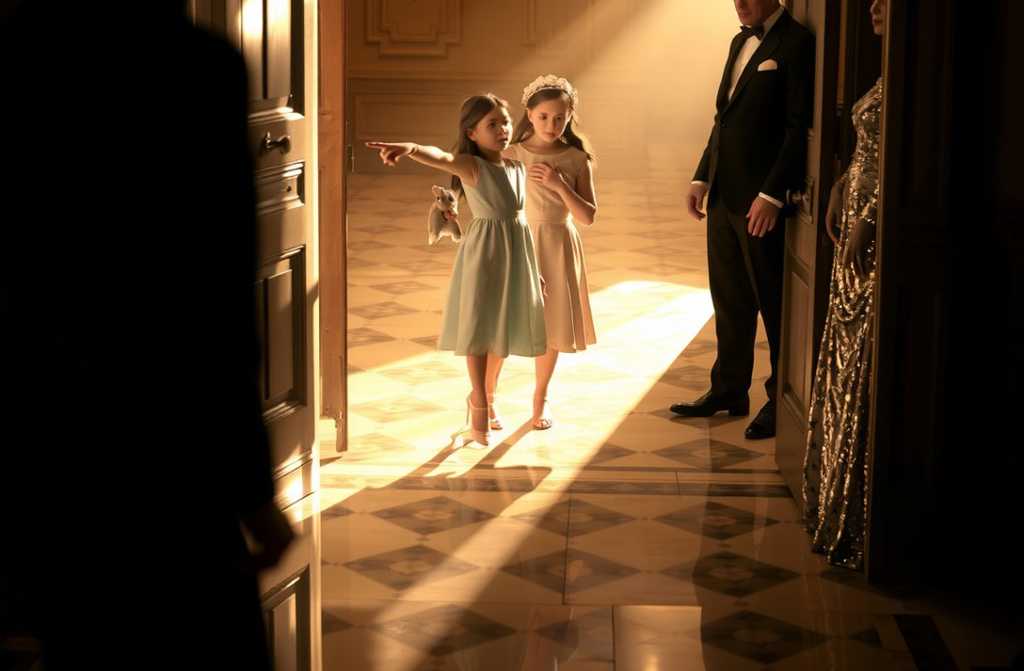
The words echoed up the gilded corridor of Whitmore Manor, carrying through that elegant hush, and all conversation stilled in an instant.
Sir Daniel Whitmoremillionaire, renowned businessman, a man celebrated in Londons boardrooms for his unflappable composurestood stock still as if the very breath had been knocked from his chest.
He was accustomed to intricate negotiations with foreign dignitaries, persuading sceptical shareholders, sealing million-pound contracts before the ink could dry. But nothing in that rarefied world had prepared him for this.
In the centre of the marble-floored hall stood his six-year-old daughter, Sophie. She wore a pale blue dress, clutching a well-loved, floppy-eared bunny to her chest. Calmly, Sophie laid her small hand out and pointed directly at Marythe parlour maid.
The room was ringed with models: tall, elegant, clad in splendid silks and sparkling jewellery, each chosen by Daniel himself. At his invitation, they had gathered here on this fine Hertfordshire evening. Their role was simpleDaniel hoped his daughter might choose, from among them, a lady whom she might welcome as her new mother. Three years had passed since his beloved wife, Isabelle, was lost to him, and no amount of wealth or business triumphs had filled that aching void.
Convinced that sophistication, beauty and refinement would stir his daughters admiration, Daniel had orchestrated the whole event, imagining the air of graceful elegance would gently ease Sophies tender heart. Yet she ignored all this dazzling pageantry and, without hesitation, chose Mary: the modest maid in her somber black dress and crisp white apron.
Mary pressed a hand to her chest, quite flustered.
Me? Sophie, no, darling, I am only
Youre kind, Sophie said, her voice gentle but sure in that childs way. You read me stories when Papa is busy. I want you to be my mummy.
A ripple of muted astonishment ran round the room. A few models exchanged looks edged with scorn; others lifted painted brows in surprise. One even let slip a nervous little laugh and then fell silent. All eyes turned to Daniel.
His countenance grew grave. Rarely had he lost his composure, but now, he looked openly confounded. He scrutinised Mary as if searching for the faintest hint of ulterior motives or ambition, yet she looked every bit as taken aback as he felt.
For the first time in years, Sir Daniel Whitmore had no words.
By evening, the tale had spread through servants passages and out into the courtyard, where the drivers gathered in their flat caps. Discomfited models hastened away, high heels tapping upon marble like a drumbeat of embarrassment.
Daniel retired to his study and poured himself a generous measure of brandy, the golden liquid glowing in the lamplight, his thoughts circling restlessly back to his daughter.
Papa, I choose her.
This, most certainly, had never been part of his plan.
He had always pictured at his side a woman who could sparkle at charity dinners, grace the pages of society columns, and host diplomats with cool poisea companion who suited his standing, elegantly formidable and admired by all.
Mary, his daughters chosen, was another matter entirely: a woman who polished silver, folded linens, and chirped gentle reminders to Sophie about brushing her teeth.
Yet Sophie was unwavering.
The next morning at breakfast, she sat across from her father with both hands gripping her glass of orange juice, her eyes resolute.
If you dont let her stay, she said, her tone stubborn, I shant speak to you again.
Daniels spoon clattered against his plate.
Sophie Mary stepped forward, uncertain. Sir Whitmore, the child shes only little, she cant possibly But Daniel, his voice taut, interrupted:
She does not understand the world I live inthe responsibilities, the reputation
His gaze settled on Mary. Nor, it seems, do you.
Mary lowered her eyes and nodded, but Sophie crossed her arms, stubborn as her father could be while sealing a deal.
Over the days that followed, Daniel tried reasoning. He promised a voyage to Paris, new dolls, even a puppy. Each time, Sophie merely shook her head. I want Mary.
So Daniel began to observe the maid more closely, noticing things he never had before.
How patiently Mary plaited Sophies tangled hair, even when she fidgeted and fussed. How she always came down to the childs level, listening as if every word mattered. How freely Sophie laughedtruly laughedwhenever Mary was near.
Mary lacked the polish of high society, but she possessed patience and kindness. She wore no costly perfume; she smelled always of clean linen and warm bread. Her speech was unembellished, with no affectations of the grand, but she cared for Sophie in a way that no riches could replace.
For the first time in an age, Daniel began to wonder:
Had he sought someone to ornament his life, orat lasta real mother for his child?
Everything changed two weeks later, at a grand charity ball in London.
Intent on appearances, Daniel brought Sophie, who wore a dress fit for a little princess but whose smile seemed held on by will. The ballroom shimmered with laughter and music while Daniel fell into talk with investors.
And when his eyes next sought his daughter, she was gone.
Whats happened? he demanded, voice tight.
She wanted an ice cream, sir, began a flustered footman. But some children started to laugh at her. Said her mummy hadnt come
Daniel felt his heart twist hard. Before he could gather himself, Mary was there. That evening shed accompanied them, ever quietly attentive, and now knelt beside Sophie, dabbing away her tears with the edge of her apron.
Darling, you dont need ice cream to feel special, Mary whispered with a gentle firmness. Youre already the brightest star here.
But they saidI didnt have a mummy, Sophie wept.
Mary hesitated, then looked at Daniel before replying, soft but sure:
You do have a mother. She is watching over you from heaven. And for nowwell, I shall be right beside you. Always.
For a brief moment the nearby guests fell silent, catching her words despite themselves. Daniel felt their eyes on himnot accusing but expectant.
And in that instant, clarity dawned.
A child thrives not on status, nor glitter, nor acclaim.
A child needs love.
In the days that followed, Daniel changed. He no longer spoke sharply to Mary, though he maintained a certain reserve; instead, he watched.
He saw how, with Mary, Sophie blossomedcalm, sure of herself, happy. Mary did not treat her as the daughter of a wealthy man, but as a child deserving stories before bed, plasters for grazed knees, and comforting arms after nightmares.
Daniel saw something else: Marys quiet dignity. She never angled for favour or luxury. She simply did her duty, steadfast and sincere. But when Sophie needed her, she was so much more than a maid.
She was a haven.
As autumn passed, Daniel often lingered in the hall to listen to Marys gentle voice reading tales at bedtime. The grand house that had once echoed with cold silence grew alive again.
One evening, Sophie tugged at her fathers sleeve.
Papa, promise me something.
He smiled, not unkindly. Whats that?
That youll stop looking at other women. Ive chosen Mary.
Daniel stifled a laugh, shaking his head.
Sophie, things arent so simple.
Why not? she demanded. You can see, cant you? With her, were happy. Mummy in heaven would want this, too.
Her earnest words struck him deeper than any logic could. This time, Daniel said nothing.
Weeks rolled into months. Gradually, his resistance ebbed, and he grasped at last a simple truth: Sophies happiness mattered more than his prideor the image of what ought to be.
On a cool autumn day, Daniel asked Mary to walk with him through the gardens. She smoothed her apron, obviously nervous.
Mary, Daniel began, his voice softer than shed known it, I owe you an apology. I have been unfair.
She started to protest, but he gently interrupted.
Your place is where Sophie needs you. And it seemsthat is here with us.
Marys eyes widened. Sir, do you mean
Daniel exhaled, letting years of uncertainty fall away.
Sophie chose you long before I understood. She was right. Will youwill you be part of our family?
Tears glimmered in Marys eyes as she covered her mouth in astonishment.
Then, from up on the balcony, rang Sophies triumphant cry:
I told you, Papa! I told you it should be her!
She clapped, giddy, her laughter lifting through the garden like birdsong.
The wedding was simplefar humbler than society would have expected from Sir Daniel Whitmore. There were no journalists, no dazzling fireworks. Only close friends, relations, and one little girl holding Marys hand as she walked to the altar.
Standing there, seeing Mary walk towards him, Daniel understood something profound. Where hed spent years building an empire on control and appearances, nowat lasthe had discovered what truly stood as the foundation of his life.
When the ceremony ended, Sophie shone with happiness, pulling at Marys sleeve.
You see, Mummy? I told Papa it should be you.
Mary kissed her gently atop her head. Yes, darling. You did.
And in that moment, Daniel realised he had gained far more than a wife.
He had, at last, found a familya treasure no amount of pounds could ever buy.