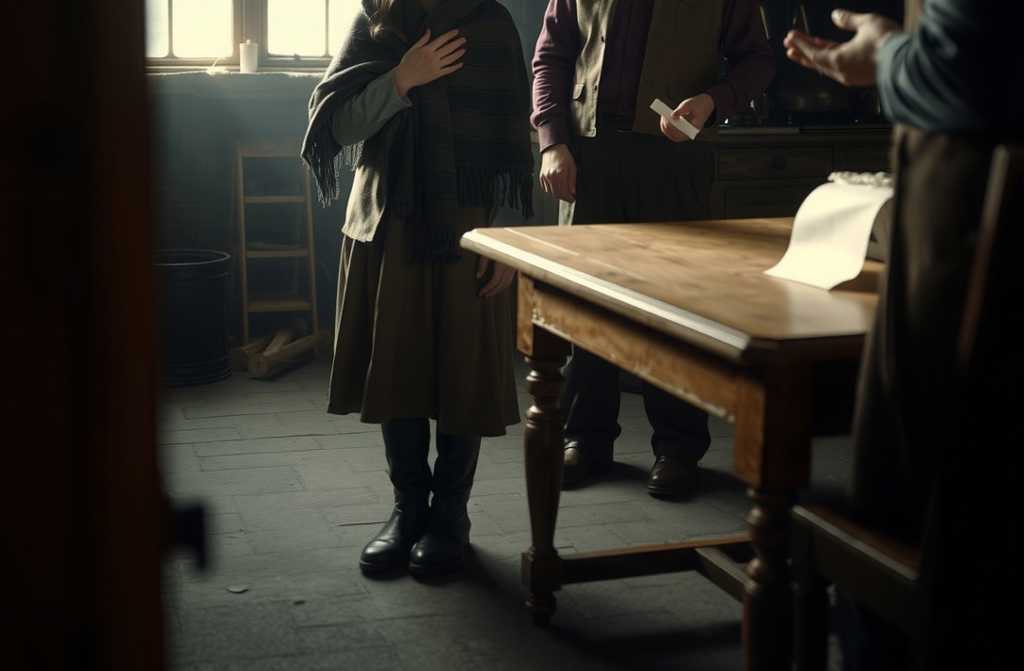
At barely eighteen, she was given in marriage to a widower with three children. Many believed that was where her youth ended and her dreams as well.
But the passage of years proved them wrong. It was not an ending, but the beginning of something miraculous.
In the winter of 1878, at just eighteen, Grace Whitfield was married off to a widower, himself the father of three, in the Yorkshire Dales. In those distant, windswept villages shaded by the Pennines, a woman’s life was often decided less by feeling than by necessity.
The wind swept through the ancient oaks with an age-old sigh, while snow carpeted the cart tracks, erasing footsteps as if eager to bleach destinies away.
Grace stood on her uncle Alfreds porch, her late mothers grey shawl gripped tightly about her shoulders. She did not weep. Since her mother’s passing six years ago, she had learned well enough that tears could not turn a wagon.
Inside, by the fire, the arrangement was settled.
Shes untouched, her uncle declared, without ceremony. Strong as an ox, a hard worker, not one for frailty.
The man listening was tall and broad-shouldered, his hat respectfully doffed. Henry Blackwell, a farmer of thirty-six, widowed these past three years. The grey in his eyes spoke not of cruelty but of weariness.
Upon the table, a worn leather pouch spilled out a few sovereigns and the deed for a sturdy calf.
Were square, said Uncle Alfred.
Grace made no protest. In those days, one did not ask a woman. One simply moved her.
She climbed onto the wagon without glancing behind. Before the horse had taken two steps, snow began blanketing her footprintsas if the earth itself accepted she no longer belonged.
The farm, Ashgrove, stood on the outskirts of Settlea lonely blur of stone and snow on the edge of moorland. The house bore the winds onslaught with weary dignity. In the barn, tools Henrys departed wife, Margaret, had once ordered so neatly still hung in quiet testament.
The children observed her from the corridor:
Rosie, three, peering out from behind her brother Edward; Thomas, the oldest at eight, arms folded, his gaze toughened by grief greater than his years.
Good afternoon, Grace murmured.
Thomas turned away without a sound.
Thus her new life began.
The first days were a string of awkward missteps. The range refused to cooperate, the scones burned, the wells water turned her hands red raw. She didnt know how to plait Rosies hair, nor still Edwards night-time tears.
Yet she refused to give in.
And Henry simply watched.
He never raised his voice. He offered no praise. Still, every morning a slip of paper appeared by the stove:
Use oak for the fire. Lasts longer.
Edward likes his beans with mint.
And one, under a chipped plate:
You dont need perfection. Only resolve.
Those humble notes warmed her more than any flame.
If she left the pans unwashed at night, theyd be clean by morning. Forget to fetch kindling and a stack would appear by the door. These small mercies passed without comment.
The ice began to crack, so quietly it could not be named.
Illness came as it always did in villageswithout warning.
Rosie stopped eating. Her little body burned with fever; in dreams, she called for her mother.
Grace did not falter. She brewed mint tea, changed cloths, wrapped herself around the child to lend warmth from her own body. Three sleepless nights, three nights inventing prayers shed never learned.
On the third dawn, Henry waited outside what had been Margarets room. He did not knock. Simply gazed through the frosted pane.
He saw Grace singing low, cradling Rosie as if shed birthed her.
He lowered his eyes. And when, with the days first slant of light, Rosie whispered
Thank you Mum Grace.
he did not correct her.
That word was no small thing. A silent earthquake.
Days later, Grace found Margarets modest grave behind the house. She wasnt competing with the memory. She tended it.
She laid wild flowers gently and whispered, Im not here to take your place, only to see your children are never alone again.
That evening, Thomas asked quietly, Did you spell her name right?
Yes, Grace replied.
He nodded.
Not affectionnot yet.
But not rejection, either.
Yet pain leaves its mark.
One night, Grace overheard voices in the barn.
I took her out of convenience, Henry was confiding. Needed someone to tend the house Thats all.
It wasnt an insult. It simply hurt for its truth.
She felt less of a womanmore a piece of furniture.
If she was only ever needed, she thought, then she could just as well vanish.
All shed ever wanted, deep in her heart, was to matter.
That dawn she left a note on the kitchen table:
If I am shadow, let me go before spring arrives.
She wrapped herself in her coat and departed. The frost bit her ankles; snow groaned underfoot.
She did not look back.
When Henry found the note, something fractured inside him.
He mounted his horse and rode without hesitation, following tracks half-lost to the wind. He found her by the frozen becksmall, shivering, the landscape too vast for her frame.
He knelt.
I dont know how to love rightly, he confessed softly. When Margaret died, I shut my heart. Thought silence safe. But Im learning silence wounds, too.
Grace met his gaze with wounded dignity.
I never needed your love. Only to matter.
He let a single tear fall into the snow.
You matter so much more than you could know.
No grand speech, only honestyclumsy, human, honest.
They returned together.
But forgiveness is sometimes the start of a harder path.
What the Yorkshire winter failed to break, life soon tried.
When spring came to Ashgrove, none imagined what was to come.
Part 2
Spring reshaped the landgreen shoots cleaved through the earth where silence and white had reigned.
But not all birth is painless.
Henry led Grace to the clearing where Margarets ashes rested. The air was thick with pine and damp earth. There was no grudge hereonly recollection.
He took out an old pearl necklace, lustrous more with history than wealth.
It belonged to my mother, he saidthe gentlest she had ever heard him. Margaret always said it should stay with the woman raising our children.
The world seemed to pause.
His hands trembled as he fastened it at her neck. It was not a lovers token, but an offering.
I see you now.
Not as shadow.
Not as substitute.
Not as obligation.
He truly saw her.
In that instant, something in Grace ceased seeking permission to exist.
Then, disaster struck as suddenly as any English rainstorm.
A furious April squall battered Ashgrove, wind rattling windows as if to tear down what little still stood.
Thomas dashed toward the stable before anyone could call him back.
A slip.
A scream.
A childs form hitting timber.
Then blood.
Silencenot the absence of noise, but of breath.
Grace felt herself split in two seeing red staining the boys brow.
Thomas! Her voice was no longer steady, but bare fear.
They rushed him down to the village surgery in Settle. The doctor spoke low, as if words might change fate.
All we can do is wait.
Wait.
The cruelest word in the language.
Grace remained by his bedside all night. She would not eat, nor sleep. No pretty prayersonly ragged ones.
She whispered to him, told invented tales, promised mornings with ponies and warm scones and laughter.
You cant give up now, she pleaded, forehead pressed to his cold hand. Were only just learning how to be a family. Dont leave me to finish it alone.
Henry watched from the doorwaya large man, dwarfed by dread. For the first time, he saw he couldnt save his sonor himself.
Then
A small stir.
A finger twitched.
Lids fluttered.
Thomas looked up at last and, in a fractured voice, asked,
Did you cry for me Mum?
The word fell like lightning.
Mum.
Not Grace. Not Maam. Mum.
Something broke
But it wasnt her heart.
It was the final wall.
Grace wept freely, no pride, no restraint. Henry, from the doorway, did not hide his tears.
For suddenly he knewlove hadnt entered his house as a replacement, but as a rescue.
They married in the weeks that followed.
No city frock nor orchestrajust a simple service beneath a twisted old oak that had outlived anyones memory.
The village priest spoke of new chances.
Rosie brought in blooms shed plucked herself. Edward nearly let the rings slip, red-faced and nervous. Thomas gripped Graces hand in newfound strengthas if hed realised, at last, she was already his.
You look lovely, Mum.
No one doubted that word now.
The wind that had battered their house so harshly blew gentle that dayas though even the sky was weary and content to rest.
Yet the story was not quite done.
A fortnight on, Uncle Alfred trudged down the dusty lane. Bent more with guilt than years.
I sold you as cattle, he admitted, voice gruff. Thought it was best. Thought you had no future.
She looked long at him.
No hatred.
Just remembrance.
You took away my choice, she said with a steady gentleness. But I chose what to make of what Id been given.
She did not forgive the deed.
But she refused to carry it further.
Forgiveness, after all, is not forgettingit is ceasing to bleed from the same wound.
Alfred wept, leaving lighter than he arrived.
May brought gentle rain,
Not tempest,
Not ruin,
But revival.
That afternoon, as the fields shimmered green, Grace placed Henrys hand upon her growing belly.
No words.
She didnt need them.
He understood.
His eyes filled with something greater than joytremulous gratitude.
I lost a good woman, he murmured. And God gave me anothernot to take her place, but to rescue what was left.
He held her as one does a rare and fragile thing.
And there, in that corner of Yorkshire where a girl was handed over as a mere bargain where she arrived feeling only like shadow
Winter was over.
For the worlds true miracle is not that two people find each other.
It is that, after betrayal, fear, and loss
They choose to stay.
And to rebuild.
Together.