
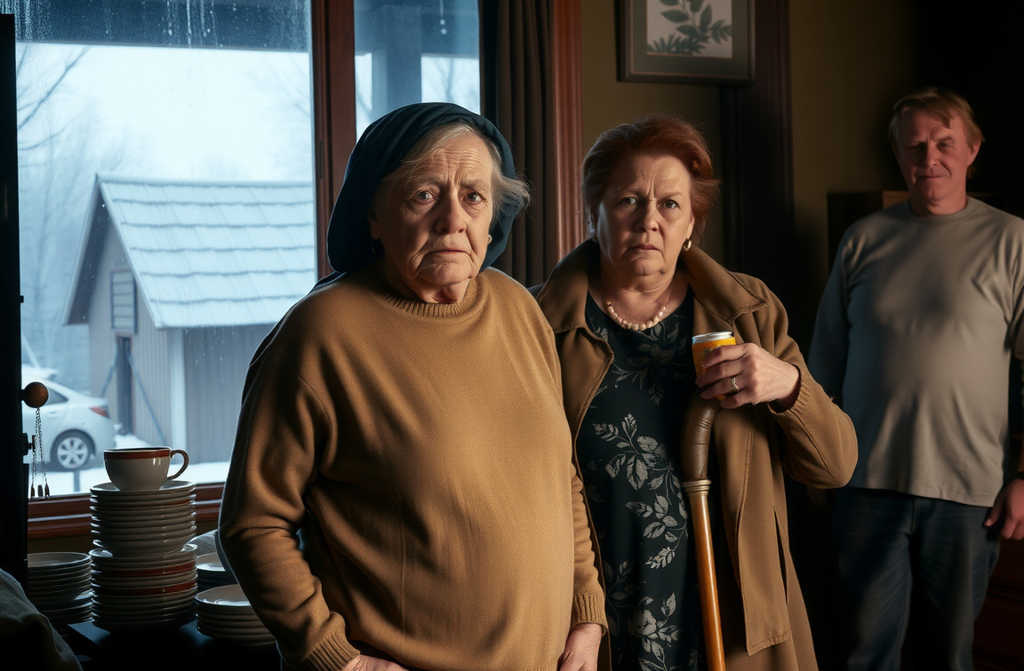
I had been driving for three hours already, and the road was empty and sodden. In November the English countryside goes dark early, and I was hurrying to make it home before the dusk swallowed everything. The radio sputtered in the passenger seat, the heater barely managed a whisper of warmth, and in my mind I was already at the kitchen table where my husband, son‑in‑law, daughter and, of course, my mother‑in‑law with her perpetual complaints were waiting. I was so lost in my thoughts that I didn’t notice when someone appeared on the back seat.
“Alright, love, you’ve got me to the house, haven’t you?” the voice croaked.
I jerked the wheel so hard I nearly sent the car into a ditch. My heart sank and I slammed the brakes, glancing into the rear‑view mirror. There, leaning back in the seat, was an old woman. Her face was a map of deep wrinkles, a dark headscarf hidden her hair, and her eyes—unnaturally bright, almost black—stared at me calmly and intently.
“You… where did you come from?” I stammered, my voice dropping to a whisper from sheer fright. I was absolutely sure I’d got into the car alone. The flat’s keys were on the passenger seat next to my handbag, and I hadn’t picked up anyone.
“From the road,” the old woman replied, smoothing her scarf. “I’m freezing to death out there. Are you taking me, or what?”
I wanted to tell her I didn’t take hitch‑hikers, that it was unsafe, that I had a house waiting, but the words got stuck in my throat. She looked at me as if she already knew everything about me, as if I were a book opened wide.
“I’m heading to Littleford,” I murmured, hoping she’d get out at the next village.
“Littleford, too,” she chuckled. “Don’t worry, dear. I’m not here to kill you—I’m too old for that. But I might be able to help. I can see a darkness hanging over your soul. Is your husband out? Is your mother‑in‑law chewing on you?”
I fell silent. We’d lived with Violet for six years, and the last two had turned my life into a never‑ending torment. Yet I hadn’t expected to spill that to a stranger. The old woman seemed to have read my thoughts.
“Fine, keep quiet,” she said, poking a gnarled finger toward me. “I can see it. You’re kind. Too kind. In this world, the kind ones get eaten first. Let’s get moving before it gets darker.”
I turned the engine over and merged onto the highway. One thought whirled in my head: why on earth was I doing this? Yet my foot obediently pressed the accelerator. We rode in silence for about half an hour. The old lady stared out the window, muttering to herself now and then. When the first twinkling lights of Littleford appeared ahead, she suddenly barked:
“Stop here.”
I pulled up next to a half‑ruined wooden cottage. The old woman opened the door, turned, and before stepping out she looked back.
“Thanks, otter,” she said, using the nickname I’d never heard before. “Listen. In a month I’ll knock on your door. Don’t be scared. Just know this: when everything falls to pieces, I’ll be there.”
“What?” I could barely find words.
“Exactly that,” she replied, climbing out of the car and leaning on a crooked cane as she trudged toward the house, never looking back. “Remember: a month. To the day.”
I drove away, my hands shaking on the wheel. All the way home I convinced myself it must have been a nightmare, a hallucination from exhaustion. I tried to push the episode out of my mind. The exact date—one month—loomed like a ticking clock.
A month later we were prepping for a family celebration—our ten‑year wedding anniversary. Or, as Violet liked to call it, “a decade of my son’s suffering.” She was perched at the kitchen table, sorting through flour and, unsurprisingly, grumbling.
“Mark, you look like a skeleton, you can’t even cook properly. You’ve over‑cooked the meat again. And seriously, who’s that serving? We’ll have guests, not beggars.”
I silently plated the salad. Mark lounged in the living room, nursing a pint and watching the telly. I couldn’t expect any help from him. I was working one‑and‑a‑half jobs, juggling the mortgage we’d bought jointly with his mother—who owned a share too—along with the household chores and raising our daughter. Emily had just turned ten and often stared at me with eyes that seemed to read my fatigue.
The doorbell rang. I wiped my hands on the apron and opened it. On the doorstep stood my sister‑in‑law Claire, her husband, and two teenage lads. They barged in without even taking off their trainers.
“Oh dear, what’s not on the table?” Claire asked, dumping muddy boots straight into the hallway. “Mark! Meet the family!”
“Come in,” I said quietly, though inside I felt like a pressure cooker.
And then the whole thing blew up. Cousins, distant uncles, some “family friends” I’d never seen before swarmed in. Violet felt like royalty, barking orders:
“Lena, bring that. Lena, pass this. Clear this mess. Mark, sit down, you look exhausted.”
The guest list swelled beyond any sensible limit. I ran around with plates like a frazzled waitress while Claire chattered loudly:
“Oh mum, look at this spread—Olive salad with chicken? Should’ve gone with proper ham. And the herring under a blanket is far too salty.”
“Maybe you should have cooked it yourself if you were going to be such a guest?” I snapped, setting another dish on the table.
“What? Me?” Claire widened her eyes. “I’m the guest, not the servant. You never really work around here, so try to behave.”
“I do work,” I muttered through clenched teeth.
“Look, love, the pay is a pittance,” Violet interjected. “If it weren’t for Mark, you and your girl would be living under a bridge. By the way, get Emily into her room; she’s in the way.”
I glanced at my daughter. She was curled up in the corner, knees pulled to her chest, eyes wide with terror. No one had even noticed her.
“Emily, go to your room,” I said, feeling my teeth grind.
Just then another knock sounded. I went to answer, expecting another late guest. Standing there was the same old woman, same dark scarf, same cane, but her eyes burned brighter than before.
“Hello, otter. I said a month, remember? I’m here.”
“What the—” Violet’s voice snapped like a rifle.
The old lady, ignoring Violet, stepped over the threshold. She slipped off her thread‑bare, tape‑wrapped boots and made her way to the living room, where the crowd fell silent.
“Good afternoon, dear people,” she said, nodding. “I’m Ethel—call me ‘Granny.’ I’m here to see Lena. Just a quick visit.”
“What?!” Mark leapt from the sofa, cheeks flushed from the beer. “Lena, have you lost your mind? Who’s she?”
“I…” I stared at Ethel, utterly bewildered.
“Lena, are you sane?” Claire piped in, eyeing the newcomer with disgust. “What kind of homeless lady are you bringing in? We have a cultural programme, not a charity case!”
“How dare you?” I felt anger rise, mixed with humiliation. “This is my flat too!”
“It’s our flat!” Violet shrieked. “I won’t let any drifter move in!”
Ethel settled onto the only free chair I’d set aside for myself. She scanned the table, the dirty plates, the sour faces, and sighed loudly.
“‘Drifters,’ you say?” she repeated calmly. “Am I a drifter? Who are you then? You’ve come into someone else’s home, treating the owner like a servant, snapping at my granddaughter… ‘Drifters,’ you say?”
“Lena! Get that thing out of here this instant!” Violet shouted.
“It’ll stay,” I heard my own voice, firm enough to surprise myself.
“What?!” Claire and Mark asked in unison.
“You heard me,” I said, stepping between the old woman and the relatives. “Ethel is my guest. If you don’t like her, the door’s right there. I’m not your maid.”
Silence hung heavy. Claire grabbed Mark’s arm.
“Well, stay with your granny then! I’m out of this circus!” she declared, marching toward the door.
Guests started streaming out, hurling angry looks at me. Violet stayed at the kitchen table, drilling me with icy stares, while Mark turned the TV up to a blaring volume. When the last guest slammed the door, Ethel slipped back to me.
“Good work,” she whispered. “You’ve taken the first step. The road ahead will get rougher, but hold on. Now, where shall I sleep?”
I led her to the tiny room we called the “nook.” An old sofa sat in the corner. She collapsed onto it with a creak, closed her eyes and murmured:
“All right, Lena. The real fun begins now. Tomorrow your ‘family’ will show their true colours.”
The next morning I was jolted awake by shouting. I rushed to the kitchen to find Mark and Violet standing over Ethel, who was calmly sipping tea from my favourite mug.
“She stole my earrings!” Violet screamed, shaking like a leaf. “The gold ones! Mark, call the police!”
“What earrings?” I asked, glancing between my husband and the old lady.
“You don’t know!” Mark snapped, eyes flashing. “You staged this so Mom could survive! You brought a beggar in and now she’s stealing!”
“I didn’t take your earrings,” Ethel said placidly, taking another sip. “I’ve enough of my own modest wealth. Money isn’t happiness, dear.”
“Out of here! Now!” Violet shrieked. “Leave at once!”
I stared into Violet’s eyes. She wasn’t angry, she was triumphantly smug. Then it clicked—this was a set‑up.
“Where did you look for them?” I asked.
“In that room,” Claire said, stepping out from behind Violet. “I saw her slip them into the pocket of her cloak this morning.”
“You’re lying,” I said calmly.
“Who are you ‘lying’ to?” Claire lunged at me. “I—”
“Hands off!” Ethel sprang up, her voice suddenly steel‑strong. “You think I’m a fool? I heard every whisper while I was asleep, every scheme you tucked the earrings into my coat. I heard it all.”
Violet’s face turned pale.
“What did you hear, you old hag?”
“You were planning to get rid of me, to send me off with my daughter, while Mark would stay silent. I saw Lena working nights to pay the mortgage, while you—” she gestured at Mark—“squandered every penny on the telly.”
“Defamation!” Violet shrieked.
“Let’s check,” Ethel suggested coolly. “Mark, produce your income statement for the past year. Where did your money go? Or were you just living off your wife’s salary?”
Mark went white as a sheet. The judge‑like lady, the magistrate, looked at him.
“Do you have those documents, Mr. Parker?” she asked.
“I… I worked off‑the‑books…” he stammered.
“Understood,” she noted.
The hearing lasted three hours. In the end the magistrate stood.
“The claim by Mrs. Parker is dismissed in full. The child remains with the mother. The property, jointly owned by Ms. Hart and her daughter, shall stay as is. Parties are urged to reach a mediated agreement regarding share usage. Court adjourned.”
Violet clutched her chest, pale as parchment.
“We’ll appeal!” she declared.
“Your right,” the magistrate shrugged and left.
I exhaled. In the hallway, Mark approached.
“Are you happy now?” he hissed. “You’ve torn the family apart!”
“What family, Mark?” I asked, meeting his gaze. “Where were you when my mother‑in‑law tormented me? When I wept at night? Leave. Stay away from Emily. I’ll file for maintenance and restrict your contact if you don’t change.”
He spat and stalked away.
Back home I collapsed onto the sofa and sobbed—a cathartic, liberating wail. Ethel sat beside me, gently patting my head. When I finally steadied, I asked the question that had haunted me from the start.
“Who are you, really, Ethel?”
She sighed, stared out the window, then answered.
“I’m your grandmother,” she said simply.
My mouth dropped.
“My mother had an older sister who vanished in the war,” I whispered. “Grandma always said she’d died.”
“She didn’t,” Ethel shook her head. “She survived, but didn’t come home. She got involved with the wrong sort of man, had a child, then abandoned that child to an orphanage, hoping to claim her later. She never could. She lived in the country, alone. Your mother was her daughter, which makes me your great‑grandmother, and you my great‑great‑granddaughter.”
“Why didn’t you come sooner?”
“Why would I? So you’d call me a ‘beggar granny’? I watched from a distance, saw how Violet bullied you, how Mark undervalued you. I waited until you were ready, then placed you on the road to test you. You’re kind, I thought—full of the same kindness I once had.”
“And the house in Littleford?”
“My house,” she declared. “The land, the cottage—it’s mine. I’m not poor. I’ve saved a pension for thirty years, and back in the day we mined gold in the hills. I don’t need city property. I’ll leave it to you and Emily.”
She handed me a crumpled envelope.
“Inside are the deeds to the house and land, a gift deed that was drawn up a year ago as soon as I learned you were struggling. My solicitor is ready. All legal.”
“You’ve been watching me all this time?” I asked, incredulous.
“Every step,” she said, a faint smile curling her lips. “You’re my blood. Nothing beats family. Those people? They’re not people; they’re just placeholders.”
Tears welled up again, this time gratitude flooding my heart. That night Ethel and I sat in the kitchen for hours. She recounted surviving forests, finding gold, saving every penny. The strange old lady I’d imagined turned out to be a fierce survivor.
A month later Mark and Violet disappeared. Rumour had it they tried to overturn the court verdict but lost in the appellate court. Claire, I heard, fell out with her mother over the money spent on a solicitor. Their once‑tight family fell apart without a scapegoat—without me.
Emily, Mark, and I repaired the cottage in Littleford. I decided to keep the city flat, rent it out, and use the income to pay the mortgage I now bore alone, while we moved to the country house. It was quiet, the air smelled of pine and dry herbs. Emily started at the local primary school where she finally smiled without fear.
One evening we were perched on the veranda. Ethel, as usual, sipped her herbal tea and stared at the stars.
“Well, otter,” she said, “have I done my job?”
“What job?” I shivered.
“You were my last concern,” she replied, stroking my hand. “I set you upright, cleared the snakes, gave you a home. Now I can finally rest. Don’t be scared. I’m here with you, but my spirit is already elsewhere. You’ve done well. Remember: kindness is fine, but life is a tough nut. You’ve got to show yourAnd as the night deepened around us, I finally understood that the strange, stubborn kindness of my grandmother had not only freed me from a lifetime of oppression, but also handed me the courage to build a new, peaceful future of my own.





