
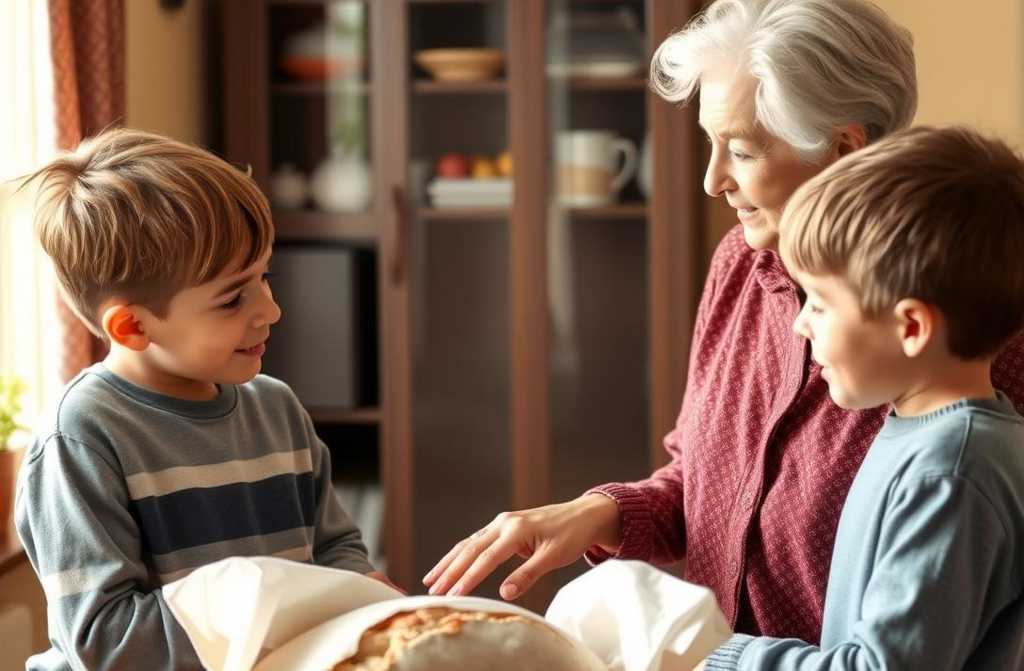
**A Lesson in Humility**
I watched my grandson Thomas with a mixture of anger and disappointment, itching to give him such a smack that he’d remember the strength of his grandmother’s hand for the rest of his days. I wanted to land a blow so fierce his backside would sting like fire, leaving him desperate to dunk himself in icy water just to soothe the ache.
Through the window, I saw Thomas and his mate William—the lad with ears like jug handles—tossing a loaf of bread about as if it were a football. One lad had it in his bag until the strap snapped, sending it tumbling into the dirt. The other kicked it, and soon enough, they were passing it between their feet like a proper match had broken out in the street.
When I realised what they were booting around, my heart lurched. A strangled cry tore from my throat before I could stop it, and suddenly, I couldn’t move. Words stuck in my chest like a solid lump. I stumbled outside, gasping like a fish on dry land, and hissed through gritted teeth:
*”That’s bread, you fools! How could you?”*
The boys froze, caught like rabbits in headlights as I dropped to my knees, cradling the loaf like a wounded thing. I trudged back home, my steps slow and unsteady, clutching it to my chest as though it were something precious—which it was.
My son, Edward, took one look at my face, then at the mangled loaf, and without a word, he unbuckled his belt and marched outside. I heard Thomas wailing but didn’t lift a finger to defend him—not this time. When he finally bolted inside, his face blotchy with tears, he clambered onto the old settle by the hearth without a word. Edward followed, still brandishing the belt, and declared that from now on, Thomas wouldn’t get a single bite of bread with his meals—no toast at breakfast, no sandwich at lunch, no crust to mop up his stew. And as for William? Oh, Edward would be paying his parents a visit—see what they thought of their little footballer’s antics.
William’s dad was a tank of a man, a farmer who’d shorten his own son’s legs if he heard about this. And his grandad? He’d done hard labour back in the day—bread wasn’t just food to him. He’d flay the lad alive over a single ruined loaf.
Back home, I always crossed and kissed the fresh-baked loaf before slicing it thick, the way it ought to be done. We rarely bought bread—my daughter-in-law and I baked ours in the old brick oven, filling the house with that warm, yeasty scent that clung to every corner. It was the kind of smell that made your mouth water, no matter how full you were.
Edward did march over to William’s house, the same ruined loaf in hand. The family had just sat down to supper when he barged in. William squirmed like a worm on a hook, but his grandad silenced him with a sharp tug on the ear. Without fuss, old George cut a hefty slab from the dirtied loaf and shoved it under the boy’s nose.
*”This is your supper,”* he growled. *”You don’t touch another crumb till you’ve finished every last bit.”*
Thomas didn’t dare go near bread the next morning. The sight of me—barefoot, on my knees, weeping over it—burned in his memory. Shame clamped around his throat. He didn’t know how to face me.
I ignored him entirely. Where I’d once fuss over his breakfast, now I set down a bowl of porridge and milk without a word—no golden slice of buttered toast in sight.
William, meanwhile, trudged to school crunching grit between his teeth, near tears. He begged Thomas to help him finish the mess they’d made, but Thomas wasn’t having it.
*”Not a chance,”* he muttered, rubbing his sore backside.
That evening, Thomas crept up and wrapped his arms around me. I sat stiffly, hands limp in my lap. He babbled about school marks and sums, but I stayed silent. In the end, he crumpled, dropping to his knees and burying his face in my skirt.
I cupped his chin, forcing him to look at me. What he saw in my eyes—pain, disappointment, pity—would haunt him forever.
*”Listen close,”* I murmured, smoothing his hair. *”There are lines you never cross—not in jest, not in anger. You never raise a hand to your elders. You never hurt what can’t fight back. And you* never *dishonour bread.”*
My voice wavered then, memories pressing in. *”When I was a girl—through the war, after—all I dreamed of was a full loaf, no chaff, no flour stretched thin with potato. Just real bread, warm and soft. Back then, we’d have kissed the hands of anyone who spared us a crust. And you—you treated it like rubbish.”*
Thomas’s face crumpled, but he held back his tears.
Just then, William slunk in, red-eyed. I made him sit too and listened as he confessed his grandad’s lecture—how bread was life, how folk had starved for it, how every crumb was sacred.
*”I’m sorry,”* he whispered, shoulders shaking.
The anger in me softened. I pulled them both close and led them to the table. William whimpered about the grit still lodged in his teeth; Thomas admitted he wasn’t allowed any at all.
But I cut two slices from the loaf anyway and pressed them into their hands.
*”God knows what you’ve done,”* I said quietly. *”But He forgives. So do I. Now eat—properly. And don’t forget: bread isn’t just food. It’s life itself.”*
They chewed slowly, savouring it this time. And I knew—they’d remember.





