
**A Lesson for Life**
Margaret stared at her grandson, her fingers itching to give him such a hiding he’d never forget the sting of her hand. She wanted to wallop his backside so hard it’d burn like fire, leaving him desperate to dunk it in the icy River Thames for relief.
Through the window, she spotted Peter and Alfie—that cheeky, big-eared lad—kicking a loaf of bread between them like a football. One had carried it in a sack, but the bag split, sending the loaf tumbling onto the cobbles. The other booted it straightaway, and soon they were laughing, punting it back and forth across the pavement.
When Margaret realised *what* they were kicking, her breath seized in her chest. A wild scream tore from her throat, but her feet tangled beneath her—she ran but went nowhere. Words clogged in her throat as she staggered forward, mouth gaping like a fish gasping for air.
“That’s *bread*,” she hissed, voice trembling. “That’s sacred! How could you?”
The boys froze, watching in stunned silence as she sank to her knees, gathering the battered loaf with shaking hands. Tears streaked her weathered cheeks as she clutched it to her chest, then trudged home on unsteady legs, the loaf pressed close like a wounded thing.
Inside, her son Edward took one look at her ashen face and the ruined bread in her arms. He needed no explanation. Without a word, he unbuckled his belt and strode outside. Margaret heard Peter’s howls but didn’t move to shield him—not this time.
Red-faced and snivelling, Peter bolted inside and scrambled onto the kitchen settle. Edward followed, shaking the belt. “From today, no bread for you,” he growled. “Not with your soup, not with your roast, not even with your tea. No rolls, no biscuits, nothing. And tonight, I’m paying a visit to Alfie’s parents—let’s see what they think of their little footballer.”
Alfie’s father was a farmhand—he’d tan the boy’s hide proper. And the grandfather? He’d done ten years in prison during the war for stealing a loaf—he’d thrash Alfie senseless.
Margaret always treated bread with reverence. She’d cross herself, press a kiss to the crust of a freshly baked loaf, then slice thick, steaming pieces with joyful care. She rarely bought bread from the shop—instead, she baked with her daughter-in-law in their old brick oven. The rich, yeasty scent filled every corner of their sturdy cottage, lingering for hours, teasing appetites. No one could resist tearing off a golden crust, slathered in butter, washed down with cool milk.
True to his word, Edward marched to Alfie’s house, the dirtied loaf in hand. Neighbours gawked when he set it on their dinner table. Alfie squirmed like he was sitting on hot coals, but his grandfather silenced him with a sharp tug on his ear.
Edward explained in clipped tones. Without hesitation, old Mr. Higgins hacked off a hefty slice of the filthy bread and slammed it in front of Alfie. “This is what you’ll eat,” he said, voice like iron. “Every last crumb. Only then will you touch proper bread again.”
The next morning, Peter skipped breakfast—his father’s orders. But mostly, he couldn’t face Margaret. Shame burned in his gut as he remembered her kneeling in the dirt, weeping over something he’d treated like rubbish.
Margaret, usually doting, now moved past him in silence. Where once she’d fussed over his porridge and toast, now she set down a plain bowl of oats—no bread in sight.
Alfie, meanwhile, trudged to school with gritted teeth, nearly in tears as sand ground between his molars. He begged Peter to help him finish the wretched loaf, but Peter scoffed. “Not a chance. My backside’s still sore—I’m not asking for more.”
That evening, Peter crept to Margaret’s chair, wrapping his arms around her stiff shoulders. She didn’t move, didn’t speak—not when he babbled about top marks, not when he sniffled. Finally, he sank to the floor, resting his head in her lap, desperate for forgiveness.
Her calloused hands lifted his face, and what he saw in her eyes shattered him. Pain, betrayal, pity—all written there, clear as ink.
Settling beside her, she wiped his cheeks and spoke softly. “Listen well, my lad. There are lines in life you never cross—never. You don’t turn on your elders, you don’t harm a helpless creature, you don’t betray your country, you don’t curse the Lord, and you *never* disrespect bread. When I was a girl, through the war and after, I dreamt of nothing but a full loaf, pure and wholesome—no sawdust, no potatoes mixed in. Just bread. It’s how we welcome newlyweds, how we honour guests. To kick it is to spit in your mother’s face. In the war, folks kissed your hands for a crust of black bread. And you—you *laughed* while trampling it.”
Peter nearly wept, but he bit his lip hard.
Just then, Alfie shuffled in, eyes red-rimmed. Margaret bid him sit, and he stammered through his own shame—how his grandfather had thrashed him, then forced him to eat that filthy bread, grain by grain, while recounting how men had starved for less.
Alfie broke down, begging forgiveness.
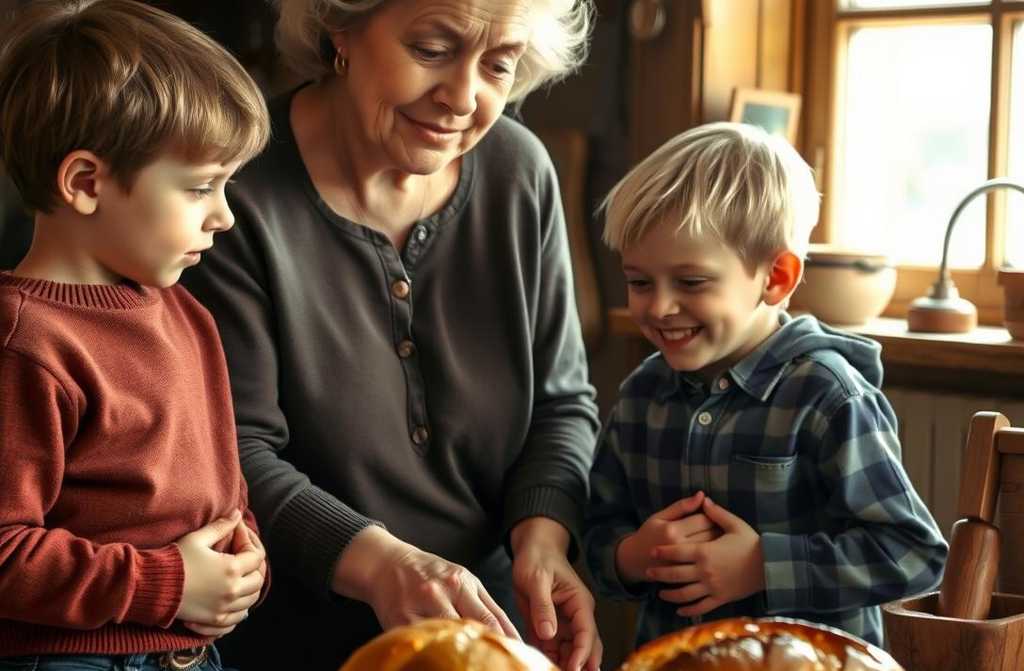
Margaret’s anger softened. She pulled them both close and led them to the table.
Alfie moaned, “It’s still full of grit—it’s horrible.” Peter muttered, “I’m not even allowed any.”
But Margaret smiled faintly, slicing two thick pieces from the loaf. “God sees, and so do I,” she whispered. “But we’ll keep it between us. Now eat. Fresh, warm, *good* bread. And remember—it’s life. It’s God’s grace. It’s everything.”





