
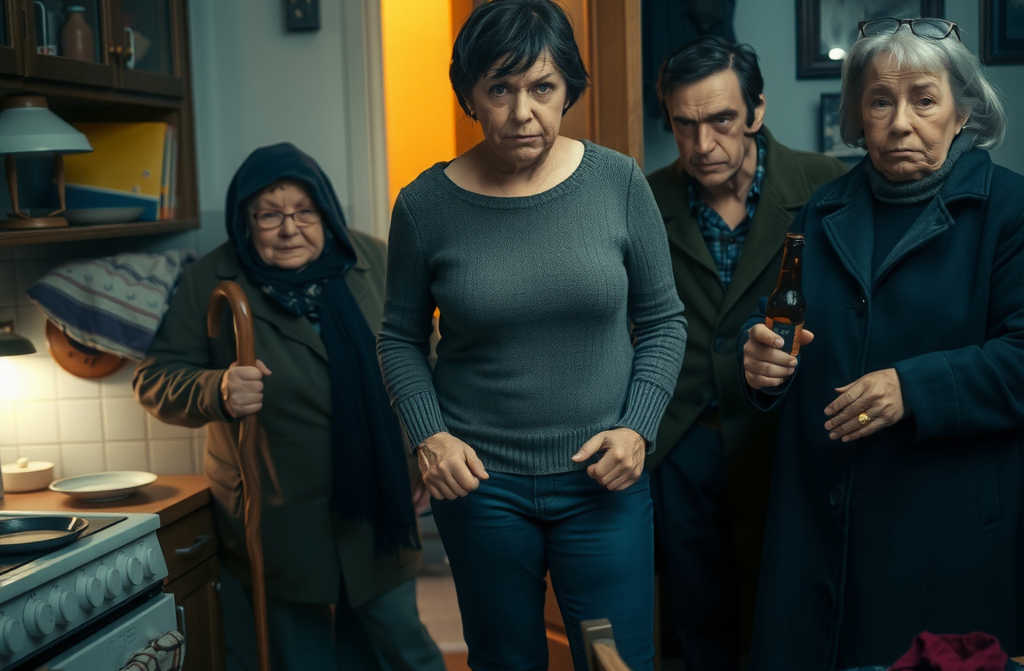
Hey love, you won’t believe the night I had. I’d been driving for about three hours on that bleak, slushy November road out of Kent. It gets dark early around here, so I was hurrying to get home before the blackness settled. The radio was on low, the heater barely working, and I was already picturing the cosy kitchen waiting for me – my husband Tom, our little Emily, and, of course, my mother‑in‑law Agnes, forever with a sour look on her face.
I was so lost in my thoughts I didn’t even notice when someone appeared on the back seat.
“Alright, love, got me wherever you’re headed?” the voice asked.
I jumped so hard I almost sent the steering wheel into the ditch. My heart lurched, I slammed the brakes and peered into the rear‑view mirror. There, slumped in the seat, was an old woman. Deep wrinkles carved her face, a dark scarf covered her hair, and her eyes glittered an almost black, unsettlingly bright, staring at me with a calm intensity.
“Where… where did you come from?” I stammered, terrified. I was sure I’d gotten into the car alone. The flat‑keys sat on the passenger seat next to my handbag, and nobody else had climbed in.
“From the road,” the old lady replied, adjusting her scarf. “I’m freezing to death out there. You’ll give me a lift, or what?”
I wanted to tell her I didn’t take passengers, that I was in a hurry, that my house was waiting. The words got stuck. She looked at me like she’d read my whole life like an open book.
“I’m heading to Ashford,” I whispered, hoping she’d get out.
“Me too, dear,” she said with a sly smile. “Don’t worry, I’m not here to harm you. I’m too old for that. I might actually help. I can see there’s a darkness hanging over you. Is Tom out? Is Agnes nagging?”
I kept quiet. We’d been living with Agnes for six years, and the last two had been pure misery. Talking about it with a stranger? The old woman seemed to have plucked the words straight from my mind.
“Fine, keep quiet,” she said, pointing a knobby finger at me. “I see it already. You’re too kind, love. In this world, the kind ones get eaten first. Let’s get moving before it gets pitch black.”
I turned the engine over and merged onto the highway. All I could think was, why am I doing this? Yet my foot kept pressing the accelerator. We drove in silence for about half an hour. She stared out the window, mumbling to herself now and then. When the faint lights of Ashford finally appeared, she snapped, “Stop here.”
I pulled up beside a crumbling wooden cottage. She opened the door, then turned back at me.
“Thanks, dear. Listen. In a month I’ll knock on your door. Don’t be scared. Just remember: when everything falls apart, I’ll be there.”
“What?” I barely found a reply.
“And that’s that,” she said, stepping out of the car with a cane, heading for the house without looking back. “Remember: one month. Exactly.”
I drove away, hands shaking on the wheel. All the way home I tried convincing myself it was a fatigue‑induced hallucination. I pushed the memory aside. One month.
Exactly a month later we were prepping for a family celebration – our ten‑year wedding anniversary. Or, as Agnes liked to call it, “a decade of my son’s suffering.” She was in the kitchen, sorting flour, still nagging.
“Mark, you’re a wreck. You can’t even cook a proper roast. The meat’s dry again. And who’s that setting the table? We’ve guests, not vagrants,” she scoffed.
I plated the salad in silence. Mark was in the lounge, downing a pint and watching the telly, not a soul to help. I was juggling a part‑time job, the mortgage on our semi‑detached, which we’d bought jointly with Agnes, the household chores and raising Emily, who’d just turned ten and often stared at me with eyes that seemed to ask, “Are you okay?”
The doorbell rang. I wiped my hands on my aprons and opened it to find my sister‑in‑law Claire with her husband and two teenage lads, shoes still muddy.
“What’s not on the table?” Claire shouted, kicking her boots in the hallway. “Mark! Look who’s here!”
“Come in,” I said quietly, though everything inside me was boiling.
More relatives streamed in – distant uncles, “family friends” I’d never seen before. Agnes strutted around like a queen, bossing everyone.
“Emily, bring that over. Pass the gravy. Clean up here. Mark, sit, you look exhausted,” she ordered.
The guest list exploded beyond anything I could manage. I was running around with plates like a waiter while Claire jabbed:
“Oh my God, what’s this? Olivier with chicken? Should’ve been proper ham. And the herring under a coat is way too salty.”
“Maybe you should’ve cooked yourself if you’re such a guest,” I snapped, slamming another dish on the table.
“Me? I’m a guest, not a servant,” Claire rolled her eyes. “You don’t even have a proper job here, so try harder.”
“I work,” I snapped through clenched teeth.
“Right, you work,” Agnes waved a hand. “Our salaries are peanuts. If it weren’t for Mark, you and the girl would be living under a bridge. By the way, get Emily into her room – she’s in the way.”
I glanced at Emily. She was curled up in a corner, knees drawn up, eyes wide with fear. Nobody had even invited her to sit.
“Emily, go to your room,” I said, teeth grinding.
Just then the doorbell rang again. I went to answer, expecting another late guest, and saw her – the old lady, still in that dark scarf, cane in hand, eyes brighter than before.
“Hello, love,” she said, “I told you a month, right? I’m here.”
“Who the hell is this?” Agnes barked.
The old woman ignored her, slipped off her patched-up galoshes and walked into the living room where everyone fell silent.
“Good day, folks,” she said, nodding. “I’m Mabel, but you can call me Dot. I came to see Len, that’s you. Just a little visit.”
“What?!” Mark leapt from the sofa, face flushed from beer. “Len, are you out of your mind? Who is she?”
“I… I don’t know what to say,” I stammered, utterly shocked.
“Are you sane, Len?” Claire interjected, eyes narrowed. “Who are you bringing into our house? This is supposed to be a proper family gathering, not a charity event!”
“Excuse me?” I felt my blood boil. “This is my flat too!”
“It’s our flat!” snarled Agnes. “I won’t let some stranger move in!”
Dot settled onto the only spare chair I’d set aside for myself, glanced around the mess, and sighed loudly.
“‘Scum,’ you say? Who’s the scum here? Me? Or you lot, crashing into someone else’s home, treating the mother‑in‑law like a servant, and pushing my granddaughter around?” she asked, voice steady.
“Len! Get her out of here now!” Agnes shrieked.
She didn’t move. I found my voice and said, “She stays.” It came out firmer than I expected.
“What?!” Claire and Mark shouted in unison.
“You heard me,” I said, stepping between Dot and my relatives. “Mabel is my guest. If you don’t like her, the door’s right there. I’m not your servant.”
The silence was deafening. Claire grabbed Mark’s arm.
“Then stay with your old lady! I’m out of this circus!” she hissed, storming out with him.
The guests filtered out, muttering and glaring. Agnes stayed at the kitchen table, eyes boring into me, while Mark turned the TV up to drown everything out. When the last guest left, Dot approached.
“Well done,” she whispered. “First step taken. It’ll get tougher, but hold on. Now show me where I’ll sleep.”
I led her to the tiny “nook” we called the spare room. An old sofa sat there, creaking under her weight. She collapsed, closed her eyes, and muttered, “Alright, Len. The fun begins tomorrow when your ‘family’ shows its true colours.”
The next morning I was woken by shouting. I rushed to the kitchen to find Mark and Agnes hovering over Dot, who was calmly sipping tea from my favourite mug.
“She stole my earrings!” Agnes screamed, shaking with fury. “Gold ones! Mark, call the police!”
“What earrings?” I asked, glancing between husband and old woman.
“Don’t act innocent!” Mark snapped, eyes flashing. “You invited a beggar, now she’s pilfering!”
“I didn’t take any earrings,” Dot said evenly, taking another sip. “I have enough of my own, cheap as they are. Money isn’t happiness, love.”
“Out of here, now!” Agnes yelled. “Immediately!”
She looked almost triumphant, as if she’d set a trap.
“Where did you look for them?” I asked.
“In that room,” Claire said, stepping out from behind Agnes. “I saw her slip them into the lining of her coat this morning.”
“Lies,” I said calmly.
“Who are you lying to?” Claire advanced. “I…”
“Hands off!” Dot suddenly rose, voice turning steel. “You think I’m dim? I heard you whisper to your son, ‘Mark will believe Mum, kick her out, and Len will run to her granny.’ It won’t work.”
Agnes went pale.
“What did you hear, old hag?” she snarled.
“You talked about the plan, about making me leave so you could keep the house,” Dot replied. “Mark, you either let this old lady stay or you leave yourself. Choose.”
Mark stared at me, his face a mix of anger and fear. Ten years of marriage, ten years of silent abuse, his constant “mum knows best.” Emily stood in the doorway, eyes wide, terrified.
“Choose,” he repeated.
I looked at him, at the mortgage that was only in my name and Emily’s, at the life I’d built.
“Leave,” I said.
“What?”
“I said leave. To your mother, to Claire, wherever you want. But out of this flat, which is mine and Emily’s, you’re out.”
The threat hit him like a punch. He froze. Something finally snapped inside me.
“You’ll regret this,” Agnes hissed, grabbing Mark’s arm. “Let’s go, love, see how she manages without us.”
They stormed out, slamming the door. I sank into a chair, knees trembling.
“That’s it,” I exhaled.
“No, love,” Dot said, patting my head. “It’s just the beginning. They won’t give up easily. The flat belongs to you, but they own a share too. They’ll sue, demand alimony, try to take your car. Are you ready?”
I raised my head. I wasn’t. But I had no other choice.
Three days later Mark returned – not with apologies, but with a court summons. Agnes had filed for my eviction, demanding the flat be sold and the proceeds split. The claim listed me as creating “unbearable living conditions,” bringing a stranger into the home, and psychologically abusing her son.
I sat at the kitchen table, paper in hand, stunned. My mother‑in‑law, who’d been living off my wages, now wanted to strip me of my roof.
“Don’t worry, love,” Dot murmured, brewing herbs over the stove. “The court decides who’s right. The strong win.”
“But they have a share, a solicitor,” I whispered. “What good is my paperwork?”
“Doesn’t matter,” Dot replied, pulling the curtains. “Go to the children’s services tomorrow. Get a statement that you’re the primary caregiver, that the father isn’t contributing. It’s iron‑clad.”
“Where do you know all this?” I asked, bewildered.
“I’ve lived a long life,” she said, sighing. “Seen a lot, sat in a few courts – not as a defendant, but as a witness. I’m blunt, I tell the truth. Judges like that.”
Later that night I went to the social services office. The officer was cautious at first, but after I showed payslips, Emily’s school report, and explained that Mark had vanished without a penny, she nodded.
“Typical case,” she said. “We’ll prepare a report. The child must be protected. Has your husband tried to take anything or threatened you?”
“Not yet,” I answered.
“Write a statement, just in case,” she instructed. “It’ll be useful.”
I got home late. Mark was leaning against the building entrance, smoking. As soon as he saw me, he flicked his cigarette away and blocked the path.
“Len, think about this before it’s too late,” he said, trying to sound calm, but his eyes were icy. “Kick the old woman out, and we’ll forget all this. Mum won’t push for a sale.”
“So you admit this is blackmail?” I asked, meeting his gaze.
He stammered.
“I admit you’ve overstepped. Mum’s just an old lady, nervous.”
“Your mother wants to leave me and our child on the street,” I shot back, heat rising. “And you support that? Go home, Mark. To your mum.”
I walked past him, up the stairs. He shouted something, but I couldn’t hear. I knew there was no going back.
The court date was set for two weeks later. Dot coached me on what to say, how to sit. On the day, I wore a smart navy suit, dressed Emily in her school uniform, and we walked into the courtroom.
Agnes sat in the front row, playing the martyr. Beside her, Claire and a leather‑jacketed uncle, their solicitor, smirked. Mark stood by the window, avoiding my eyes.
The judge – a weary woman in her forties – opened.
“The plaintiff claims the defendant has made the home uninhabitable, introduced a stranger who behaves aggressively, and exerts moral pressure on the minor,” she read.
“It’s false,” I said when asked if I admitted the claim.
“The defence,” Agnes’s solicitor began, “has witness testimony from Claire… that the defendant assaulted the old lady, threw plates, drove her to a breakdown.”
“It’s a lie!” I shouted.
The judge called for a witness. Claire stepped up, describing how I “lunged at her mother, smashed dishes, drove Mark to a nervous breakdown.” Her story was so detailed I briefly doubted myself.
“Your honour, may I present the child‑care assessment?” I interjected, handing over the report from social services. In black and white it stated: “The child’s living conditions are satisfactory; the mother provides necessary care; the father is absent and does not contribute financially; relocation is not in the child’s best interest.”
Agnes’s solicitor winced. Then Dot rose, leaning on her cane, and faced the bench.
“Your honour,” she said softly but firmly, “I’m an old woman, I have no reason to lie. This lady –” she pointed at Agnes – “tried to frame me, to steal my earrings, to smear my name. Mark,” she continued, “doesn’t work, lives off his wife’s earnings. I’ve seen the mortgage statements, the utility bills, everything she’s paid for.”
“The accusations are serious,” the judge noted.
“Can we see Mark’s income proof?” Dot asked. “Where is his salary slip? Or does he simply lounge on his wife’s wages?”
Mark turned a pale shade. The judge asked him, “Do you have documentation?”
“I… I’ve been working off‑the‑books,” he muttered.
The hearing stretched three hours. In the end, the judge ruled:
“The claim for eviction is dismissed in full. The child shall remain with the mother in the property jointly owned by the defendant and the child. Both parties are advised to reach a mediated agreement regarding share usage. Court adjourned.”
Agnes leapt up, face ashen as a sheet.
“We’ll appeal!” she declared.
The judge simply shrugged. “You’re entitled to do so.”
I exhaled, feeling the tension leave my shoulders. Mark lingered in the corridor.
“You happy now?” he hissed. “You’ve torn the family apart!”
“What family, Mark?” I asked, eyes cold. “Where were you when your mother belittled me? When I wept at night? Stay away from Emily. I’ll pursue child support and restraining orders if you don’t shape up.”
He spat, turned, and walked away.
Back home I collapsed on the sofa, crying for the first time in weeks – a release of long‑held fear. Dot sat beside me, gently rubbing my head.
When I finally steadied myself, I asked, “Who are you, really, Mabel?”
She sighed, stared out the window, then said, “I’m your grandmother, love. Your mother’s older sister disappearedShe smiled, placed her weathered hand over mine, whispered that the future was finally ours, and signed the promise with a gentle, steady dot.





