
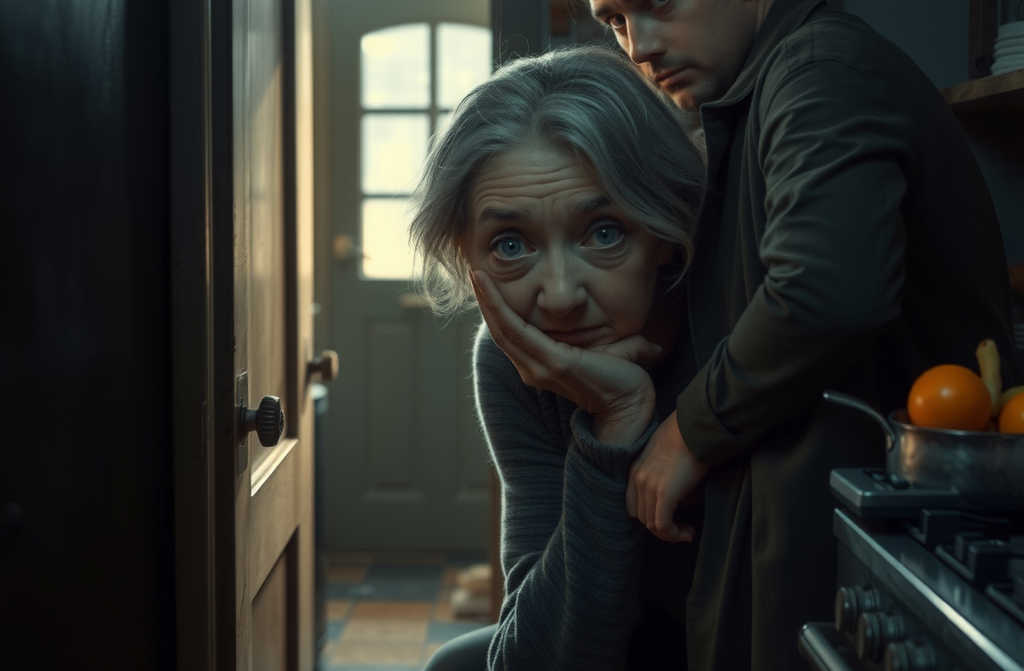
Helen Harper slipped behind the pantry door a breathless second before the lock clicked shut.
She pressed her back against the row of tin cans, felt for the inner knob, and pulled it just enough to leave a slit no wider than a fingertip.
Her breathing came in ragged, hoarse bursts; she clamped a palm over her mouth because the hallway was dead quiet and any sound would echo through the flat.
The front door flung open.
Mark shuffled in, a coughing cough, his hands full of two white grocery bags bulging with produce, the ropehandles digging into his fingers.
Mum! he called. You home?
Helen pressed her hand tighter against the pantry wall.
***
Helen had been living alone for five years. When Kolyaher husbandvanished without a word, the shock had shattered her heart and left a hollow that never filled.
The first year without him was the hardest. It wasnt grief that broke her; she could stand that. It was the silence that seeped into every room. Kolya used to laugh at the TV so loudly that every word reached the kitchen.
In the bathroom he sang blasphemously, mangling lyrics and melodies without a hint of shame. Now, with the bathroom door closed, the only sound was the low rumble of the pipes, and that droning seemed deafening.
Their daughter Emily rushed from Leeds in the first few days, stayed two weekscleaning, cooking, sleeping beside her mother at night, never demanding conversation. It was a lifeline.
Tom never turned up, neither then nor later. Eleven years had passed since he disappeared, and Helen had long stopped trying to explain aloud why, even as the memory looped in her mind like a cracked record.
The story of his departure was tangled and painful, the kind that arises when truth is buried under the rug for too long. Tom had been difficult from the start: sharptongued, quicktempered, prone to tantrums over the smallest things.
At school he barely scraped by, repeating the sixth year and scraping through with barely passing marks. His sister Claire was his oppositecalm, studious, a straightA student.
Tom resented Claire, snapped at any criticism, and Mark sometimes snapped too, though he fought to keep his temper in check.
When Tom turned nineteen, Mark sent him to spend the summer with his mother, the stern old Margaret, at a small village in Yorkshire. Let him work with his hands, smell the earth, get some fresh air away from city idle, Mark thought.
Margaret was blunt to a fault, never one to hold her tongue. When Tom botched something in the garden, she snapped, What did you expect, you lazy sap?
Tom returned to London the same day, tossed his bag in the hallway, trudged to the kitchen, sat down and asked in a flat, almost toneless voice:
Is that true?
Helen stared at Mark. Mark stared back.
They had been planning to tell Tom the truth when the right moment came, but kept postponing, each convincing the other it was still too early, that he needed more time to grow.
It’s true, Helen said. We took you home when you were eight months old. Youd scream, shake the whole room, but the moment you saw us you fell silent and stared at me.
I told Mark then: we have nowhere else to go.
Tom rose and walked to his room. Helen and Mark lingered in the kitchen until midnight, talking about anything but that, because they didnt know how to speak of it.
A few days later Tom vanished, taking the savings Helen and Mark had set aside for his dorm room, a surprise theyd been planning for the autumn.
He gave the surprise first.
Mark almost never spoke of him. In the evenings he would sit by the window, watching the street.
Helen saw his pain, but she never pressed him for details; Mark dealt with his hurt through silence, and she respected that. A few years later his heart gave out.
Tom reappeared at the beginning of April. He knocked gentlyno ring, just a tentative knock as if unsure anyone would answer.
Helen opened the door, froze a moment, taking in a thirtyyearold man with a stubbled jaw, slightly hunched, clutching a bag of oranges.
Mum, he said. Im sorry. I was foolish back then.
She stood there, unsure what to do with herself.
I want to make it right, he added. If youll give me a chance.
She pulled him into an awkward hug at the threshold; he returned the embrace clumsily, as though a man whod spent years without a hug tried to remember how.
At dinner he talked about travelling the country as a chef, from Brighton to Newcastle, starting in cheap takeaways and climbing to respectable restaurants. He cooked well, indeed.
Helen watched him deftly carve a chicken, thinking how strangely life worked: a man disappears for eleven years and then returns to fry you a steak.
He settled back in his old room, spread his belongings on the shelves, and each morning made porridge or scrambled eggs.
Helen called Emily every evening.
Back now, huh? Emily said, a pause on the line. Hows he holding up?
Fine. Polite. Good cook.
Mum, are you sure everythings alright? Eleven years is a long stretch.
Emily, hes my son. Dont act like a stranger.
She rang relatives across the country, telling everyone: Toms home. His cousin from Bristol gasped on the phone, muttering that theres no smoke without fire and people dont just stroll back from the brink.
Helen replied that there was no need for drama, everything was fine.
About two weeks later Helen noticed she was tiring far more quickly than before. By evening her head felt padded with cotton, the mornings left her dizzy.
She chalked it up to springtimevitamin deficiency, bloodpressure swings, age. At sixty, health was a fickle thing, she thought, nothing concrete to blame.
The main thing is the sons here, she told herself.
Emily asked about her health each night; Helen replied she was okay, a little fatigued, it would pass.
Maybe see a doctor? Emily suggested.
Dont be ridiculous. Im not going to the GP for every ache. You wait two weeks for an appointment; itll pass on its own.
It didnt.
Nausea grew, her head weighed down by noon.
She took vitamins, brewed rosehip tea, tried not to obsess.
One night she woke before six, the April sky a dull grey, the street empty. Her mouth was dry; she swallowed hard, slipped on slippers, and shuffled to the kitchen for water. The hallway was dark; she knew every turn of the flat by heart.
She stopped short of the kitchen.
Tom stood at the stove, a single burner lit under a pot of porridge. He held a small plastic sachet of powder, tipped it into the pot, then stirred with a spoon.
Helen retreated down the corridor, slipped into the bedroom, pulled the covers over herself, and stared at the ceiling with open eyes. Minutes later the bedroom door creaked.
She shut her eyes, breathed evenly, feigning sleep, feeling Toms gaze through the doorway.
He lingered, then shut the door, slammed the front door.
Helen opened her eyes.
Dawn was breaking outside. She lay there, counting dates in her headwhen the sickness began, when the nausea arrived, when that heavy fatigue settled in. It all lined up exactly with the day Tom moved back and took over the cooking.
She rose, dressed, and headed for the neighbour on the third floor, Tamara, a sensible woman who didnt mince words and could sort a mess without tears. As Helen reached for her coat in the hallway, the lock clicked.
She never even realized shed been back in the pantry.
Through the slit she watched Tom pull out his phone and press it to his ear.
Hello? Yes, Im home, he said. Pause. No, the old womans gone, shes vanished. He paced the corridor. Dont panic, Im saying.
He sounded almost relieved. Whats next? Well clear the flat quickly, its simple, and Ill be with you.
Well survive!
Helen stayed frozen, hand over her mouth, watching him through the gap.
Blasted, I forgot the pharmacy again, he muttered irritatedly. Ill have to pop out again. He cursed. Alright, Ill be back soon, wait for me.
The door slammed. Footsteps faded down the stairs.
Helen emerged from the pantry, stood in the entryway, eyes fixed on his coat hanging, his boots by the door, the spare key on the shelf. The lower lock was only on her key; she hadnt given a spare to anyone.
She packed a bag in twenty minutespapers, her pension card, a tiny framed photo of Mark.
She dialed Emily.
Mum, whats with the early call? Emily yawned.
Im thinking, love, Ill come to you. I miss you.
Come, of course. When?
Today.
Today?! And Tom?
Hes off on a job, not around. Ill come alone.
Give me the train number, Ill meet you.
Helen hung up, gathered Toms clothes that had accumulated over the monthseveral shirts, a razor, a battered bookand slipped them into his bag, zipping it up.
She placed the bag on the stairwell landing.
From her pocket she took a scrap of paper and a pen, wrote slowly, clearly:
Tom. I loved you, always have, and will, even if you never deserved it.
Thats why I wont go to the police. But I do not want to see you again.
Never. Mother.
She folded the note, laid it atop the bag, left, locked the lower door with her key, and slipped the key into her coat pocket.
She caught a bus to the Victoria underground station, rode the tube, boarded a southbound train and stared at her reflection in the dark window instead of the adverts above the doors.
The train lurched forward, then onto the Thameslink service to Blackfriars, transferred at London Bridge, and finally onto a daylight service to Leeds. The platform was empty, echoing.
She bought a ticket to York, found a bench in the waiting hall, and watched a man toss breadcrumbs to a flock of pigeons, the birds pecking and flapping.
Helen sat, thinking she would have to tell Emily everythingmaybe not today, not right away, but eventually. Emily was clever; she would understand without drama.
She tried not to think about Tom at all; it was impossible.
Emily met her on the York platform, ran almost halflunging, threw her arms around Helen, hugging tightly before any words could be spoken. Helen rested her head on her daughters shoulder and closed her eyes.
Mum, Emily whispered. What happened?
Ill tell you later, Helen replied. Lets get home first.
They walked together down the platform, Emily carrying the bag, the soft morning sun spilling over them.
Helen imagined back in London, in the pantry on the high shelf, a jar of cherry jam from a summer that never opened, preserved for winter, still untouched.
Let it stay there. Happiness isnt in jam.





