
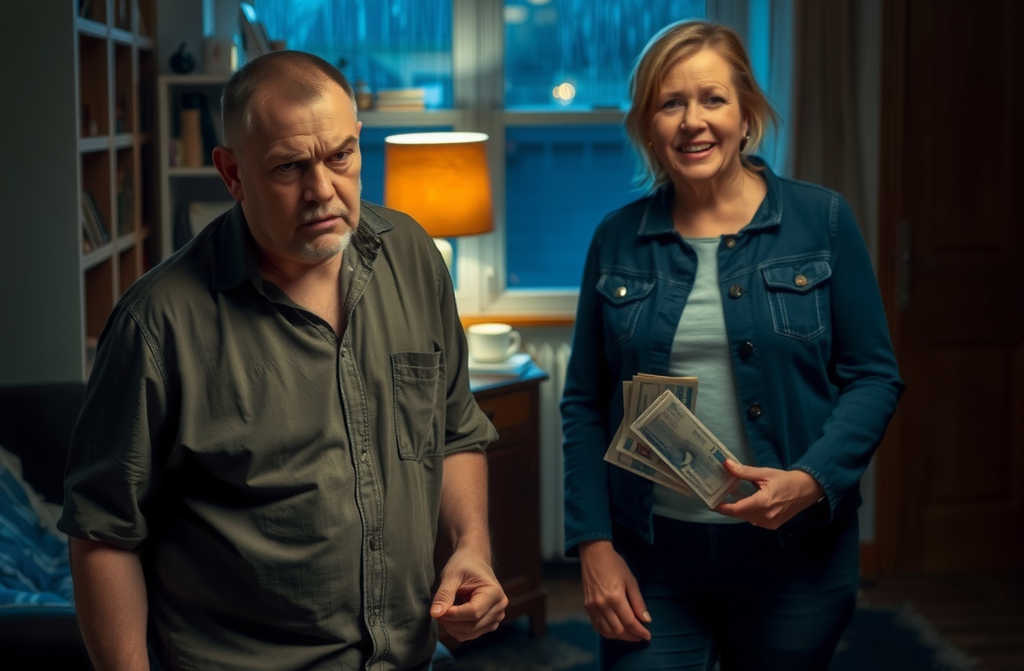
I once thought Id found the perfect balance when I suggested we keep our finances separate, only to watch Ethel quietly save up for a holiday, never asking permission and leaving me to fend for myself.
Arthur, 52. You asked for a split budget, Arthur
But not *that* split!
How split, then? So Im the one who saves while you decide what I may spend on?
Honestly, I still cant pinpoint when my brilliant plan turned against me. At first it seemed sensible, convenient and, most of all, fairat least in my head, where I always cast myself as the chief strategist of the relationship and my wife as the diligent executor, never taking initiative or making independent choices.
Im 52, not a youngster; Ive been married, divorced, learned a few hard lessons, and when I met Ethel, 46, eight years ago, I was convinced Id finally discovered a woman with whom life could be calm, free of modern fuss about personal boundaries, financial independence, and the like. Back then I believed those concepts only complicated the simple, natural order: man as head, woman alongside him.
We lived in my flat in London, and I made a subtle point of reminding her that the comforts she enjoyed were thanks to me. Everything was fineuntil the idea that would later unravel the whole system crossed my mind.
A separate budget.
I floated the suggestion calmly, without pressure, believing it noble: modern, honest, transparent. Each adult should be responsible for his own money, I argued, which would erase grievances, misunderstandings and endless who put in what debates. To my surprise Ethel agreed instantly, without argument, without conditions, without a hissy fitjust a nod and a simple, Alright, lets give it a go.
That should have set off a warning bell.
A woman who consents too quickly isnt always being acquiescent; sometimes shes already decided everything inside, and you simply havent been told.
The first months were pictureperfect. We split the costs of groceries, utilities and household bills; each paid for his own share, and I felt a refreshing fairness, a lack of the sneaking suspicion that I was being used. In truth, Id sometimes been irked that I seemed to pay more, though I tried not to show itafter all, a gentleman ought to be generous, within reason.
And then came the beauty of it all: Each for himself.
But as I later realised, each for himself isnt limited to money. It also means freedom, and I had not accounted for that.
About six months in I noticed Ethel changing. Outwardly she was the samecooking, cleaning, caringbut there was a new calm, a quiet confidence, a streak of independence that began to rattle me. I had been used to feeling that she relied on me to some degree; now she no longer consulted, no longer asked, no longer checked in.
It started with little things, then grew. I saw new handbags, shoes, splurges that, in my eyes, seemed unnecessary, and I wondered where the cash came from, especially since we were both supposed to be saving for a summer break together. We had agreed to fund a joint holiday, to plan it responsibly, and I trusted shed be as diligent as I was.
Well not quite.
To be blunt, my own money was slipping through my fingers. I lent it to a mate here, settled a few debts there, bought occasional gadgetsnothing majorbut the sum I was supposed to set aside for our trip never quite materialised. I didnt fret; I told myself wed sort it out together, that Id chip in, shed chip inrelationships, not ledgers.
Ethel, however, saw it differently. To her, it was a ledger.
One evening she said, perfectly composed, Ive bought the tickets.
I was taken aback. Tickets for what?
For the coast. Four weeks. With my friend.
My mind went cold. With a friend? What about me?
You said it was a waste of money.
I recalled that months earlier shed suggested we go away together, and Id dismissed it as frivolous, insisting we could vacation cheaper, perhaps at a countryside cottage. Shed heard me, drawn her own conclusion, and booked herself out without a word to me.
You could at least have asked! I snapped.
Its my money, she replied.
Thats when everything inside me flipped. Formally, yesher money. But it felt wrong, unfamilylike, unmanly.
I tried to explain that decisions in a partnership are made jointly, that you dont just up and leave your partner solo as if his opinion mattered not. She looked at me calmly, without a shout, without a tantrum, and said, You were the one who suggested a separate budget. Im just following the rules.
In that instant I realised Id walked into a trap of my own making. My version of a split budget carried an unspoken clause: I decide, she merely participates. In reality she became an equal partner. And equality, I discovered, isnt just about duties; it also grants rights. I wasnt ready for that.
She left. She took the cat, Whiskers, and her belongings, and the flat that had felt like my domain turned oddly empty, suddenly foreign. For the first time in years I was truly alonenot just physically, but in the sense of having no influence, no authority, no familiar role.
She sent pictures from the seaside, messages about how peaceful it was, and every note carried the most irritating thing of all: she didnt miss me. She didnt beg to return, didnt feel guilty. Thats when I wondered whether the problem lay not with her, but with me. Yet that conclusion still sits uneasily. Its far easier to label her overstepped, went rogue, or got too much freedom, than to admit Id built a convenient model where a womans independence stopped exactly where it became inconvenient for me.
When she came back a month later, sunkissed and serene, she was a stranger in my own house. We live together again, but the dynamic has shifted. We no longer bring up money; she doesnt either. Between us hangs an invisible, palpable line.
And the most bitter realisation is this: it wasnt about the cash, nor the holiday. It was about seeing equality not as a lofty slogan but as lived reality, and discovering I wasnt prepared for it.
**Psychological analysis**
The tale exemplifies the clash between proclaimed equality and an underlying need for control. The mans proposal of a separate budget is framed as fairness, yet he secretly expects the old hierarchy to persist, with his opinion still decisive while the woman remains merely a participant.
When the partner takes the rules literally and begins to act independently, cognitive dissonance erupts: outward fairness meets internal loss of authority. The resulting irritation, resentment and attempts to reimpose the former order are classic defensive moves.
True equality cannot be halfhearted. Splitting expenses while retaining unilateral decisionmaking is a contradiction. Financial independence inevitably brings autonomy in other sphereshow to spend, where to go, with whom.
The protagonists crisis stems not from his partners actions but from the collapse of his comfortable, convenient woman model. Until he revises his expectations of a partner who is both independent and equal, any attempt at a genuinely balanced relationship will likely end in inner conflict and disappointment.





