
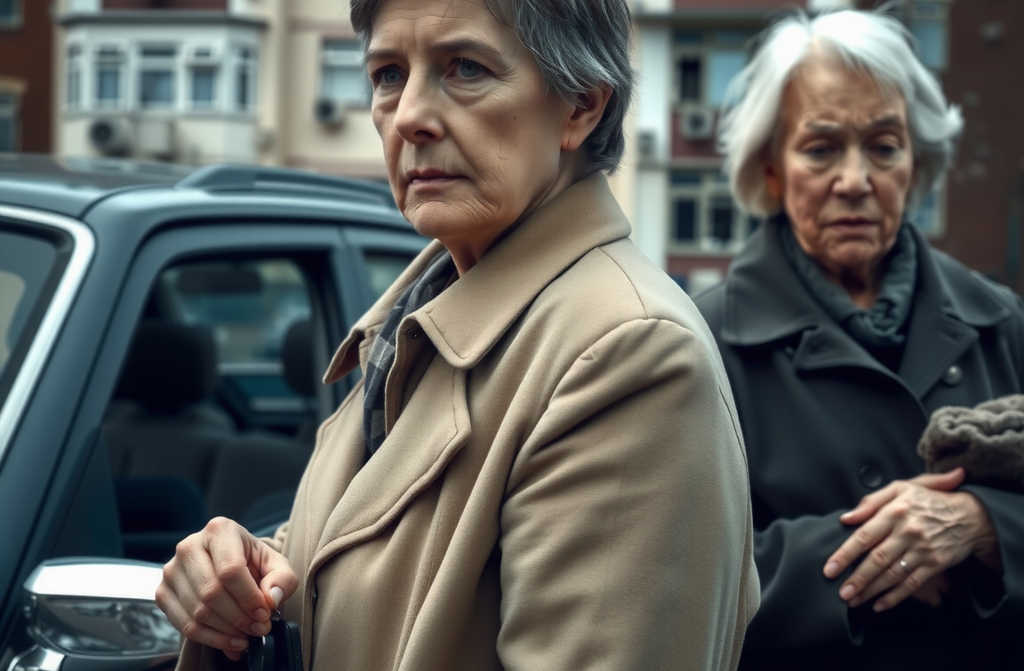
Im 58 years old. While standing at the checkout I recognised a woman who had once taken my husband, and I finally saw the price of my happiness.
It didnt start with her face but with her handsthin, dry, veins standing out. She laid out on the conveyor belt a loaf of bread, a carton of milk, a packet of rice, chicken legs, cheap cottage cheese and a small chocolate bar.
She then put the chocolate bar back.
The cashier announced the total, the woman fished out her wallet, counted the notes and whispered, No need for the chocolate.
When she turned a little, I saw her.
Veronica.
My husbands first wife.
The very woman Id spent thirty years telling myself, Well, love doesnt ask for permission.
Im 58. Thirty years ago I was twentyeight, working in a project office, wearing bright red lipstick and feeling that life was just beginning.
Victor was nine years my senior. He wasnt a magazinecover handsome man, but he was steady, confident, and listened as if I were the only woman in the room.
He was already married.
I knew that from the start.
The ring on his finger. The photograph of his daughter tucked in his wallet. The oldfashioned excuses: The house has been empty for years, We live like neighbours, Veronica doesnt understand me, I stay only for the child.
Now it disgusts me to recall how easily I believed those lies.
Back then it seemed we had a special story. Not dirty, not sordid, not the other woman. Just two people who were meant to meet.
To me Veronica was not a living person but an obstacle, a character out of Victors narrative: the cold wife, exhausted, perpetually dissatisfied, neglectful of herself, unable to grasp the subtlety of a man who craved warmth.
I had never seen her, yet I already blamed her.
Convenient, wasnt it? If the wife is bad, then Im not the one destroying a family. Im the saviour.
A year later he left me.
The scandal was terrible, but I only heard his side. Veronica wept, screamed, their daughter shut herself in her room, and Victors mother cursed him over the phone.
He arrived at my flat with two suitcases and the look of a man who had finally chosen life.
I felt victorious then, not aloud, but deep inside.
He chose me, so I must be better.
We married eight months later.
And yes, there was happiness. I wont lie.
We truly loved each other. We took trips to Brighton, renovated the house, had a son. Victor worked, earned a steady wage, built a country cottage, fixed the car, bought me new boots when he saw the old ones soaking through.
His relationship with his daughter from the first marriage deteriorated. At first he visited on Sundays, then less often, until she stopped answering his calls.
I told myself, She needs time, while secretly relishing the fact that Sundays now belonged to us.
We barely spoke of Veronica; when we did it was in passing.
She kept asking for money. She tried to manipulate the child. She couldnt accept that life had moved on.
I nodded. It was easier to think of her as a spiteful exwife. If she was spiteful, I wasnt at fault.
Thirty years passed.
Victor died two years agoheart attack, quick, at home, early morning. I still sometimes set two mugs on the kitchen table, then remove one.
Our son is grown and lives on his own. I own a flat, a cottage, a modest pension, a parttime job. Not lavish, but a decent life.
Exactly the life Victor and I built together.
One ordinary afternoon I stopped at the grocery for milk and saw Veronica at the checkout.
She had aged visibly, though were almost the same age. Her weariness wasnt from years but from longstanding fatigue that settled in her shoulders, her gait, her stare.
She returned the chocolate bar, grabbed her bag and was about to leave.
I wanted to turn away, honestlypretend I didnt recognise her, walk out, forget.
But she looked straight at me and instantly knew.
Good afternoon, Margaret, she said.
I was taken aback.
Good afternoon.
We stood by the exit while shoppers weaved past us, a boy begged his mother for a chewinggum, someone cursed at an ATM.
I stared at the woman whose life I had once split in two, unsure what to say.
How are you? was the only question I could muster.
She gave a faint smile.
Im getting by, she replied, then mentioned shed heard about Victors death from his daughter.
The same daughter who, years ago, had locked herself in her room when her father left with two suitcases.
I asked how she was doing.
Veronica looked at me intently.
Do you really want to know? she asked.
I didnt answer.
She told me her daughter now lived with a disability after an accident, could barely walk, couldnt work properly. They lived together.
Victor had never spoken of this. Or I had never listened. Or I had never asked in a way that would bring the truth out.
I offered to give Veronica a lift.
I wasnt sure whyperhaps to smooth something over, perhaps to feel, for once, not like the victor but simply a human being.
She initially declined, then accepted, fatigue evident in her shoulders.
We drove in silence. I stole glances at her clean, old coat, the wornout bag, the knot of hair at the back of her head.
I recalled Victors remark from thirty years ago: She stopped being a woman. Everythings about the house, about complaints.
And I thought: perhaps she never stopped being a woman. Perhaps she was simply a single mother fighting to keep a home, a child, and a husband who was already looking elsewhere.
We pulled up in front of a fivestorey council block, its paint peeling, a small shop with two elderly women behind the counter, curtains drawn on the groundfloor windows.
I said, almost without thinking, I often wondered if I should have spoken with you.
Veronica didnt turn.
When?
I searched for words.
I dont know. Back then.
She answered calmly, Back then you didnt want to talk. You wanted to win.
Her words cut straight to the heart, and I fell silent.
She opened the flat door, then closed it again and faced me.
I hated you for a long time, she said.
I nodded.
I understand, I replied.
She shook her head.
No. You dont understand, she said, clutching the bag with both hands. You didnt take a man away. You stole a normal life from me.
Those words left me breathless.
I wanted to arguethat a person cannot be taken if he chooses to leave, that he was an adult, that if their marriage had been happy he wouldnt have gone. Those were the defense lines Id rehearsed for three decades.
But sitting across from a woman who had just put a chocolate bar back because she couldnt afford it, my rehearsed lines felt hollow.
Veronica spoke quietly, without shouting, which made it even harder to bear.
She recounted how she had cared for Victors mother after a stroke, shuttled her daughter to doctors, worked two shifts, while Victor came home smelling of my perfume, expecting her to be lighthearted and understanding.
When he left, she was only thirtyfar from an old woman or a monster. Just a mother with a child, a mortgage, a sick motherinlaw, the very things he had abandoned as we built our new life.
I whispered, I didnt know.
She snapped, And you wanted to know?
I said nothing.
Because I didnt want the answer.
I needed a version where love triumphs over circumstance, where Im blameless, where the first wife is the one who ruined everything, where the man left not out of responsibility but for happiness.
Veronica got out of the car. I followed, still unsure why.
Veronica, Im sorry, I said.
She looked weary, Dont.
Why? I asked.
Because its what you need now, not me, she replied, quieter still.
I stood there, keys in my hand, like a schoolgirl before a stern headmistress.
She whispered, I survived. I raised my daughter. I tended to his mother. Can you imagine? She kept calling me stepdaughterinlaw until the end. He visited once a month with money and guilty eyes, then even less.
Victor had told me he was helping.
I never asked how much.
He said the daughter was difficult, that she was still under her mothers influence.
I didnt ask why.
He said Veronica was strong and would manage.
I believed it, because if she could manage, I could finally be happy without her pain.
At the blocks entrance she paused, delivering her final line:
Youre not the only one at fault, Margaret. He was a bigger part of it. But you werent blindyou just didnt look.
She entered the stairwell.
I sat in the car for about twenty minutes, then drove home. For the first time in many years I looked at my life not as a romantic saga but as a house partly built from other peoples broken pieces.
Everything was as usualmy kitchen, my curtains, a photograph of Victor on the mantel, smiling, tan, holding a fishing rod.
I used to stare at that picture and think, My husband, my love, my destiny. Now I see it and wonder how many people paid the price for him to become mine.
That evening my son called.
Hey Mum, how are you?
I almost said fine but couldnt.
I told him Id met Veronica, that she was struggling, that his sister had a disability.
He sighed, Mum, why bring that up now? That was ages ago.
A convenient phraseages ago. It made the pain feel distant, as if it no longer hurt.
I replied, For her, it isnt ages.
He fell silent.
Since that day Ive begun to recall the things I used to sidestep.
How Victor delayed child support yet bought me a new coat. How we drove to the coast while he claimed his daughter didnt need a break. How irritated I got when Veronica called late at night. How, once, I suggested, Maybe stop paying her extra beyond the maintenance? We have a child too. He looked at me oddly and said nothing.
Now I feel shamenot the theatrical kind that can be turned into a lesson, but a raw, lingering shame that comes too late to change anything.
I cannot give Veronica her youth back. I cannot reunite her daughter with her father. I cannot restore an honest version of my happiness.
All I can do is stop lying, at least now.
A week later I found Veronicas number. I stared at my phone, then typed:
Veronica, Im not asking for forgiveness again. Youre right; it would mean something to me. If your daughter needs help with doctors or medication, Im willing to helpno strings attached.
She replied the next day, Ill think about it.
And that was it.
She may never write back.
She may be right.
I have no right to insert charitable gestures into her life as if they could amend the past. But I can no longer pretend nothing happened.
The strangest part of this whole tale is that I truly loved Victor.
I cannot claim our life was a lie. There was tenderness. There was a son. There were good years. There were evenings when he held my hand and I felt happy.
Yet now, forever beside that happiness, stands another woman at the checkout, putting a chocolate bar back because she cant afford it. And I cant sweep her away.
Perhaps that is the late reckoning.
Not that something is taken from you, but that you finally see the full cost of what you once seized.
The truth is simple: love that builds on anothers loss can never be clean. The only real redemption lies in honesty, in acknowledging the damage, and in allowing both sides to bear their own burdens rather than pretending the past was ever just a love story.





