
Lessons in Silence
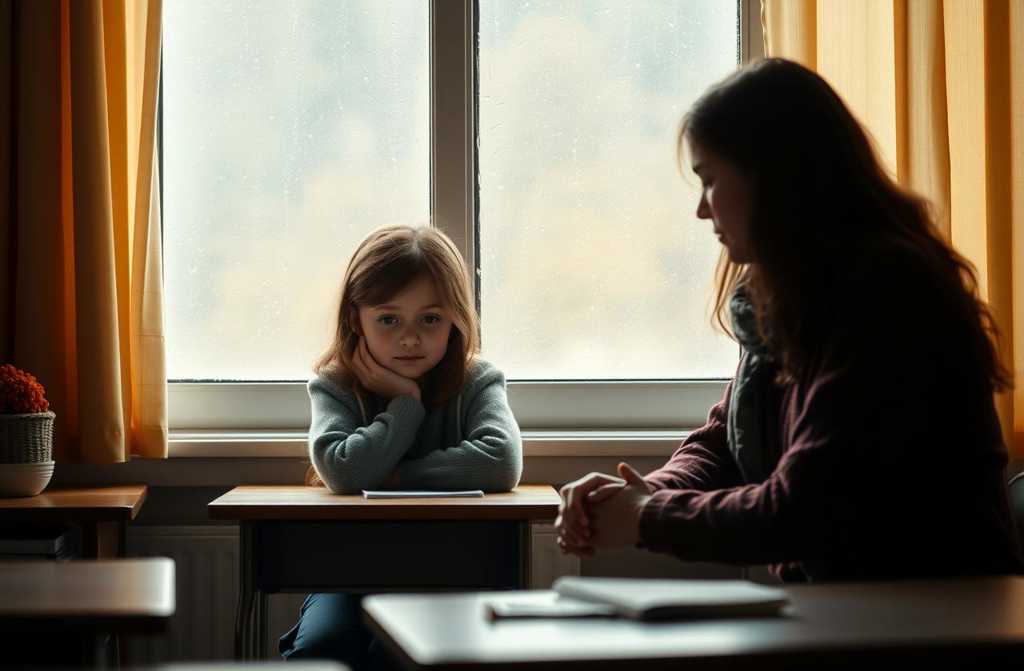
When James walked into the classroom at eight in the morning, the air was thick with the smell of rain, school dinners, and old chalk dust. A heavy quiet hung over everything, like fog, and the floorboards creaked underfoot, almost grumbling about the early hour. He shut the door and paused for a second, his eyes flicking to the window. Outside, a fine drizzle painted the glass, droplets smudging the sill like careless watercolours in grey. October was bitter out there—the kind of cold that seeped into your bones and settled in the gaps between words.
The students sat still. Too still. Not just well-behaved but frozen, wary, like they knew something was wrong, or maybe they were bracing for it.
James moved to the front, dropped his worn-out folder on the desk, shrugged off his coat, but didn’t sit. It didn’t feel like his usual classroom. More like a room where something irreversible had just happened, and nobody wanted to say it out loud. Without turning, he spoke:
“Right then. Who’s going to explain why the textbooks are still shut?”
Silence. Not even the usual rustling or whispering—everyone was statue-still, as if someone had ordered them to stay quiet. The tension in the air was like a drawn bowstring, ready to snap at the lightest touch. James turned around. None of them were looking at him—their eyes were fixed on the back corner, by the window, where Emily Taylor sat.
She wasn’t crying. Just staring out at the rain, watching it streak the glass with blurred lines. Her face was eerily still, like wax. On her desk, an open diary lay flat on a blank page, as if she’d meant to write something but couldn’t. Next to it—a pen with no cap, the same one she clicked nervously during tests. Nothing else. No books, no pencil case. Just a bag on the floor, unzipped, the corner of some crumpled paper poking out like an unfinished thought.
James waited. Then he walked over, tossing over his shoulder, “Rest of you—physics. Problem three, read carefully.”
He sat beside Emily. She didn’t react, like he wasn’t even there.
“What’s wrong?”
“Nothing,” she whispered. Her voice was fragile, like glass about to crack. Every word sounded like it might be the last.
He didn’t push. Just stayed there. Silent. After a beat, he leaned down, pulled an exercise book from her bag, and set it gently in front of her. He didn’t ask. Didn’t look her in the eye. She didn’t resist—just kept her hands frozen in her lap, like stone.
“Emily,” he said softly, “if it’s something serious, you can say it. Keeping it in doesn’t make it go away. It just gets heavier.”
She frowned. Her lips twitched. For a second, she almost turned to him.
“And what’ll you say? The same as everyone else? ‘You’re strong, hang in there’? Or will you start asking about my mum—why she hasn’t left her bed in weeks? And then tell me, ‘Childhood’s the best time, make the most of it’? Yeah, right. Make the most of lying awake, listening to her cry in the next room. Or the neighbours screaming through the walls. Or opening the fridge and seeing nothing but empty shelves. That’s the best time, is it?”
Her voice was steady, but exhausted. Like she’d rehearsed every word a thousand times—in her head, in dreams, alone.
James stayed quiet. He glanced at her diary, where she’d sketched houses in the margins—dark, empty, no lights inside. One of them was crossed out, like it had fallen down.
He said quietly, “Sometimes silence is a way out. But it’s not a way through.”
Emily looked up. No tears. Just stubbornness, and a tiredness that didn’t come from one sleepless night—but from a life too heavy for a kid.
“Do you know what it’s like? Coming home and pretending everything’s fine when your dad left, and your mum just—stopped? Making toast for dinner because there’s no money for anything else? Smiling at school because you have to, because if you don’t, who will? And then listening to the shouting next door, waiting for an ambulance because you know—sooner or later—one’s coming. Do you know?”
Her voice was low, but it hummed like a tight wire—not with anger, but with the weight of holding too much for too long.
James watched her. Didn’t answer. She wasn’t waiting for one.
“I’m thirteen. And I already know no one’s coming to help. Everyone says the right things, nods, makes promises. Then disappears. I don’t want you to disappear too. And I don’t want pity. Pity’s when you look down on someone. I’m not below you.”
He nodded. Then stood.
“I’m not looking down. And I won’t disappear. I’ll be here. Every morning at eight. That’s all I can give. And—a decent stew. Not out of thin air.”
She looked down, sharp, like she didn’t dare believe it.
“What kind of stew?”
“Beef, carrots, potatoes. Proper one. I’ll make it at home. Bring it in. If that’s alright.”
“If you do,” she murmured, “I’ll wash the dishes after. Promise.”
He almost said something else. Something important. But kept quiet. Sometimes silence is a promise too—if there’s warmth behind it.
Chalk scratched the board. Someone started writing. Life went on—not louder, not softer, just as it could.
James walked back to his desk. Glanced up once—Emily had opened her book. Slowly, like she thought someone might stop her. Like it was the first move after being frozen for years.
He pretended not to notice. Some lessons in silence speak louder than words.





