
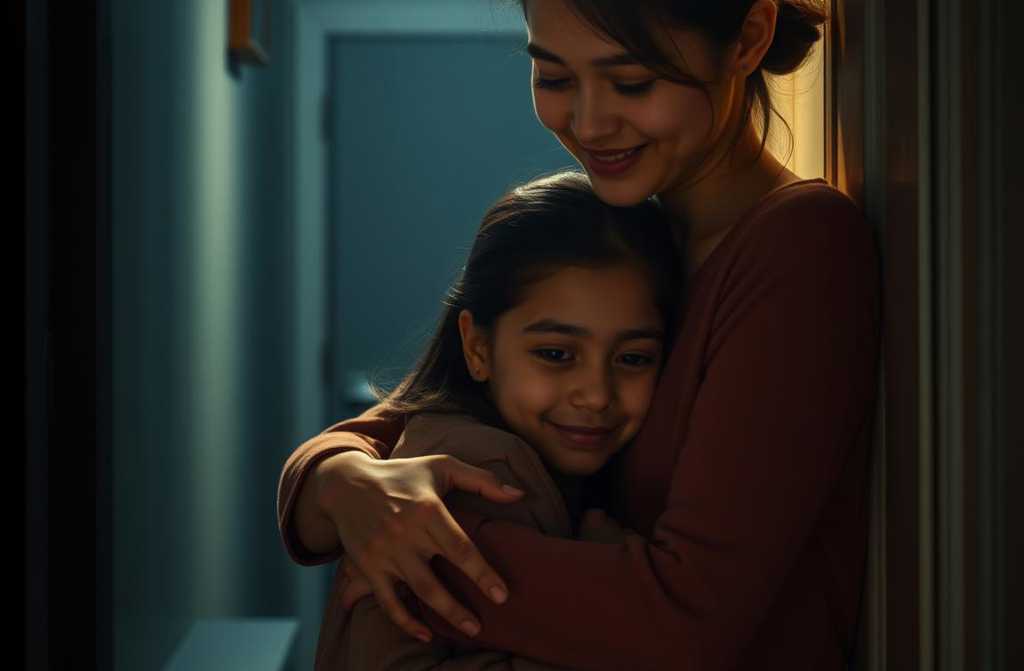
My daughter has not come home until one in the morning for years, and her shadow never follows her.
You only notice the strange things when you stare too long, or when something refuses to look back. In my case it all began with something I did not see.
A shadow.
My daughter’s shadow.
It was gone.
And it has not returned.
Her name is Ethel. She is twelve. She loves spiced pies, arithmetic, and mimicking the latest TikTok dances in front of the cracked bathroom mirror. For the first twelve years of her life Ethel was pure sunshine on two legs, with tangled braids, mud‑stained socks and a constant hum of an out‑of‑tune song.
Until three weeks ago.
That is when she started slipping back home at one o’clock in the morning.
The first night I nearly fainted when the front door creaked open so late. I had fallen asleep on the settee, waiting for her after her after‑school classes. She was supposed to be back by half past six in the evening. When the clock struck ten I phoned the school, her friends, even her private tutor – nobody had seen her.
Then, at one a.m., she slipped in through the door.
She was calm. Too calm.
I sprang up.
“Ethel! Where have you been? I was—”
She lifted a hand slowly and said,
“Don’t worry, Mum, I’m fine.”
That was all.
No tears.
No apology.
No fear.
She went straight to her bedroom and locked the door.
I stared at the floor for a long while. Something felt odd. The air she brought in was as cold as a freezer. The hallway lights flickered once, then steadied. I told myself I was over‑thinking. Children her age can be strange, can’t be?
The next night the same thing happened. She did not return until one a.m. Again she entered as if she lived in a different time zone, offering the same words in the same tone.
But this time I saw it.
She passed the wall‑mounted lamp in the dining room… and her shadow did not.
It simply was not there.
No outline.
No shape.
Nothing.
I thought I was hallucinating. I switched on every light in the house and made her stand beneath them. Nothing. The light lit her face, but the floor behind her remained empty. She realised I was watching.
“What’s the matter, Mum?” she asked.
I blinked. “Nothing. I’m just tired.”
She nodded and walked away.
I watched her once more as she left. Her body moved, but no shadow trailed her.
The following day I called the school to ask why they were letting her out so late each day. The lady on the phone hesitated, then said,
“Mrs. Thompson, your daughter has not attended school since the last half‑term exam… over three weeks ago. We sent several notices, but you never replied.”
My heart stopped.
“She goes out every morning,” I whispered. “She puts on her uniform. She even carries her water bottle.”
I went to the kitchen after the call. Her water bottle was still there, untouched, exactly as I had left it on the day of the last exam.
That night I did not sleep.
I turned off every lamp, sat by the living‑room window and waited.
At precisely one a.m. the front gate swung open on its own.
And she came in.
Ethel. But not the Ethel I knew.
From the outside she looked the same. Her eyes did not flutter as before. Her breathing fell into an odd rhythm. She looked at me and tilted her head.
“Why are you awake, Mum?” she asked.
I forced a smile. “Waiting for you.”
Then I said something I had not intended:
“Where is your shadow?”
She smiled.
Not with her mouth – with something colder.
“It stayed behind.”
She slipped past me.
When she passed the wall mirror, something did flash for a heartbeat.
A figure taller than her.
Eyes far too large… and a grin far too thin.
I turned my face away, my heart pounding, my hands shaking.
Now she lies in her room.
Sleeping in her own bed.
Breathing.
Quiet. Calm.
But her shadow…
Her true‑self shadow?
I think it lingers outside.
And I think it waits for another chance to come in.
Episode Two: What Crawls Beneath the Door
Since the “return” of Ethel, the house no longer breaths the same.
By day everything seems ordinary.
Ethel rises, sits down for breakfast, but she does not eat. She stirs the porridge absent‑mindedly.
She pretends to leaf through her notebooks. Sometimes she hums low‑key songs I have never heard. The lyrics are in no language I recognise.
And by afternoon she simply vanishes.
She says nothing of where she goes. She does not ask permission to leave.
The front door opens and shuts on its own at precisely six forty‑five in the evening – not a minute sooner or later.
And I sit there… waiting. In the dark. Alone.
With a question growing more poisonous each hour:
Is that thing really my daughter?
I began to notice tiny oddities.
The walls, for instance, seemed to breathe.
At least when Ethel was in the house.
The cracks in the ceiling widened slightly, as if stretching with her presence.
The houseplants – the ones I have tended for years – wilted only in her bedroom,
as if an invisible hand brushed them each night.
One night I woke thirsty and passed her bedroom door. It was ajar.
Inside she was not asleep.
She sat on the edge of the bed, back turned, humming that nameless tune.
She brushed the hair of a doll that had no eyes.
And on the wall behind her I saw a shadow.
Not hers.
It was taller. Slimmer. It moved before she did, not after.
As if it were directing her, not the other way round.
I ran to my own room, slammed the door, wedged a chair beneath it.
I prayed.
But prayer did not answer when something had entered of its own will.
The next day I did something desperate.
I took the most recent photograph of Ethel and compared it with one taken a month earlier.
The eyes were different.
In the old picture the irises were light brown.
Now they were a sickly green‑grey, like stagnant water.
And there was more.
The pupils were not round. They were vertical, like a cat’s, or a serpent’s.
That night I spread flour across the hallway floor.
A simple trap.
At one a.m. I heard the door open.
Soft steps.
Then a pause.
I pretence‑slept, keeping one eye cracked open.
Ethel stood in the doorway of my room.
She said nothing.
She did not move.
And then I saw something shift beneath her feet.
In the flour there were no human footprints.
Only fine, dragged marks, as if something with long claws had scuttled just above the ground.
The worst part was the final line: a long, curved trace, like a tail dragging behind her.
This morning I found a note beneath my pillow.
It was not written by hand. It looked as if the words had been burnt into the paper.
It read:
“Mum, I’m trapped. This isn’t me. Don’t let her in tomorrow.”
Now I am terrified.
Because it is fifty‑nine minutes to midnight.
And the front gate… is already beginning to swing open on its own.
Episode Three: The Voice Behind the Door
One a.m.
The clock’s hand clicked its familiar tick.
Then the front door swung open by itself.
I was in the sitting‑room, the note still clenched in my hand, my heart hammering as if it wanted to break my ribs and flee without me.
I did not go to meet her. Not this time.
I hid behind the curtain, a dead phone on silent, the lights off.
I heard footsteps.
One. Two. Three.
They were not the light tread of a teenager.
They were heavier, as if something was being carried, or as if the footfall was not wholly human.
Then I heard a voice.
“Mum… I’m here.”
But it was not wholly her voice.
It was lower, with an odd echo, as if two mouths were speaking at once.
One tried to sound like Ethel.
The other dragged syllables like claws across glass.
“Mum… are you awake?”
The door knob turned.
I held my breath.
Nothing entered. Not yet.
She pressed her forehead against the door and began to weep.
The tears did not sound like tears.
They were dry, brittle, as if something inside her was shattering.
“Mum… I’m cold. Let me in…”
I wanted to open it. I wanted to rush to her.
It was my daughter’s voice, at least in part.
But then the note flashed in my mind.
“This isn’t me. Don’t let her in tomorrow.”
And though the thing was inside the house, I understood what it meant.
The real Ethel was out there.
What was in the house… was something else‑wise.
At three thirty‑three a.m. the footsteps retreated.
I heard the front door swing open once more.
Then silence.
At last the air entered my lungs again.
At dawn I went to Ethel’s room.
It was empty.
Not quite.
On her bed lay a box.
Wrapped in black cloth, tied with a human‑hair bow.
Inside was a doll.
A perfect replica of me.
Behind its head something was etched with a knife:
“You will be next.”
Episode Four: The Mirror That Refused to Reflect
The following day was unreal.
Ethel did not return to school. She did not answer her friends’ texts.
Her phone stayed dead.
The doll on her bed remained, eyes wide, my own frightened expression frozen in cloth.
I tried to burn it.
It would not catch.
It only smelled of charred flesh.
At 12:55 a.m. I did something foolish.
I placed a mirror opposite the front door.
It was not superstition. It was desperation.
If what came each night was not Ethel, I wanted proof.
One a.m. the lock turned.
I sat in the dark hallway, breath held.
The door opened slowly.
A figure stepped in.
It was Ethel.
She wore her blue jacket, school bag slung over a shoulder.
Hair pulled back.
Skin pale.
“Hello, Mum,” she said, as always.
She did not look at me.
She looked at the mirror.
And the mirror showed nothing.
“What is that?” she asked, pointing at the glass with a frosty smile.
“Nothing, love,” I replied, my voice cracked. “How was school?”
“Fine,” she said. “Today we learned about photosynthesis.”
I knew that lesson had been taught two weeks earlier.
Ethel – whatever she was – passed the mirror without casting a shadow, without an image, without any presence at all.
Only a cold draft brushed my feet.
I slept with the door locked, the doll sealed in a bag and buried in the back garden.
At three a.m. I heard laughter.
Not from the hallway.
From the wardrobe.
I opened it slowly.
The doll sat there, a new expression on its face:
It smiled.
Between its tiny fingers it clutched a lock of my hair.
The next day I took the doll to the parish church.
The priest would not even touch it.
He muttered one word on seeing it: “Parasite.”
He whispered something about entities that imitate, a thing that learns and infiltrates.
Sometimes they need an invitation.
Sometimes belief alone is enough.
I asked, “Where is my daughter?”
He looked at me with pity.
“If her shadow does not follow her… perhaps she is no longer of this world.”
That night, before one a.m., I set up hidden night‑vision cameras.
I wanted proof.
What they captured…
My god.
My daughter entered the house,
but not through the door.
She fell from the roof like a broken puppet.
She rose with disjointed movements.
As she shuffled down the corridor, something slithered behind her.
No shape, no face, just clawed whispers on the walls.
She turned to the camera and said,
“Mum… stop watching.”
The screen went black.
Episode Five: The Place She Goes When She Leaves
Since I saw that footage I could not sleep.
I smashed the cameras, threw the doll into the river,
prayed with my last breath.
Nothing helped.
Ethel still slipped in at one a.m.
Each night colder, more perfect,
more empty.
One morning I rifled through her schoolbag while she slept.
There were no books.
Only damp earth, the colour of a fresh grave.
And a folded piece of paper‑thin note:
“She is at school.
I am the one who returns.
Ask no more.”
I called the school.
“Has Ethel been attending?” I asked, tears threatening.
A silence answered.
“Madam… your daughter has not been in class for a month.”
“What? We thought we had sent you the notices.”
“No, we never got a reply. Someone else answered my calls, using my voice. Living my routine. Sleeping in my bed.”
That night I waited for “Ethel”.
I hid behind the hallway curtain.
One a.m. – silence.
Then a dry thump on the roof.
The same sound of a body falling like soulless meat.
She rose, walked straight to my bedroom.
I followed.
From the cracked doorway I saw something impossible:
She knelt before the wardrobe,
whispering in a tongue that sounded like reversed wailing.
The wardrobe opened on its own.
From inside emerged another girl.
She looked like Ethel, but filthy, pale, lips sewn with black thread,
trembling,
mute.
The impostor embraced her, murmuring,
“You’re almost ready.”
…
Both turned toward the door,
toward me.
“Mum,” they said in unison, “now it’s your face.”
I ran.
I do not recall descending the stairs. I only know I was barefoot in the street, screaming.
No neighbour turned on a light.
It seemed the whole village lay in a forced slumber.
I returned the next day with the police.
The house was empty.
The wardrobe empty.
No cameras. No earth in the bag.
No doll.
Only a carving on my bedroom wall:
“It is not your daughter.”
I did not give up.
I demanded the school review their CCTV.
There I saw her.
The real Ethel,
trapped in a room that did not exist on any floor plan.
No windows, no exit.
Just a chair, a desk, a mirror.
In the mirror I smiled at her.
But it was not me.
Now I understand.
My child is caught somewhere between this world and another.
The thing that lives with me,
that walks like her,
that calls me “Mum”…
It will never bring her back.
Unless I can pull her out.
Episode Six: The Name I Must Not Speak
I scoured old archives, hidden forums, deserted chapels.
In a dark corner of the internet – a place no sane person should wander – I found a word.
A name.
According to the lore,
saying it once summons the thing behind the mirror.
The warning read:
“Speak it once, she sees you.
Speak it twice, she hears you.
Speak it thrice… you belong to her.”
I wrote it down, then burned the paper.
But the letters seemed to breathe, to shift, and they lingered in my mind.
That night “Ethel” made breakfast.
Flapjacks, flawless.
Too flawless.
“Did you like them, Mum?” she asked.
“Yes, love…”
She looked at me with those dark, bottomless eyes and I realised she knew I knew.
I waited until she left, then slipped down to the cellar.
Behind the boiler I found what I had been looking for: the mirror we had tossed weeks before.
Someone had brought it back.
It was draped in a black sheet.
I pulled it away.
The reflection showed nothing.
I was not there.
She was.
Ethel – the real one –
pounding from the other side,
screaming,
but her voice could not cross.
I whispered the name once.
Silence.
I said it a second time.
The glass trembled.
I stopped before a third utterance,
wondering if I would vanish.
Then I recalled my daughter’s sketches,
her laughter,
the terror in her eyes the night I last saw her.
I spoke the word a third time.
Everything went dark.
I opened my eyes.
No house.
No mirror.
Only a damp, blackened corridor.
At the far end, an empty classroom.
I entered.
There she was.
Ethel, chained to a chair.
I lunged, hugged her.
“Mum!” she sobbed.
“I’m here, love. I have you.”
“She’s coming. Don’t say it again.”
“Who?” I asked.
She could not answer – her voice was gone.
Behind her the mirror began to bleed.
From the blood rose a faceless woman.
The one who had copied me.
The one who had taken my child.
I ran with Ethel down the corridor.
The woman followed, soundless,
her shadow stretching across the walls like a living stain.
“Don’t look back,” I urged. “No matter what, don’t look back.”
We neared the door back to the living world,
the only escape.
Ethel leapt.
I was about to step through…
when a cold hand gripped my ankle.
She whispered in my ear,
“You said my name.”
I awoke in my own bed.
Ethel stood in the kitchen, flipping pancakes.
Her shadow followed her.
“Mum? Are you alright?”
I nodded, though my voice felt missing.
I went to the bathroom,
looked into the mirror.
No one was reflected.
Episode Seven: Mum No Longer Lives Here
The house smelled of breakfast,
of fresh pancakes,
of ordinary life.
But I was no longer myself.
Ethel looked at me with love, as if everything were fine,
as if she never recalled the dark hallway, the faceless woman,
as if she never knew I had been trapped behind glass.
“Feeling better, Mum?” she asked.And as the kitchen light flickered once more, I realized the silence that now filled the house was not peace but the relentless echo of a mother forever waiting beyond the glass.





