
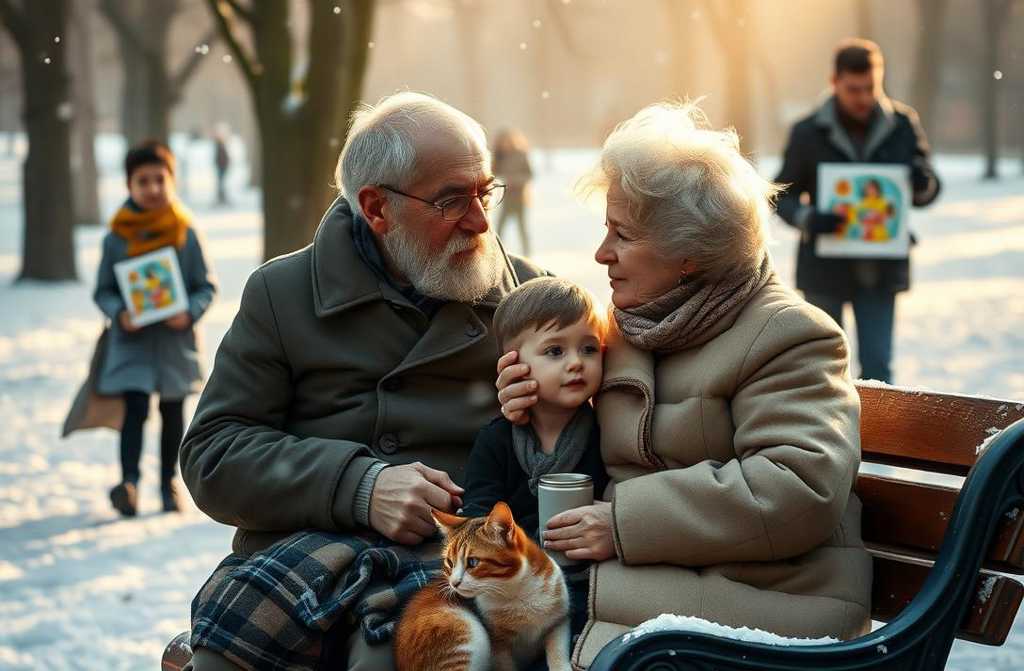
On a cold metal bench in a quiet park in Manchester sat an elderly man wrapped in a worn-out overcoat. Once, he had worn it proudly as an electrician for the local council. His name was Alfred Simmons. A widower, a pensioner, and—once—a proud father and grandfather. But all that had crumbled in a single day, like a house of cards, under the weight of another’s will.
When his son brought home his new wife, Natalie, Alfred felt his chest tighten with unease. Her polished smiles hid steel in her gaze, a silent storm brewing. She never raised her voice, never made a scene—instead, she carved away at his presence with clinical precision. First, his books vanished, decades of collected favourites banished to the attic. The armchair where he’d read his evening paper was deemed “old-fashioned.” Even his favourite teapot, the one he and his son shared each morning, disappeared without a word. Then came the hints: “Dad, you should take more walks. The fresh air would do you good.” Soon followed the ultimatum: “Maybe a care home? Or your sister’s place in Cornwall?”
Alfred didn’t argue. Pride wouldn’t let him. He packed a small suitcase—a few shirts, a photograph of his late wife—and left. No tears, no accusations. Just a hollow ache that settled deep in his ribs.
For weeks, he wandered Manchester’s frost-laced streets like a ghost. His only refuge was that park bench, where he’d once walked with his wife, Margaret, and later pushed his son on a swing. Now, he sat for hours, staring at nothing, until memories seared worse than the cold.
Then, one bitter afternoon, a voice cut through the wind:
“Alfred? Alfred Simmons?”
He turned. A woman in a thick woollen coat stood before him, her face half-hidden by a knitted scarf. Familiar, but it took him a moment. Eleanor Whitmore. His first love, lost to time—first to his military service, then to his marriage to Margaret.
In her hands was a thermos and a paper bag of homemade scones.
“What are you doing out here? You’ll catch your death,” she said, voice soft with concern.
That simple question thawed something in him. Alfred accepted the tea, took a bite of the warm scone. His throat tightened. The tears wouldn’t come, but his heart ached like a fresh wound.
Eleanor sat beside him as if no years had passed.
“I come here sometimes,” she murmured. “But you… why are you alone?”
“Old memories,” he rasped. “This is where my son took his first steps. You remember?”
She nodded, warmth flickering in her eyes.
“And now…” Alfred exhaled sharply. “He’s grown. Married. The house is in his name. His wife gave him a choice—her or me. He chose her. I don’t blame him. Young people have their own lives.”
Eleanor said nothing, just studied his work-roughened hands, so familiar and so lonely.
“Come home with me,” she said suddenly. “Warm up. Eat. Tomorrow, we’ll figure out what’s next. I’ll make stew. Talk. You’re not made of stone, Alfred. No one should be alone.”
He stared at her, disbelieving. Then, quietly:
“And you… why are you alone?”
Her gaze clouded.
“Husband passed years ago. No children. Work, pension, my cat… it’s all just routine. You’re the first person in years I’ve shared tea with.”
They sat there as snowflakes dusted the ground, the park silent around them.
The next morning, Alfred woke not on a bench but in a warm room with lace curtains. The smell of fresh bread filled the air. Sunlight glinted through frost on the window, and for the first time in years, he felt something like peace.
“Morning!” Eleanor entered with a plate of crumpets. “When was the last time you had a proper breakfast?”
“Ten years,” he admitted hoarsely. “My son and his wife only ever ordered takeaway.”
She didn’t press. Just fed him, wrapped him in a quilt, turned on the old radio. The silence no longer suffocated him.
Weeks passed. Alfred mended sockets, helped with chores, told stories—how he’d once saved neighbours from a fire. Eleanor listened, cooked his favourite meals, darned his jumpers. She gave him the one thing he hadn’t known in years: care.
Then, one day, everything changed.
Eleanor returned from the market to find a car idling at her gate. A man stepped out—Alfred would’ve known him anywhere. His son, James.
“Excuse me,” James began awkwardly. “Does Alfred Simmons live here?”
Eleanor tightened her grip on her shopping.
“Who’s asking?”
“I—I’m his son. I’ve been looking for him. He left, and I… didn’t know. Natalie’s gone. Turned out I was blind.”
Eleanor studied him.
“Come in. But remember—a father isn’t furniture. He doesn’t owe you forgiveness just because you’re lonely now.”
James nodded, head bowed.
Inside, Alfred sat with the newspaper. At the sight of his son, he froze. Memories of cold nights, of betrayal, surged like poison in his veins.
“Dad…” James’ voice cracked. “I’m sorry. I was a fool.”
Silence hung thick between them. Then Alfred spoke.
“You could’ve said that sooner. Before the streets. Before the cold. But… I forgive you.”
Tears slipped down his cheeks—bitter, but warm with hope.
A month later, James asked him to return. Alfred refused.
“I’ve found my home,” he said. “It’s warm here. I’m wanted. I’m not angry—just too old to start over. Forgiving doesn’t mean forgetting.”
Two years on, Alfred and Eleanor visited that same park. They held hands, fed birds, shared tea. Sometimes silent, sometimes talking.
One day, Alfred gazed at the sky and murmured,
“Life’s a strange thing. They kick you out, and you think you’re finished. Then someone comes—not with demands, but with warmth—and gives you a home. Not walls. Love.”
Eleanor squeezed his hand.
“Then it wasn’t wasted. Even if it started on a bench.”
They lived quietly, never marrying, never using titles. But their home brimmed with family—in the scent of stew, the crackle of the radio, the quiet way they looked after each other.
One spring, James returned. A boy of eight trailed behind him.
“Dad… this is Oliver. Your grandson. He wanted to meet you.”
Alfred froze. The boy held out a drawing: a park bench, two figures.
“That’s you and Grandma Eleanor,” Oliver whispered. “Dad told me stories. I want a grandad.”
Alfred knelt, pulled him close. Warmth flooded his chest.
From then on, Oliver was part of their lives. He played in the garden. Alfred fixed his toys, told him tales. Eleanor watched, smiling.
“You’re living again, Alf,” she said once. “Not just surviving.”
He kissed her hand.
“Because of you.”
That autumn, they married quietly, just James and Oliver as witnesses.
The registrar smiled. “Bit late for a wedding, isn’t it?”
Eleanor laughed. “Love doesn’t have an age. It just is.”
Years passed. Alfred wrote his memories—for Oliver, so he’d know: life could be cruel, but light always found a way.
At sixteen, Oliver said, “Grandad, I’m turning these into a book. So people know—don’t abandon family. Forgive. Walk away if there’s only pain.”
Alfred nodded, pride swelling in his chest.
Then, one day, Natalie came. Grey-haired, empty-eyed.
“I lost everything,” she said. “The man I left for was hollow. Health, happiness—all gone. I thought you were holding James back. Now I see—you were his strength.”
Alfred studied her.
“I’m not angry. But you’re not welcome here. This house is warmth. You brought ice. Now you want to thaw where you caused frost? No. Find your own peace—elsewhere.”
He closed the door.
Ten years later, Eleanor passed in her sleep, the scent of chamomile wrapping her. Alfred held her hand, whispered his love. Didn’t cry. Just said,
“Thank you. I’ll see you soon.”
At her funeral, the park children came. Neighbours. Friends. All who knew her—kind, generous, always sharing cake and smiles.
Oliver published his book:
*”The Bench Where Life Began Again”*
Dedicated to his grandparents. It moved thousands. Letters poured in—thanks for honesty, for hope, for proving love could come late.
Alfred lived a little longer. One day, he lay on that bench, closed his eyes, and saw Eleanor.
“Time to come home, Alf,” she smiled.
He did.
The park bench, now engraved with *”Love finds you where you least expect it,”* became a place where others, too, learned to pause and listen to the quiet stories of those the world had once forgotten.





