
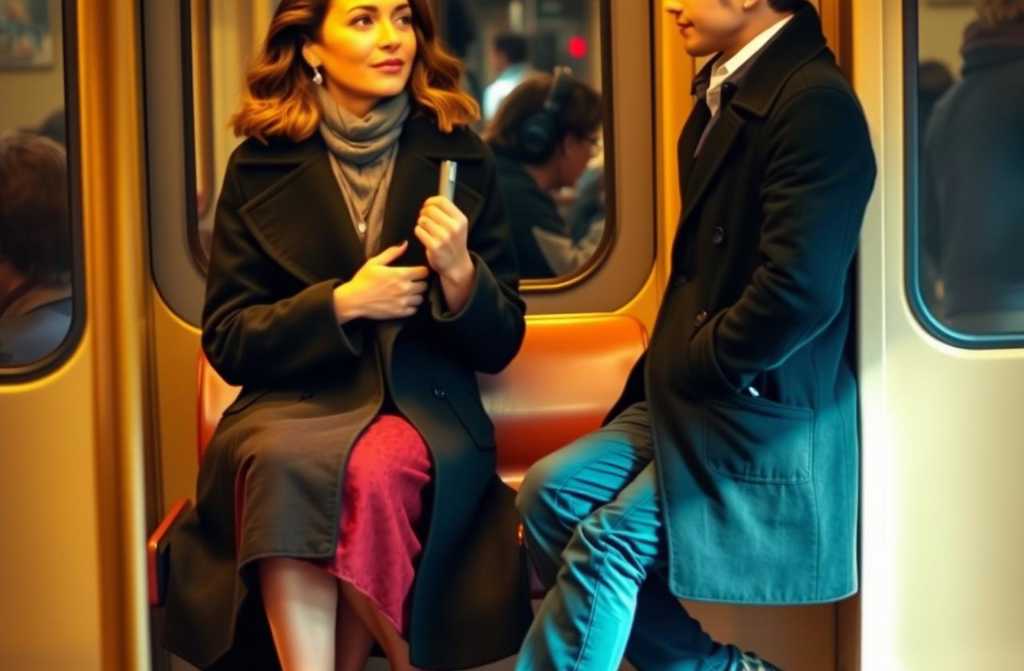
The Actress
Alice stepped into the Tube carriage and sank onto the seat. Why on earth had she worn heeled boots? Because, at any age, a woman should still look like a woman.
She glanced at her reflection in the dark window opposite. Not bad at all. *Especially when you’ve had enough sleep, slapped on a ton of makeup, and aren’t peering into a mirror but a dim subway window,* her inner voice remarked.
*Still, the eyes look sad—probably just tired.* Alice looked away. *Maybe I should dress my age, ditch the heels at least. Oh, just get home already, kick off these wretched boots, shed this heavy coat. What was I thinking, dressing up like this?*
She’d long been forgotten, unrecognised on the streets, but the habit of facing the world with a “face” remained. Not that Alice had ever been famous. Still, after a couple of film roles, people noticed her. And the men who had courted her! Rarely did a night pass after a performance without someone waiting at the theatre doors with flowers.
Back then, she wasn’t Alice Morrison but Lillian Fairfax. *Now that had a ring to it.* She’d swelled with pride seeing her name in film credits, even if just for two small parts.
The carriage felt stifling. Alice undid the top button of her coat, loosened the scarf around her neck, and shook off the weariness. Her hair had thinned, but a clever cut and colour gave the illusion of volume. She glanced up again—but instead of her reflection, she saw a young man looking right at her, smiling.
Lillian reacted instantly, as she always had to male attention. A slight tilt of the chin, a fleeting smile, then an averted gaze. *Noted, appreciated—now behave.*
*Should’ve taken a cab. Pricey, but quicker. And I wouldn’t be this exhausted.* Her third husband had urged her to get a driver’s license. But she’d never dared.
Edward, her third husband, had been the best of the lot. Shame he’d died so young. After him, she vowed never to remarry—not that anyone asked.
Oh, but she’d been radiant in her youth! That delicate nose, scarlet lips, lush lashes. And those eyes—bright, sparkling with life. Even now, her figure held up. Not many women her age could say the same. *Kept yourself trim, never had children. And now here you are, alone and forgotten,* the inner voice sneered.
“Piss off,” Alice muttered, then glanced around. Lately, she’d caught herself talking aloud more often.
No one noticed. The carriage was sparse—dozing commuters, blank stares. Only the man opposite still watched her. She looked away and slipped back into memories.
A pity she’d been born too late. With her looks, she could’ve rivalled Julie Andrews in *Mary Poppins*. Shame about the voice—shrill, piercing. But that hardly mattered; someone else could’ve sung for her. Dancing, though? She’d had the moves.
On the set of her first film—a dance scene—she’d met husband number one, a dashing actor. A whirlwind romance, a hasty marriage. It lasted barely a year.
Turned out, he gambled. Money vanished, then her jewellery. Pleas and rows changed nothing. The day he struck her, she packed her bags and left.
Almost instantly, she married Vincent. A decade older, wealthy, respectable. She didn’t love him, but after the first disaster, passion seemed overrated. He’d left his family for her—wife, son, all of it. His ex called often, begging visits for the boy’s sake. He’d return quiet, brooding.
Then a heart attack took him. At the funeral, his first wife howled, clinging to the coffin. “How could you leave us? Bury me beside him! That actress drove you to your grave—” Alice slipped away before the scene worsened.
Flings came and went, but marriage? No rush. Until, five years later, she met Edward—a retired colonel. The courtship! Flowers, furs, diamonds. How could she refuse?
Twelve years they shared. He begged for a child. It never happened, nor did she mind much. His stroke left her genuinely grieving—for the first time. She’d loved him, like a father, a rock. His relatives side-eyed her. *Typical actress.*
For a week, she didn’t leave the flat. Her oldest friend, Margaret, found her a wreck, forced brandy down her throat, tucked her in. While Alice slept, Margaret cooked broth. By evening, a hairdresser had primped her back to life. Staring into the mirror, Alice decided to keep living.
She returned to the theatre. But something had dulled inside her, and youth had fled. Fewer admirers lingered. Roles aged with her. Newer, younger actresses eclipsed her. Film offers dried up. Offended, she quit.
Yet bills needed paying. Alice took a job directing amateurs at a community arts centre. The pay was dismal, but Edward’s legacy cushioned her. She sold furs, jewels. Eventually, she retired. Teaching talentless hacks grew tedious.
Lost in thought, she barely noticed the young man sidling onto her bench.
“I recognised you straightaway. You’re Lillian Fairfax. My mum adored you—watched your films on loop, saw all your plays.”
Alice arched a brow.
“You’ve hardly changed,” he smiled.
“Flatterer,” she said but straightened her spine.
“Shame you left the stage. You’ve got one of those faces—unforgettable.”
Alice studied him. Mid-thirties, well-dressed, handsome. And the way he looked at her—as if she were still a star. No one had gazed at her like that in years.
She nearly missed her stop. He followed her out.
“Let me walk you home?”
“Very well,” she sighed. “But don’t expect coffee.”
The outskirts were icier than central London. She took his arm, steadier now. At her door, he kissed her hand. Inside, under harsh light, every wrinkle showed. *Plastic surgery? On what budget?*
Next morning, she spotted him outside—shivering, hands jammed in coat pockets. She threw on her fur and hurried out.
“Why are you here?”
“Wanted to see you.”
His teeth chattered.
“Come in. Tea will warm you.”
He sipped mint tea, nibbled biscuits, eyelids fluttering. “Divine.”
Alice watched him. *Too young. Too handsome.*
When he asked to see her old photos, she fetched an album.
“Here’s my first husband. That’s the second in Brighton—”
“Why keep their pictures?” he asked, almost curt.
“They were part of my life. My youth.”
“Mind if I take this one? How old were you here? Not that it matters—you’re still stunning.”
“No. Pick another.” She reached for it.
“Why?” He leaned back, holding it aloft.
She lunged—and he kissed her.
“How dare you?” She recoiled.
“Sorry,” he murmured, chastened.
She was glad when he left.
Yet he returned—flowers, cakes, nightly visits. She preened for him, basked in lamplight that softened her features.
Margaret visited, aghast. “You look radiant. Found a new toy?”
“Noticeable, is it?” Alice blushed.
“Have you lost your mind? He’s after your money!”
“He recognised me on the Tube! Thirty-five. I’ve still got it!”
“You met him *where*? How long’s this been?”
“Two weeks. I haven’t been this happy in—”
“Listen to yourself! Men like that don’t chase women our age unless they want something. What’s his job?”
“Something with computers.”
“He hasn’t brought a laptop once. They’re glued to screens. He’s lying!”
“Maybe he works from home. We’ve…other distractions.”
“You’re delusional. He’ll rob you blind—or worse. Move in with me. Change the locks!”
“Jealous, are you?”
“You’ll see.”
Margaret stormed out.
Alice dismissed it—until, days later, invited to a play premiere, she promised Matthew a new shirt for the occasion.
She shopped all day, triumphant in heels and a smart dress. At dusk, she returned home—to chaos.
Drawers ransacked. Fur coat gone. Jewels, dresses, silverware, telly. Savings.
She collapsed, wailing. Margaret found her amidst the wreckage, called an ambulance.
At the hospital, Alice lay hollow-eyed, mute.
“Doctors say she won’t recover,” Margaret told the staff. “She was an actress—”
“Private room’s extra. Doubt she’ll last the week.”
That night, Alice died. No investigation followed.
At the graveside, Margaret wept alone.
“Should’ve listened, you silly woman.”
The groundskeeper sidled upThe wind carried away the last rose petals from the bouquet as Margaret whispered, “Rest now, love—no more performers, no more fools.”





