
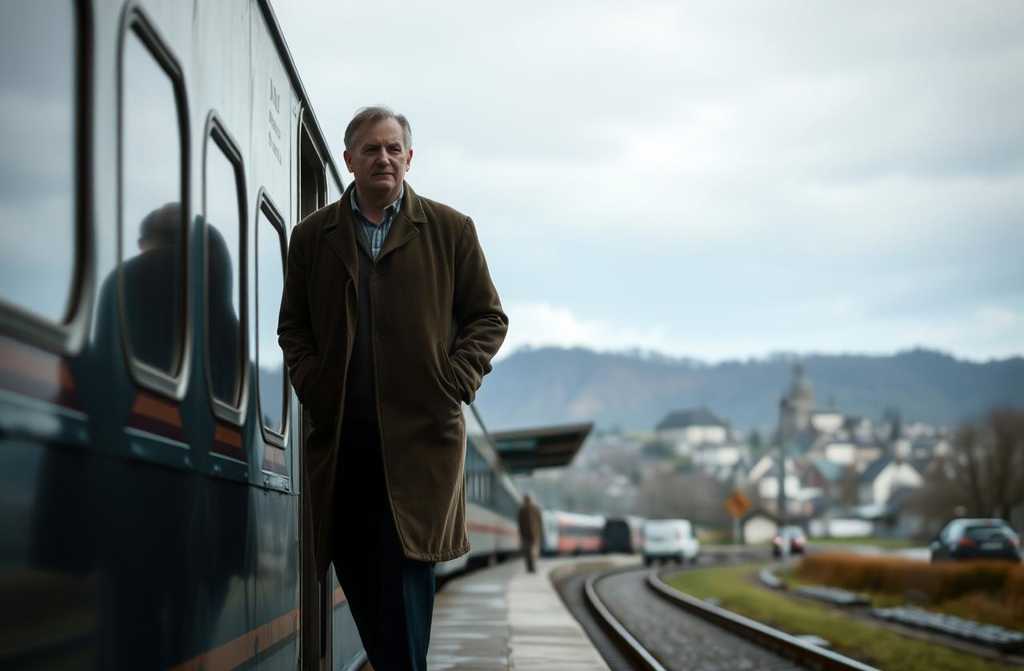
The Voice Beneath the Heart
When Oliver returned to his small hometown in the Yorkshire Dales after sixteen years away, he didn’t tell a soul. Not his mother, not his sister, not his old friend with whom he’d once shared cigarettes, hidden behind the radiator in the stairwell. No call, no message, no hint of his return. He simply bought a ticket, stepped off the train at the wind-battered station, and inhaled the cold air—smelling of coal dust, wet pavement, and distant childhood—before realizing: the time had come. Something clenched in his chest, as though someone inside whispered, *This is where you belong.*
He wasn’t heading home. His path led to the abandoned school on the outskirts, where shattered windows gaped like missing teeth and crumbling walls held echoes of the past. The building was half-ruined, but the right wing still stood—peeling plaster, broken glass, and familiar cracks in the walls where boys once hid their secrets. These walls remembered school bells, the stampede of footsteps, first confessions, and the fear that stole voices. In the old assembly hall, something waited for him—not tangible, but heavy, like a shadow soaked into bone.
Sixteen years ago, on a damp October afternoon, Oliver fell silent. At first, his answers grew shorter; his voice, quieter. Then *hello* and *goodbye* vanished. Finally, the day came when he walked into the house and made no sound at all. His mother called him for supper; his father grumbled about grades. He stared at the floor and said nothing. His parents dismissed it as teenage angst. Doctors called it psychosomatic. Therapists advised patience. But time stretched on, and words never returned. Only a tattoo—his first, painful as a bruise—spoke for him.
He was twenty when he left. He took any job—delivering parcels, scrubbing boilers, sleeping in damp basements and cheap bedsits. Towns blurred like pages in an unread book: unfamiliar streets, bitter winds, worn-out boots, and voices he ignored. Then, in the dim light of a backstreet tattoo parlour, he caught his reflection—exhausted but alive—and rasped to the artist, *”Here, under the ribs. Write: ‘I remember.’”* Those were his first words in five years—rough, nearly lifeless, but his own.
He got eight more tattoos. Each marked a silence, a scar, a truth left unspoken. For the fear of opening his mouth. For the night he couldn’t dial the number. For the name he never let slip. When people asked why he barely spoke, he’d say, *”The important things are under my skin.”* Then he’d smile, glancing away, as if he knew words could never hold everything.
Now he stood where it began. The old changing rooms smelled of damp and rust. Lockers creaked complaints of neglect. Glass shards littered the floor; the air hung thick with wet concrete and old grudges. Oliver walked the corridor and stopped at a door. Year Eleven. The last year. Here, on that day, his English teacher peered over her glasses and said, *”Oliver, why so quiet? Nothing to say?”* And from the back row, someone added, *”People like him don’t have anything worth saying.”*
The face of the speaker had faded like an old photograph, but the voice—sharp, mocking—had lodged in his mind like a splinter. It echoed for years, ringing in his ears, tightening his throat, forbidding speech. What was the point if every word became ammunition? If everything he said turned against him? That voice whispered, prodded, choked him. And so Oliver stayed silent.
Now the classroom was empty. Silence hummed like a taut wire. Dust, crumbling plaster, a chalkboard streaked with broken bits of chalk. He picked up a piece, drew a single, steady line. No words. Just to hear it scrape the board, proving he was alive. Then, with his fingertip, he wrote in the dust: *I’m here.* It was more than words—a mark, a confession finally set free.
When he stepped outside, the silence had shifted. It no longer pressed down. The building itself seemed to listen, breathing through its cracks. The air was cold but not cruel, as though it welcomed him back. Oliver pulled an old photo from his pocket: him, his sister, his father, his mother. He was seven. Everyone smiled. He held a paper aeroplane they’d launched in the field behind their house. Back then, life was simple—before words became traps.
He hadn’t returned for revenge. Not for answers. Not for a truth he’d never find. He came to silence that voice. To hear his own. Now it rang clearer. Not loud, but there. And for now, that was enough.
That evening, he pushed open his mother’s door. She gasped—older, stooped, her face lined with wrinkles, but her eyes still bright with life. He stepped forward and hugged her, feeling her shoulders—thin as twigs—and her hands, warm and unchanged.
*”Mum,”* he said softly.
She stilled. Her fingers trembled against his back. Oliver heard her exhale—long and shaky, as though she’d been holding that breath for sixteen years.
It was one word. The first. But behind it stood thousands more, waiting their turn. They no longer hid under his skin or dissolved in ink. They could come out now—as they should have all along: in a voice.
Now he could speak. Because in that quiet, at last, there was room for his sound.





