
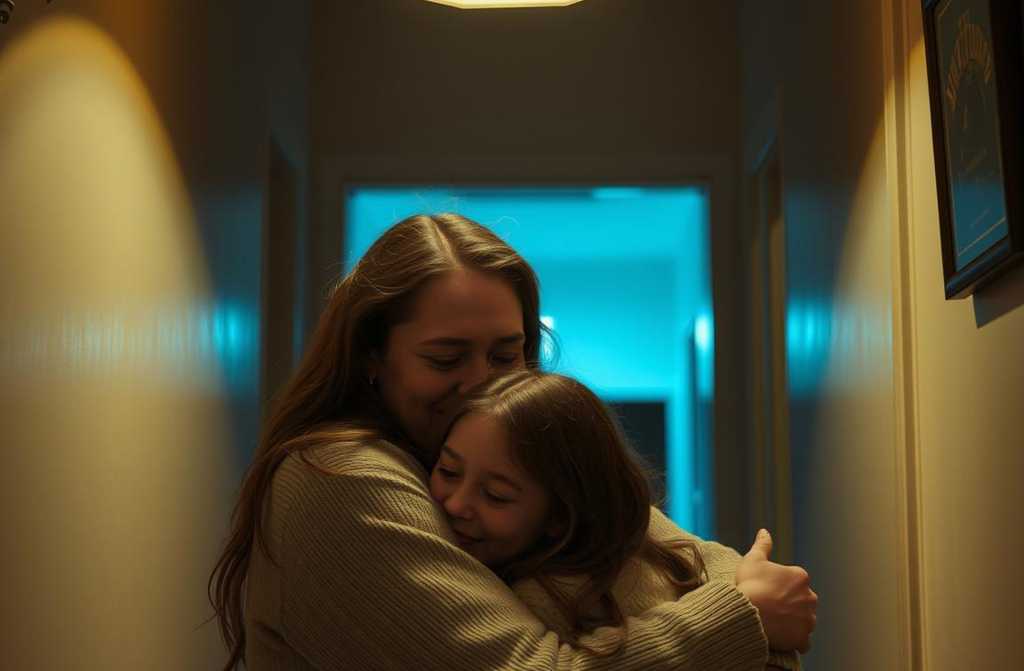
My daughter always gets home at 1 a.m. from school—her shadow never follows
You only notice the odd things when you stare too long… or when something refuses to look back at you. In my case it all began with a thing I didn’t see.
A shadow.
My daughter’s shadow.
It wasn’t there.
And it hasn’t come back since.
Her name is Emily. She’s twelve, loves mangoes, maths and practising TikTok dances in front of the cracked bathroom mirror. For the first twelve years of her life Emily was pure sunshine on legs—messy braids, grubby socks, constantly humming a tune that was always a half‑step off key.
Until three weeks ago.
That’s when she started drifting back home at 1 a.m.
The first night I nearly fainted when the front door creaked open that late. I had fallen asleep on the sofa, waiting for her after her extra‑curricular lessons. She was supposed to be home by half past six in the evening. When the clock struck ten I called the school, her friends, her private tutor—no one had seen her.
And then, at 1 a.m., she slipped in through the door.
Calm. Way too calm.
I sprang up.
“Emily! Where have you been? I was—”
She raised a hand slowly and said, “Don’t worry, Mum, I’m fine.”
That was it. No tears. No apologies. No fear. She marched straight to her room and locked the door.
I stared at the floor for a long while. Something felt… off. The air she brought in was as cold as a freezer. The hallway lights flickered once and steadied. I told myself I was overthinking it. Teenagers can be weird, right?
The next night, the same thing. She didn’t appear until 1 a.m., and she entered as if she lived in the wrong time zone, offering the same flat answer in the same tone.
But this time I noticed something. She passed the dining‑room wall lamp… and her shadow didn’t.
It simply wasn’t there. No outline. No shape. Nothing.
I thought I was hallucinating. I switched on every light in the house and made her stand under them. Still nothing. The light lit her face, but the floor behind her stayed empty. She realised I was watching.
“What’s up, Mum?” she asked.
I blinked. “Nothing. Just tired.”
She nodded and walked off. I watched her go one more time. Her body moved… but no shadow trailed her.
The next day I called the school to ask why they were letting her out so late every night. The woman on the other end hesitated, then said, “Madam, your daughter hasn’t attended school since the last mid‑term exam… over three weeks ago. We’ve sent several notices, but you never replied.”
My heart stopped.
“She’s been leaving every morning,” I whispered. “She puts on her uniform. She even takes her water bottle with her.”
I checked the fridge after the call. Her water bottle was still there, untouched, exactly as it‑was on the day of that exam.
That night I didn’t sleep. I turned off every lamp, perched by the sitting‑room window and waited.
At exactly 1 a.m. the front gate swung open on its own.
And she walked in.
Emily. But not Emily.
From the outside she looked the same, but her eyes didn’t flutter like before. Her breathing had a strange rhythm. She stared at me and tilted her head.
“Why are you up, Mum?” she asked.
I faked a smile. “Waiting for you.”
Then I blurted something I hadn’t meant to say, “Where’s your shadow?”
She smiled, but not with her mouth—something colder.
“It stayed behind.”
She slipped past me. When she passed the wall mirror, something did appear for a heartbeat.
A figure taller than her, eyes way too big, a grin too thin.
I turned my face away, heart thudding, hands shaking.
Now she’s in her room. Sleeping in her bed. Breathing. Silent. Calm.
But her shadow… her real shadow?
I think it’s still out there, waiting for a chance to get in.
Episode 2: The Thing That Crawls Beneath the Door
Since the “Emily” who returned, the house never feels right again.
During the day everything seems normal. Emily gets up, sits down for breakfast, but never actually eats—she just stirs the cereal. She pretends to flip through her notebooks. Sometimes she sings low‑key songs I’ve never heard before; the lyrics are in a language that doesn’t exist.
And in the afternoons she simply disappears.
She never says where she’s going. She never asks permission to leave. The front door opens and shuts itself at precisely 6:45 p.m., not a second early or late. And I sit there, waiting, in the dark, alone, with a question that grows more insistent each night: is that thing really my daughter?
I’ve started noticing tiny oddities. The walls, for instance, seem to breathe—at least when Emily is home. The ceiling cracks widen ever so slightly, as if they’re stretching with her presence. Even the houseplants I’ve tended for years wilt only in her room, as though something invisible is touching them nightly.
One early morning I got up thirsty and passed her bedroom door, which was ajar. Inside, she wasn’t sleeping. She was perched on the edge of the bed, back turned‑away, humming that unearthly tune, brushing the hair of a doll without eyes.
Behind her, on the wall, I saw a shadow—but not hers.
It was taller, thinner, moving before she did, as if it were leading her.
I bolted back to my room, shut the door, propped a chair against it and prayed. The truth is, even God doesn’t answer when evil walks in on its own accord.
The next day I did something desperate.
I grabbed the most recent photo of Emily and compared it to one taken a month earlier. The eyes were the giveaway. Before, her irises were light brown; now they were a murky green‑grey, like stagnant pond water.
Her pupils weren’t round either. They were vertical—cat‑like, or snake‑like.
That night I spread flour across the hallway floor—a simple trap.
At 1 a.m. I heard the door open, soft footsteps, then a pause. I pretended to sleep, keeping one eye cracked open.
Emily stood in the doorway of my bedroom. She said nothing, didn’t move.
Then I saw something shift beneath her feet.
The flour bore no human footprints—just fine, dragged marks, as if something with long‑tailed claws had skated across the floor. The final clue: a long, curved line, like a tail, trailing behind her.
This morning I found a note under my pillow. It wasn’t handwritten; the words seemed burnt into the paper.
It read: “Mum, I’m trapped. This isn’t me. Don’t let her in tomorrow.”
Now I’m terrified.
It’s 12:59 a.m., and the front gate is already starting to swing open on its own.
Episode 3: The Voice Behind the Door
1 a.m. The clock clicked its familiar tick. Then the front door swung open by itself.
I was in the sitting‑room, the note still in my hand, my heart knocking like a jackhammer trying to escape.
I didn’t go to answer. This time I hid behind the curtain, phone on silent, lights off.
I heard footsteps. One, two, three. Not the light tread of a teenager but heavier, as if something was carrying a weight—or simply not fully human.
Then a voice.
“Mum… I’m here.”
It wasn’t quite her voice. Too deep, with a strange echo, as if two mouths were speaking at once. One tried to sound‑alike Emily, the other dragged syllables like claws over glass.
“Mum… are you awake?”
The door knob turned. I held my breath.
No one entered—not yet. The figure pressed its forehead against the door and began to weep.
But the tears weren’t wet. They were dry, cracked, as if something inside the body was shattering.
“Mum… I’m cold. Let me in…”
I wanted to open it. I wanted to rush to her. It sounded like my daughter, at least partly.
Then the note flashed in my mind: “This isn’t me. Don’t let her in tomorrow.” The thing inside the house wasn’t her. The real Emily was outside, and what was inside… was something else.
At 3:33 a.m. the footsteps receded. The front door clicked shut. Silence fell, and finally I could breathe again.
At dawn I went to Emily’s room.
It was empty—well, not entirely.
On her bed sat a box, wrapped in black cloth, tied with a human‑hair ribbon.
Inside was a doll—a perfect replica of me.
On the back of its head, a knife‑scratched message:
“You’ll be next.”
Episode 4: The Mirror That Refuses to Reflect
The next day was surreal.
Emily didn’t go back to school. She didn’t answer her friends. Her phone stayed dead. The doll on her bed remained, eyes wide, my face frozen in terror on cloth.
I tried to burn it. It wouldn’t catch fire; it only smelled of charred meat.
At 12:55 a.m. I did something foolish.
I propped a mirror in front of the front door.
It wasn’t superstition. It was desperation. If the nightly visitor wasn’t Emily, I wanted proof.
1 a.m. The lock turned.
I sat in the dark hallway, breath held.
The door opened slowly. A figure slipped in.
Emily, in her blue jacket, school bag slung over a shoulder, hair tied back, skin pale.
“Hello, Mum,” she said, as usual.
She didn’t look at me. She stared at the mirror.
And the mirror showed nothing.
“What’s that?” she asked, pointing at the glass with a chilling smile.
“Nothing, love,” I replied, voice cracked. “How was school?”
“Great,” she said. “We learned about photosynthesis today.”
I knew that lesson had been taught two weeks earlier.
Emily (or whatever she was) passed the mirror without casting a shadow, without an image, without any presence at all. Only a cold draft brushed my feet.
I slept with the front door bolted, the doll sealed in a bag and buried in the back garden.
At 3 a.m. I heard giggling—not from the hallway but from my wardrobe.
I opened it slowly. The doll sat there, a new smile on its face, holding a lock of my hair between its tiny fingers.
The next day I took the doll to a church. The priest wouldn’t even touch it. He muttered a single word: “Parasite.”
He whispered a bit of lore: there are entities that imitate, that watch, learn and then infiltrate. Sometimes they need an invitation; other times, just belief is enough.
I asked, “Where is my daughter?”
He looked at me with pity. “If her shadow doesn’t follow her… she may no longer be of this world.”
That night I set up hidden night‑vision cameras, hoping for evidence.
What they captured made my skin crawl.
My daughter entered the house—not through the front door but falling from the roof like a broken puppet. She rose with jerky, dislocated movements, and as she shuffled down the hallway, something slithered behind her—no shape, no face, just invisible claws scraping the walls.
She glanced at the camera and said, “Mum… stop watching.”
The screen went black.
Episode 5: The Place She Goes When She Leaves
After watching that footage I couldn’t sleep. I smashed the cameras, threw the doll into the river, prayed with every breath left in me. Nothing helped.
Emily kept slipping home at 1 a.m., each night colder, more perfect, more empty.
One morning I rifled through her backpack while she slept.
No books. Just damp, black earth—like fresh grave soil.
And a folded piece of paper, creased into a tiny square, that read:
“She’s at school. I’m the one who returns. Don’t ask any more.”
I called the school.
“Has Emily been attending?” I asked, trying to keep the tremor out of my voice.
A pause. “Madam… your daughter hasn’t been in class for a month.”
“What? We’ve been sending you letters!” I sputtered.
“We thought you’d withdrawn her. We never got a reply,” the woman said.
I hadn’t received any because someone else was answering my calls, using my voice, living my routine, sleeping in my bed.
That night I waited for “Emily” again, hiding behind the hallway curtain.
1 a.m. Silence. Then a soft thump on the roof, the sound of a body dropping like soulless meat.
She rose, walked straight to my bedroom, and I followed.
From the ajar door I saw something impossible: the figure knelt before the wardrobe, whispering in a language that sounded like reversed moans. The wardrobe swung open on its own, and another girl emerged.
She looked like Emily—dirty, pale, lips sewn shut with black thread, trembling, mute.
The imposter hugged her and whispered, “Almost ready.”
Both turned toward the door, toward me.
“Mum,” they said in unison, “your turn now.”
I ran. I don’t remember the stairs, only that I was outside, barefoot, shouting into a dead street. No lights flickered on, no neighbours stirred. It was as if the whole suburb had been lulled into a forced nap.
The next day I called the police. The house was empty. The wardrobe was gone. No cameras, no soil, no doll—nothing but a fresh carving on my bedroom wall: “She’s not your daughter.”
I didn’t give up. I demanded the school’s CCTV footage. There, I saw Emily—the real one—trapped in a room that didn’t exist in the building: no windows, no exit, just a desk, a chair, and a mirror. In the mirror I was smiling at her, but it wasn’t me.
Now I understand. My daughter is stuck somewhere between our world and another. The thing that lives with me—walks like her, talks like her, calls me “Mum”—won’t give her back unless I pull her out.
Episode 6: The Name I Must Not Speak
I scoured old archives, dusty forums, even closed‑door churches. In a hidden corner of the internet—a place no one should ever visit—I found a single word.
A name that, according to the lore, could summon what hides behind mirrors. The warning was clear:
“Say it once, she sees you. Twice, she hears you. Thrice, she’s yours.”
I scribbled it on a scrap, burned it instantly, but the letters seemed to breathe, lingering in my mind.
That night “Emily” made me breakfast—fluffy pancakes, flawless, the kind that look too perfect to eat.
“Did you like them, Mum?” she asked.
“Yes, love…” I replied, feeling her dark eyes lock onto mine, knowing she knew I knew.
I slipped down to the cellar, behind the boiler, and uncovered the old mirror we’d tossed out weeks ago. It was draped in a black sheet, trembling as I pulled the cloth away.
The reflection showed nothing—no room, no me. But there she was: the real Emily, pounding on the other side, screaming something I couldn’t hear.
I whispered the name once. Nothing.
A second time. The glass shivered.
I stopped before the third, wondering if I would be trapped forever. Then I thought of the notebook Emily kept, her sketches, her laughter, the terror in her eyes when I last saw her.
So I said it—three times.
Everything went dark.
I opened my eyes to a damp, stone hallway. At the far end was an empty classroom.
There she was, chained to a chair.
I threw my arms around her.
“Mom! I’m here!” she sobbed.
“Don’t… don’t say the name again,” I whispered.
She didn’t answer; her voice was gone.
Behind her‑eyes, the mirror began to bleed. From the crimson ooze a faceless woman emerged—the imitator, the one who stole my child.
We bolted down the corridor, the woman gliding behind us, soundless, her shadow stretching across the walls like a living stain.
“Don’t look back,” I urged. “Whatever happens, keep moving.”
We neared the exit—a portal to our world. Emily leapt.
Just as I was about to follow, a cold hand clamped my ankle.
“You said my name,” it hissed.
I jolted awake in my own bed. The kitchen smelled of pancakes. Emily stood at the stove, her shadow trailing her.
“Mum, are you alright?” she asked.
I nodded, but my voice felt hollow.
I went to the bathroom, stared into the mirror—nothing stared back.
Episode 7: Mum No Longer Lives Here
The house smelled of fresh pancakes, of normalcy. Yet I wasn’t myself anymore.
Emily looked at me with love, as if everything were fine, as if she didn’t remember the dark hallway, the faceless woman, the endless night.
“Feeling better, Mum?” she asked.
“Yes…” I lied. My voice sounded like it came from a second deep.
I tried to touch my face; my fingers passed through the reflected image of the mirror. My own shadow stood still, watching, unmoving.
That night I curled up beside Emily, holding her tight, but she shivered.
“Mum?” she whispered.
“Yes, love?”
“You’re not my mum.”
I walked away, hurt. Was I lying? Did she know something I hadn’t accepted?
I descended to the cellar, searching for the mirror. It was gone. In its place a note in handwriting that wasn’t mine:
“The body returns. The soul, not always.”
Below, scrawled inAnd as the sunrise painted the garden gold, I finally understood that some doors, once opened, are never meant to be closed again.





