
When he was just ten, he uttered a phrase that washed over the adults like a summer breezesweet, but passing. Grown-ups always seem to think: children say lovely things then quickly forget.
But Benjamin did not forget.
It all began in the third form of a modest school in York, when little Benjamin Foster sat beside a girl named Alice Greenwood. Their friendship seemed wholly ordinaryunless, of course, you paid close attention.
Alice had been born with Downs syndrome, and in school, that could sometimes mean others darted eyes away, left awkward silences, or simply didnt invite herto play, to join a team, or even share a lunch table.
I remember the first time, at seventy-two, I slipped on my red shoes and stepped beyond my doorway, as if Id done something scandalous, the way the neighbours looked. Yet my daughter only said a single word, and I realisedshe longed to turn me home again
Every dog in the home turned away from the silent gestures of the girl who could not hear. She had grown used to this: the world never responded to her language Until, at the twelfth kennel, a dog raised its paw in greeting.
Id only meant to visit my mother for two hours, to sign papers and catch my train, but there amongst her teacups, I found a green exercise book that made me feel shame deep in my chest
Weve bought our house, Mum. Now you can live alone, my daughter-in-law beamed, as though shed handed down a verdict. And I smiled in return, quietly, having waited for this moment twelve years
But Benjamin, he simply treated Alice as if she belongednot as a special case, but as a fellow pupil, his equal.
He included her in games, saved her a seat, and when she seemed troubled, coaxed her into fresh air with the ease of a true companion, never in the role of rescuer but as someone who simply knew: a walk and a giggle can mend a grey mood.
His care was quiet and unwavering, revealed in trifleswho waits for whom at the door, who takes whose hand in the corridor, and whose glance affirms, You matter.
Their teacher, Mrs. Tracey Spokes, watched this each day. She would later say Benjamin didnt merely befriend Alicehe looked out for her. Not from pity, but from an innate sense of what is right: if you are in a classroom, you belong within, not on its margins.
At school, Alice was affectionately known as Little Alice Sunshinenot in the cloying sense, but because as children sometimes understand better than adults, she radiated a brightness. Of course, its easier to shine when someone doesnt dim your light.
At the end of their fourth year, they were returning home from a school dance. Ordinary roads, a routine Did you enjoy it? And then, Benjamin posed a question to his mother:
Mum do children, like Alice, ever go to the leavers ball?
His mother replied gently, Of course they do.
Then, with the conviction of one striking a deal with fate, ten-year-old Benjamin said, Then I am going to take her.
A promise like that could have remained a childs sweet triflelost somewhere between textbooks and summer.
But, as life so often does, circumstances grew between them.
Alices family settled in another part of town. New schools followed; days filled with new pursuits. Benjamin grew, becoming a known leadershaking hands in corridors, the sort whom others followed.
Alice, too, got on with lifehelping her father with York Citys football team, nothing headline-making, just the business of growing up.
The friendship drifted, as they sometimes do. Yet, sometimes a vow, made in earnest youth, burns quietly insidea secret star. Years pass, but the words linger; they were spoken not for show, but from the heart.
One blustery autumn, the two schools happened to meet for a football match.
The stadium, the shouts and cheers, the edge of the pitch lined with people. And there, through the crush, Benjamin caught sight of Alice.
It wasnt some dramatic, music-swelling momentjust that sudden clarity when your mind says, There she is. Like a puzzle piece, carried for years, clicking into place.
He knew: it was time.
Not one day. Not soon. Now.
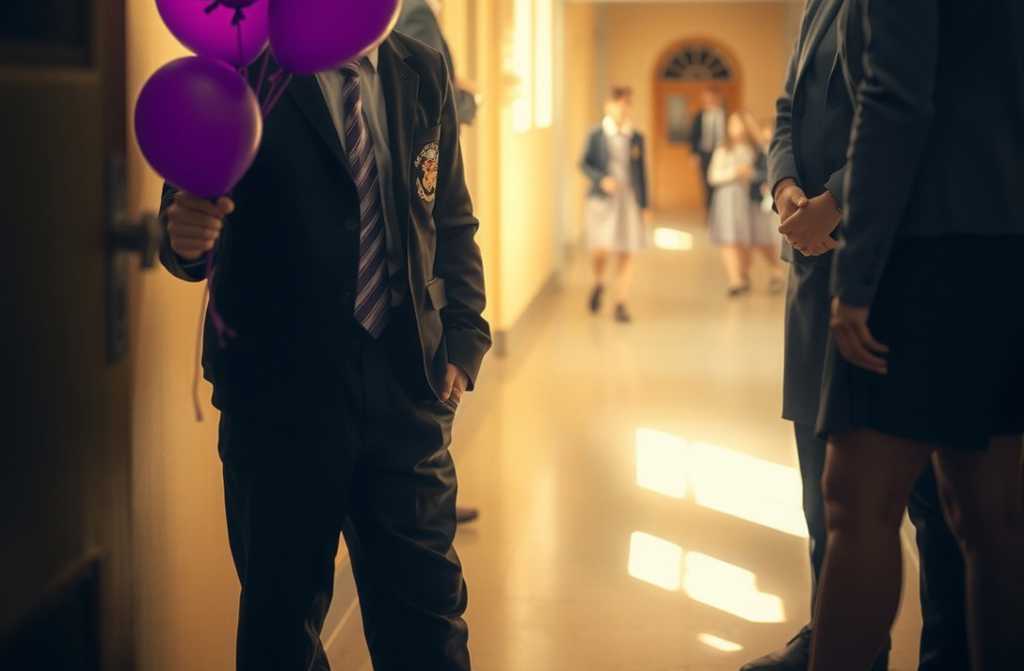
With his family, Benjamin purchased a cluster of purple balloons with PROM emblazoned across them. He approached Alice and invited her to the dance.
Imagine her face.
It was a face untouched by artifice. Joy lighted her features in an instantso pure, youd believe it could have brightened not only the stadium, but every shadow that had ever whispered, This isnt for you.
She was unsure at first. Of course, she might have already made plans. But this invitation wasnt about plans. It was a call from someone who had truly seen herback in those childhood days, and still saw her now.
She said yes.
And then came an evening that would be remembered not for the dress, but for that rare feeling: I was not invited out of kindnessI am here because I am important, because I belong.
Benjamin wore his suit and a lavender tie. Alice arrived in a matching lavender dressa detail done not by accident but with care. Their teacher came as well, for sometimes teachers remember not exam marks, but young hearts.
Benjamins mother wrote words that still bring a tear: she had never been so proud, for her son had become the sort of man who brings light to others lives, making them feel seen.
And Alices brother offered the simplest, truest observation: many would have left her behind. Not Benjamin. Hed always welcomed her to his side.
And so the tale whirled through the countrycarried by papers and radios, shared by thousands.
People asked Benjamin, How did you come up with this?
He responded with polite confusion, as though uncertain why it seemed a spectacle: Its nothing special
And this, I think, is the question to leave with you:
How is it that a simple kindness is hailed as extraordinary? Should it not simply be a part of ordinary English life?
It is tempting to fix on that enchanted evening. But what matters most is that it began not with a grand gesture in the sixth form, but in childhoods daily habitBenjamins refusal ever to see Alice as anything but her own person.
The invitation to the ball was simply the finishing touch. Before that, there were countless smaller choices: to save a seat, to join a game, to never leave her standing alone, to refuse the silent exclusion that others so often practised.
That is why the story lingers: it is a promise that grew up. A boy said at ten, I will take her, and held fast to those words, even as the world divided them.
And it is also Alices story. How much it means not to be a project of kindness, but a true part of celebration. Its not about well done, you made it, but How wonderful youre here.
A tiny promise, easily overlooked
So often adults do not hear the most important things children say.
Because children, they do not dramatise. They speak simply. Then they run off to play.
Ill take her to the dance.
At ten, it sounds charming, perhaps even a touch amusing. But sometimes words slip from our mouths as though, even then, we know just who we are to become.
Benjamin became just that fellow.
Alice as Little Sunshineand why its not just a label
Little Alice Sunshine was a lovely nickname, but such names can conceal a trap: adults love sweet stories, which substitute words for real change.
But Alice did not need a nameshe needed a place in the group.
Benjamin gave her that place everyday. Not for the camera or for applause, but in all the unnoticed momentsduring lessons, at breaktime, on the playing field.
He watched over hernot as someone fragile, but as someone important.
There is a world of difference between pitying and including.
Pity puts us below, inclusion beside.
School as a school for kindness
Inclusion is so often just policy, a word in a handbook.
But truly, it is seen in: who sits with you? Who says come along? Who keeps you close on the playground and remembers your name?
School is where children quickly grow sensitive to feeling on the outside.
If a child with Downs is always told, Youre off the pace, out of the conversation, off the team, in time, shell believe it is her naturenot circumstance, but fate.
Benjamin did another thing: he showed Alice (and everyone who watched) that her identity was not her condition. She was simply herselfa friend.
When life divides us, character is tested
Alices move could have been the ending. Childhood friends, after all, so often drift away.
But promises are not always bound to routine; they are bound to character.
When they found each other again at the football, Benjamin didnt hide or turn away for convenience.
He did the simplest thinghe walked over.
And in that simplicity lies the power.
For often, we do not do good out of malice, but out of awkwardness.
What will they think?
What if she misunderstands?
What if she doesnt want this?
Benjamin didnt hide behind such fears. He acted.
The invitation to the ball: why its more than a dance
The school leavers ball is a ritea marker: You are one of us.
For so many, it mattersnot for the music, but for belonging.
Children with Downs so often hover near life, but not within it. They are loved, perhaps cared for, but not always invited.
Thus Benjamins invitation was not merely a kindnessit was a declaration: You have as much right to this evening as anyone.
The PROM balloonstrivial, perhaps, but they said: I planned this, I thought of you. This isnt a whim. Its my decision.
Lavender tie and dress: a silent language of care
Their matching lavender, to some, might seem a sweet detail. But these gestures carry true respect: to ensure someone feels beautiful, welcome, a cherished guestnot a symbol.
Their teacher arrived for the early part of the nighta gesture in itself. For school is not solely about lessons, it is also about memory. Seeing a childs heart endure into adulthood, even teachers fall silent.
Benjamins mothers words anchor this taleshe saw her boy grow into a man with a great heart. No grand phrases, simply a mothers honest pride.
Alices brother said the only thing that needed saying: Many avoided her. Not Ben. He always chose her for his team.
Why the story went viraland why it is bittersweet
People share such tales for the hope in them, the faith they restore in their neighbours.
But it is tellingand a little sadthat simple kindness such as this still seems newsworthy. We have, as a country, so little ordinary decency.
Benjamin was right to say: Its nothing special.
Because it should be the normal way: not to cast someone aside, simply for being different.
Aftertaste: what we might learn from this story
Not all of us will become the next folk legend.
But each of us can do a small thing that may be, for another, the difference between a life on the outside and a life within the circle:
Pull up a chair;
Send an invitation;
Call someone by name;
Meet their eyes;
Be a friend, without conditions.
Perhaps then, one day, such stories will no longer be remarkable.
They will simply be life, in England, as it ought to be.





