
One of those days when nothing aches—but everything throbs.
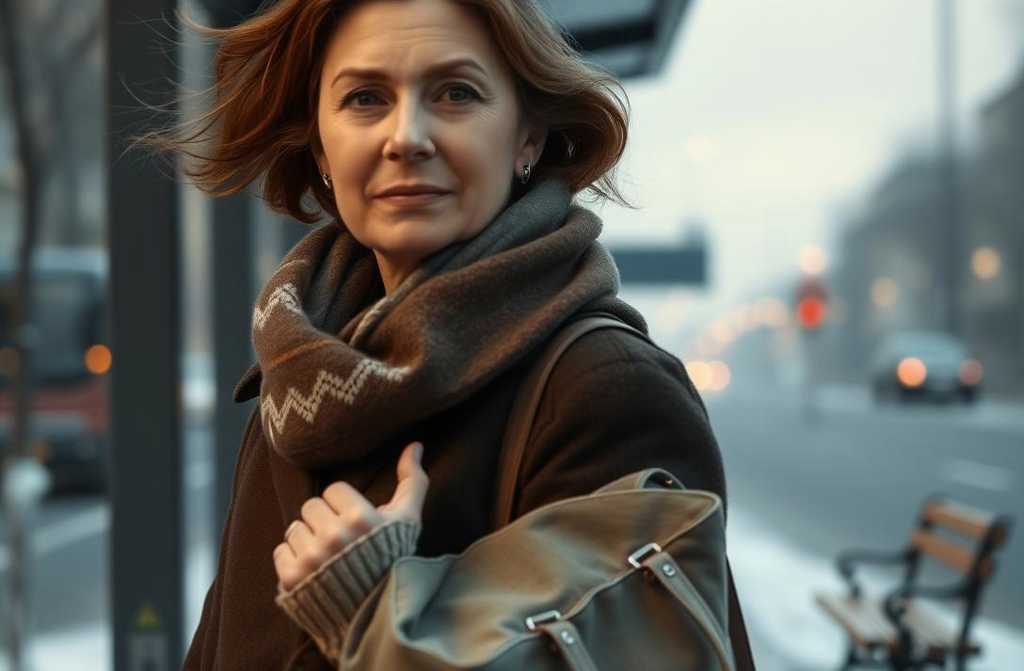
By the bus stop near the old market in Canterbury stood a woman. She shielded the flame of her cigarette from the blustery wind with one hand while clutching a worn canvas bag with the other. The bag sagged heavily at the bottom, as if weighed down not by its contents but by burdens too heavy to name. She stood at the very edge of the pavement, guarding that square of ground like the last stable thing in a world gone vague and unsteady.
Her name was Margaret. She was forty-eight. She looked younger—her face lean, cheekbones pronounced, her hair twisted into a careless bun. Her eyes were pale, ringed beneath with a faint blue shadow—not from sleeplessness but from the absence of things long missed: attention, warmth, something like wonder.
She wasn’t shattered or broken, only weary. Weary of days that blurred together, of the shrill alarm clock, of empty phrases like *”Fine”* and *”Same as usual”* that she used to mask the truth. Weary of evenings that died quietly, without so much as a question or a shoulder to lean on. Weary of waking each morning and piecing herself together just to get through another day.
She had risen at seven. The house creaked underfoot as her son, James, hurried off to college. He tossed a hasty *”Morning”* over his shoulder and left without so much as a glance toward the kitchen. She lay there a little longer, staring at the cracked ceiling, then dragged herself up.
At the mirror—just a face. No anger, no joy, not even irritation. Just a face. She drank her coffee standing at the counter, shrugged into her coat, snatched up her bag, and stepped outside. The day didn’t begin—it merely carried on from the last.
Today, she had errands in the city—collect paperwork, see the neurologist, and, if luck held, buy James a new jacket. The pavement was slick with rain. People rushed past her as she walked, clutching her bag like a shield. Along the way, she bought two pasties—ate one, wrapped the other in a napkin for the homeless man who usually sat by the underpass. Today, he wasn’t there. She left the pasty on the bench all the same. Just in case.
The doctor’s waiting room was full—four elderly women chattered about blood pressure, their gardens, and, of course, the absurdly cramped consulting room where *”that poor doctor must be suffocating.”* Margaret sat against the wall, scrolling through the news. Explosions, deaths, tragedies that belonged to strangers, glossy smiles that didn’t. Lives nothing like hers. She shut off her phone. Not because it was too much, but because none of it mattered.
The neurologist muttered something about *”autonomic dysfunction”* and *”the need for rest.”* She nodded like she was listening. But all she could think was: Where was the place—just a place—where she could lie down and stop thinking? Where she didn’t have to be strong, or smile, or hold herself together. Just vanish, if only for a day.
Outside, the cold bit deeper. The wind slipped beneath her collar. She bought a cup of coffee and drank it in small sips, as if it were the last warmth left in the world. She sat on a bench in the square, the bag pressed against her hip, her breath fogging in her scarf.
A man sat beside her. Mid-fifties, perhaps. Tired eyes, weary shoulders. Without looking at her, he said quietly:
*”Bitter out. Still don’t want to go home.”*
She wasn’t surprised. It was as if he’d spoken her thoughts aloud. They talked—about work, about food, about how life had twisted in ways neither expected. He was a night security guard at a supermarket; his wife had gone to stay with their daughter and likely wasn’t coming back. The letters she sent grew fewer. He didn’t open them anymore.
She worked at the post office. Lived with her mother, who more and more forgot names, dates, even her own reflection. At night, she wandered the house searching for her late husband, gone five years now. They spoke calmly, almost casually, as if discussing the weather instead of the quiet ache of living.
They sat in silence. Finished their coffee. The wind tugged at the hem of his coat. Then he stood, hesitating before he spoke:
*”Hope you don’t mind if I remember you?”*
*”No. Just don’t get me wrong.”*
He smiled then, just once.
*”I won’t. Just nice to know someone’s out here. Not in a phone. Not on the telly. Real.”*
He walked away without looking back. She watched until the wind swallowed him up.
That evening, James came home. She reheated dinner, asked about his day. He shrugged, thumbing through his phone. Then, abruptly, he glanced up:
*”How was yours?”*
The spoon stilled in her hand. Those four words kindled something inside her. She answered slowly:
*”Just a day. Like any other.”*
He nodded, but this time, he didn’t turn away. It wasn’t much. But in her world, where days repeated themselves like carbon copies—even that meant something.
Later, lying in the dark, she wondered: Maybe someone, somewhere, was thinking of that bench, that coffee, that silence where a stranger’s kindness had found space.
And for now, that was enough. Not a miracle. Just an anchor. Enough to rise again in the morning. And step out—into one of the days still to come.





