
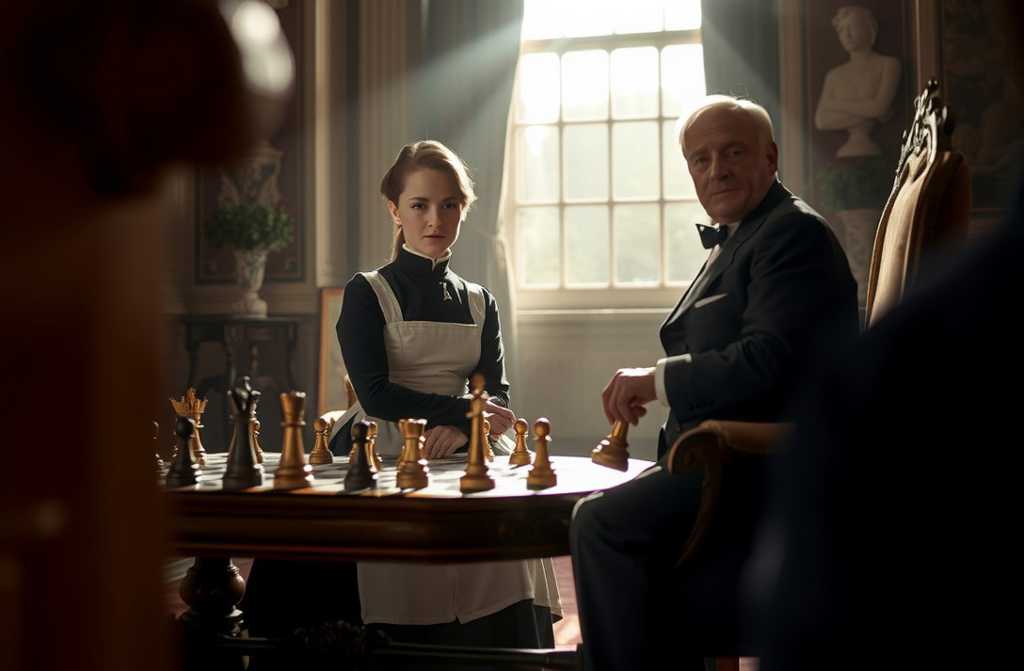
A wealthy Englishman challenged his maid to a game of chess, thinking it would amuse him to sneer at her, promising to give her a golden chessboard if she managed to win.
This happened in the grand drawing room of his stately home, with ceilings that seemed to reach the sky and glittering chandeliers casting reflections on every surface. Everyone saw me as nothing more than a maida background note to the grandeur, as silent and invisible as a painting or marble bust dusted weekly. No one ever wondered about my past.
One crisp afternoon, I was tidying the room when my attention was caught by a magnificent chess set upon the polished mahogany table. The board gleamed gold and silver, the pieces crafted with an astonishing delicacy that made them seem almost alive. Sunlight from the tall windows struck their curves just so, and for a moment, I was lost in thought.
My employer, Lord Henry Cunningham, descended the sweeping staircase, noticing the way my gaze lingered on the chessboard. I saw his lips curve with smug amusementa look Id grown used to.
Admiring my chess set? he asked, the irony in his upper-crust accent as clear as the bell in the church across the green.
Startled, I turned towards him. Yes, sir.
He raised a brow, barely hiding his own disbelief. Do you even know how to play chess?
Yes, sir, I replied, carefully folding my hands in front of me.
His eyes glinted with the anticipation of low entertainment. Splendid. Lets have a game. If you beat me, you can have the boardsolid gold, mind. Though I dare say you wont.
He laughed, easing himself into one of the Victorian chairs, confident this was all good sport. I sat across from him, composed, unruffled by the grandeur, or his condescension.
We started to play. At first, Lord Cunningham made his moves with absolute assurance, as if the outcome was written in his favour from the start. But soon he began to realise that every attack was met with a calm, precise response. Every brash attempt to seize the advantage was quietly, systematically turned aside.
I could tell, from the way his hand began to hover uncertainly above the board, that he was seeing something he had not expecteda mere maid capable of subtlety and tactical depth hed never imagined.
When I deliberately sacrificed my bishop, revealing a diagonal that would trap his queen, I saw his confidence waver. At first, he thought Id blundered; only after a few moves did he understand hed been drawn into a trap planned from the outset.
He looked up, his face red with embarrassment as he registered what had happened. The game lasted a little longer, but the balance had shifted. His attacks lost their bite, while each of my moves tightened my grip on the board.
Then, quietly and without a hint of triumph, I said, Checkmate, sir.
Lord Cunningham just stared at the chessboard, unable to speak, hardly believing his own eyes.
How is this possible? he asked at last, torn between astonishment and indignation. How did you beat me?
I met his gaze without pride, just honesty. Because you thought I was admiring the gold. I was watching the position.
He fell into silence.
My father taught me chess when I was a girl, I continued. He always said the game rewards patience and thought, not fortune or pride.
He seemed to let the sting of defeat settle, the flush of annoyance fading from his cheeks.
You were after a quick victory, I added, with all due respect. I was simply waiting for the right moment.
At last, his look changed. I was suddenly not just a servant in his eyes, but a worthy opponent, a woman with a mind to match his own. With unexpected humility, he slid the opulent chessboard across the table towards me.
Its yours. I gave my word.
But I shook my head. I dont want the chessboard.
He seemed at a loss. Then what do you want?
I looked him in the eye. A chance. To be recognised for my mind, not just my place.
And in that moment, I could see he realised the lesson was worth more than all the gold in the house.





