
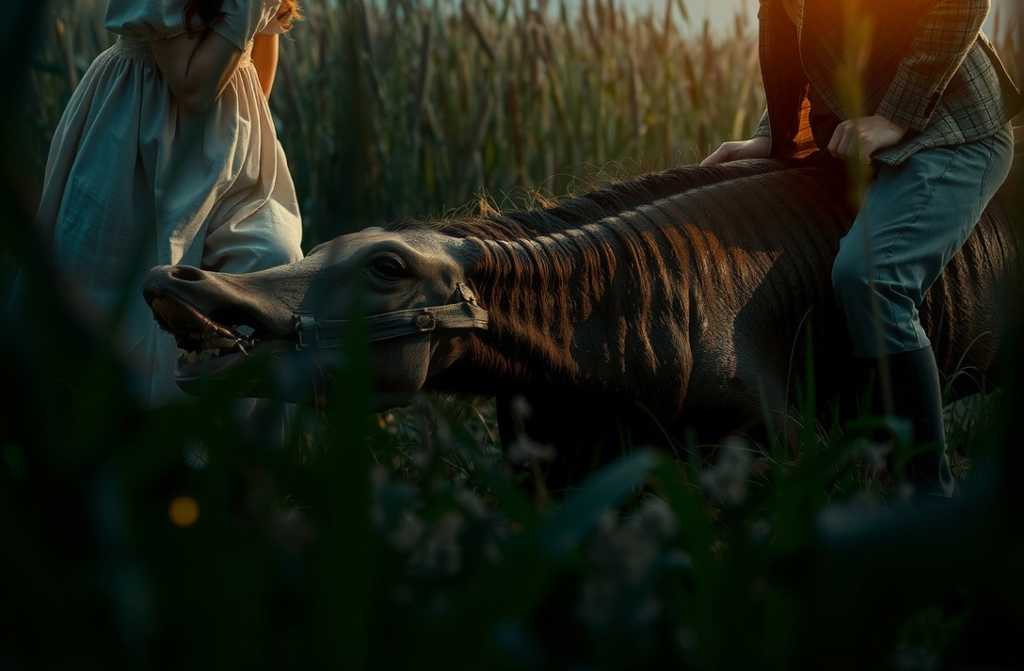
Many years ago, a pair of sweethearts wandered together across a wild English meadow, where grass grew tall and thick. Their hands were clasped, and soft, knowing smiles passed between themthose secret glances that only two people truly caught up in affection can share. Perhaps too caught up in each other, for neither noticed the world around them until, quite suddenly, they stumbled across something most unusual.
Charlotte, startled, let out a gasp and hastened a step backward. Thomas, quick with concern, stepped in front as if to shield her, even though no real danger presented itself.
At their feet, half-concealed amid the grass, lay a horse.
Or rather, what could only barely be called a horse. The poor creature more closely resembled a skeleton, its hide pulled taut over protruding ribs, dry and thin, as though a sharp gust might tear the skin altogether. Flies buzzed relentlessly over scabbed patches on its body, their droning oppressive in the still air.
The sight of the animal was so pitiful it made Charlotte shudder with revulsion and sorrow.
Oh, you poor thing! she cried.
At her voice, all the sounds of the riverside meadow seemed to freeze, and silence hung over them for a moment.
Then the horses flank trembled, the faintest of movements, but enough to set their hearts pounding in terror.
A single moment passed before both Charlotte and Thomas found their voices to shout together, the sound breaking the hush with pure fright.
Without another glance, they turned and dashed away, not stopping until they reached the dirt lane that ran just beyond the field. There, out of breath and wide-eyed, they found their composure.
No creature gave chase. As the panic waned, sensibility returned and questions surfaced.
It was alive Charlotte whispered in disbelief.
Alive, but barely, Thomas replied, his voice heavy with concern. But it moved.
They pondered whether the animal had truly stirred, or if some dreadful scavenger lurked within, worrying at the remains.
The idea sent a shiver down Charlottes spine. She sent Thomas back to investigate, unwilling herself to look upon such suffering again.
Thomas crept back into the meadow. Soon enough, he saw there were no other creatures nearbyonly the same emaciated horse. Drawing closer, he saw it was indeed alive. The horse turned weakly towards him and snorted, a feeble noise.
It was nearly unable to move, sides barely lifting with each shallow breath. Its eyelids fluttered, as if trying to see him, though a reddish veil seemed to cloud its vision. The lower lip drooped, mouth unable to shut properly, legs and tail still as stone. Only the ears twitched now and then in the breeze, or so it seemed.
Sheer exhaustion held it captive. It clung meekly to the last fragile thread of life, and Thomas could not guess how it came to be here. The grass might have grown tall around it, untouched for so long.
He returned to Charlotte and told her all hed seen. She fretted. It doesnt matter how it ended up herewhat are we to do? It looks on deaths door. I dont even know a soul nearby who understands horses.
Thomas remembered that a farm in the next village over kept horses, sometimes hiring them out for country rides.
They managed to get word to the owners, who, after some confusion, promised to come as soon as possible.
It wasnt long before the distant rumble of wheels heralded their arrival. A sturdy car and horse trailer rolled up the lane, raising clouds of dust.
Thomas and Charlotte waved them down. The couple from the farm, a Mr. and Mrs. Harrington, looked puzzled until they saw the horse up close. Their faces fell, aghast at its plight.
There was no question of the animal rising by itselfit would need carrying, if it were to reach the veterinary clinic at all.
Even with four people, moving such a creature was impossible, for despite its wasting, a horse remains no light burden. Thomas rushed home to gather neighbours and friends.
Soon, a group of men gathered around, gently lifting the broken form onto a canvas, and, together, bearing it into the trailer with a kind of solemnity.
The poor horse opened its eyes wide with fright and twitched a hoof, but that was all the strength left in it.
No one watching could hold back tears, seeing such total helplessness.
At last, the horse was snug inside the trailer, the tall door shut. The wheels rolled gently away, taking it, perhaps, to new hope.
At the stables, helpers and the local vet awaited, already summoned on the journey over.
The horse was carefully eased from the trailer, and the veta dedicated, no-nonsense woman called Dr. Barnesbegan her examination at once: checking, feeling, drawing blood.
The local constable, too, was on hand, taking statements about cruelty and recording the evidence. Yet he warned them that it was unlikely the original owner would ever be found, and justice, even slimmer.
Dr. Barnes administered injections, treated the crusted wounds, attached a drip, and together the assembled neighbours and helpers moved the exhausted horse to a quiet, empty stall.
The animals condition was so dire that Dr. Barnes doubted it could be saved, but all agreed to try. The most pressing problem was that the horse could barely eat or drink.
It soon emerged that a severe skin infection was to blamemites had left the skin inflamed, bubbles forming and bursting to leave thick scabs. The itching was torment, and the horse had rubbed raw its battered frame, losing its appetite and slowly withering away.
And there were other hardships still. Whatever sight the creature once had was clouded now by a swollen, red third eyelidlikely a tumour, which only surgery, and only when the horse gained strength, could address.
Its teeth, too, were in a dreadful state, and urgent intervention was needed.
For weeks, the stable became a field hospital. Dr. Barnes attended her patient every day without fail. Gradually, the parasites were banished, the scabs softened and disappeared, and her teeth were tended. Slowly, at first only with assistance, the animal began to eat again.
At first, the horse had to be fed from a bottle like a foal, vitamin drips trickling life into it. After a time, it nibbled food on its own, the carers lifting her head to make it easier.
She seemed to understand nothing at firsther world shrunk to a small, dark corner. She lay still, as though resigned to her ending. Yet with gentle voices beside her, she began to recognise her rescuers. She nuzzled hands for comfort, responding with little tremors when Dr. Barnes grumbled over her case notes.
Her sight was all but gone, so she learned by touch and sound. Each day her strength grew a little, and soon she could turn herself, sometimes trying to lift her body upright for a while.
But standingstanding was beyond her power. Shed attempt to curl her legs and rise, but they would not support her.
Dr. Barnes explained that after such lengthy starvation, the muscles had wasted away: walking would need time and patience.
Her owners devised a special sling out of blankets and leather straps, allowing them to support her in the stall. Outdoor exercise was out of the question without help.
Luckily, the story of the suffering horse had spread through the village, moving many neighbours and friends, who came each evening to help.
At first, the horses legs needed arranging by hand, but with regular practice, she began to move them herself, clumsily at first, but progress nonetheless.
It was exhausting for herand everyonebut nobody was willing to give up.
Weeks passed in that routine, and, in time, the horse was able to stand confidently, then began to move about, albeit slowly and gently.
No one hurried her. The farmer, Mr. Harrington, took her for little walks just beyond the door, letting her rest often. She relished the scent of fresh meadow air and seemed to yearn for freedom.
At last, Dr. Barnes pronounced her strong enough for eye surgery. The growth was removed, and for the first time since her rescue, the horse could see clearly. It gazed upon its carers and surroundings, finally taking in its world with sharp eyes.
Eyedrops became another part of the daily care, which she patiently endured. She grew into a calm and astute companion; the Harringtons were delighted with their new family member.
Eventually, she joined the other horses in the field, quickly making friends. She soothed the temper of the young gelding and peacefully grazed alongside the old mare.
Months drifted by, the seasons changing, and the horse was transformed. Gone was the skin-and-bone wretch they had found; her flanks grew round, her coat gleamed, though some scars lingered to tell the tale.
Mr. Harrington was in no hurry to ride her, but one bright morning, the horse stamped her hoof and gazed longingly at the saddle as the others went out.
At last, he yielded. With care, he saddled her, and she gave a joyful whinny. Though Mr. Harringtons weight was a challenge, she did not falter.
Together, they rode out beneath the English sun, circling the field, the past behind and hope ahead.
After all the pain, fear, and hardship, she now had loving people who would never abandon her. And the horse seemed to know, at long last, that true safety had finally reached her.





