
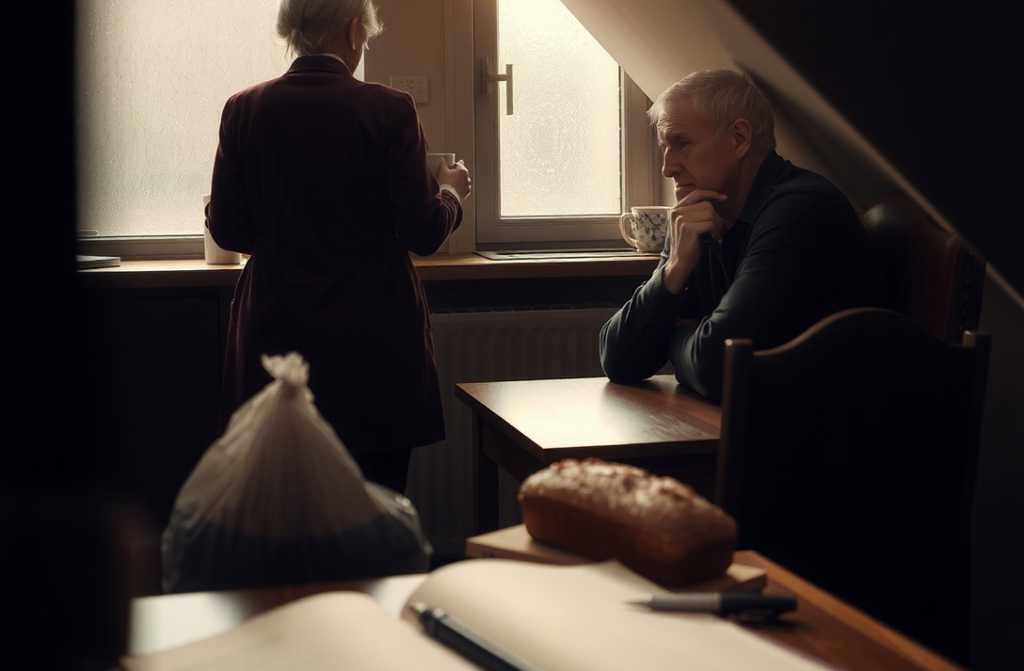
– Did you buy bread?
He looked at me as if Id asked the question in a foreign language. Not with confusion, exactlyjust a silence. Long, awkward, a gap too wide for our usual life together.
– What sort of bread? he said, eventually. Not asked, just said. Without a trace of question in his voice.
– The usual. Brown, from the Oak Tree bakery. You always get it there.
He set his bag down, glanced around the kitchen as if hed stepped inside for the first time.
– I didnt stop by the shop.
I nodded and turned back to the hob. Nothing special, I told myself. He was tired. Been away all weeka conference in Birmingham, hotel room, different food, different air. Hes tired, of course.
But he always brought bread. Seventeen yearsevery time he returned from anywhere, even just a quick trip, he stopped by the Oak Tree on High Street and brought home brown bread. It wasnt an arrangement, not a practical habit. It was just who he was. How he returned.
I stirred the soup and said nothing.
His name is Malcolm. Malc. Im fifty-eight, hes sixty-one. We live in Norwich, a modest two-bedroom flat on the fourth floor, bought back in 99, when our Sarah was little. Sarahs grown now, living in London, calls every Sunday. I work at the school library, Malcs been retired three years but took on a part-time gig, teaching building regulations at the local college. Lifes quiet, steady, almost never any rows. Thats important to know. Nothing explained what happened after he came back.
We ate dinner in silence. He ate neatly, eyes on the table. I expected him to look up and mention the triphis colleagues, the ancient hotel lift that never worked, how he missed a decent home-cooked stew. Always, thered be a story the first evening home.
– How was Birmingham? I asked.
– Fine.
– Was the seminar good?
– Yes.
I laid down my spoon.
– Malc, are you all right?
He looked at me. The same grey eyes, just a bit tired.
– Im fine. Just tired.
I cleared up. He went to the living room, lay on the sofa with his phone, as if everything were the same. As if nothing happened. Except for the bread. The missing chat. Something missing, I had no name for.
I put the first night down to tiredness. The second as well.
On the third dayFridayI noticed something genuinely odd.
I was drinking coffee at the window, watching the square. He came from the bathroom into the kitchen, poured a glass of water. Then he picked a jar of lentils off the shelf, opened it, sniffed, put it back. I said nothing. But Malc never eats lentils. Hasnt ever. When we first met, he laughed and told me lentils were the dullest thing on earth. For people without imagination, he used to say. I made him rice, barley, anything else, but he never touched lentils.
But now, he sniffed at them. As if considering.
– Fancying lentils now? I asked, trying to keep it light.
– No, he said, and walked out.
I looked at the jar for ages.
On Saturday, Sarah called.
– Dads back? she asked straightaway.
– He is. Returned Wednesday.
– How is he?
I hesitated just a second.
– Tired from the trip. Hes fine.
– All right. Mum, Ill come in October, ok? Sasha and I have leave.
– Of course. Cant wait.
I didnt tell her. What would I say? That Dad forgot the bread and sniffed lentils? Didnt sound like anything, really.
But I knew something was wrong. Not in my head or logic, but in my gutsomething deeper knew.
Sunday, I suggested a walk. Sometimes on Sundays wed go to Cathedral Gardens. He liked the bench by the pond, bought us both ginger beer at the stand if it was open, complained about his back, Id tell him to exercise, hed wave me off, wed laugha small ritual among many.
– Shall we go to the gardens? I asked.
He looked up from his phone.
– Which gardens?
– Cathedral Gardens. Weathers nice.
He considered ita bit odd, as hed usually say sure or just let me get my jacket. Nothing to consider, really.
– All right, he said at last.
We walked in silence. I didnt push talk, just watched. He glanced aroundnot with his usual relaxed Sunday mood, more like someone trying to remember which way to go.
By the gates, an old man stood with a doga ginger, tubby spaniel.
– Look, Biscuit, I said. Years ago, our neighbour Mrs. Watson had one just like him, named Biscuit. We used to call every chubby spaniel Biscuit after that. Our private joke.
He looked at the dog. No reaction.
– Biscuit, I said, quieter.
– Good dog, he replied. Polite. Neutral.
Later, by the rose bushes, I watched him. My heart was beating faster than it should on a calm walk.
He didnt remember Biscuit. Or pretended not to. But to what end?
At the pond, the drinks stand was goneprobably closed after summer. Malc sat on the bench, looked out at the water.
– Its nice here, he said.
– We come here often.
– Do we?
I turned.
– Malc. Weve come here for ten years or more.
He nodded. Calmly, without embarrassment.
– Yes. I just meant its nice.
Something inside me tightened and didnt let go. I didnt realise why until later that night, half-listening to his breathing beside me. Hed said yes with the tone you use to agree with a fact youve just been told, not remembered.
I lay awake for hours thinking what you call it, when someones here but something essential is gone. Theres a term in psychology, I read oncesometimes people change after stress, after trauma. It can feel as if theyve been swapped for someone else. Theres a word, medical, but I couldnt recall it. But thered been no event, as far as I knew. Just a seminar in Birmingham. Not much to explain turning into someone else.
I got up at three. Had some water, stood by the window. The square outside was empty. The lamp flickered. I stared and thought: Fine. Ill wait. Maybe hes just hiding something. Had a disagreement, got unwell, or just the blues. Happens to anyone, especially after sixty, after lifes taken a lot already, and you dont know whats left.
I went back to bed. He slept facing the wall. I put my hand lightly on his back as I always did, and he didnt move.
Monday morning I rang my friend Jean. Weve been friends since uni, she lives on the other side of Norwich, works at the surgery on reception. Jean is straight-talking, no frills, and I like that.
– Jean, could I pop round?
– Something happened?
– Not sure. Maybe nothing. I just want to talk.
– Come at five. Ill be home.
Jeans flat always smells of pies, even if shes baked nothing at all. We sat in the kitchen, drank tea. I told herabout the bread, lentils, Biscuit, the yes by the pond.
Jean listened, didnt interrupt. Then paused.
– Tessa, this could just be depression. Or his memory starting to slip a bit. Youre both getting on.
– Hes sixty-one, Jean.
– So? My granddad started at sixty-two.
– Hes not forgetful. He always remembers better than menames, dates, everything.
– Things change.
I stared into my cup.
– Jean its not just forgetting. He looks at me not odd, just normal, but sometimes like youd look at a polite stranger.
She broke the pie in half, offered me some.
– Are you sleeping?
– Not much.
– Thought so. Tessa, youre overthinking. Hes tired from the trip, maybe trouble at work. Men dont tell you. Give it a week.
I nodded. Perhaps shes right. Probably she is.
But going home, I kept thinking about how he opened that jar of lentils and sniffed it. A tiny move, inconsequential. Yet so not him, I still felt it in my throat.
At home, he was at the kitchen table with papers, writing. I put the kettle on, started unpacking shopping. He didnt look up.
– I went to see Jean.
– Mhhm.
– She sent this pie.
He looked at the pie.
– Whats in it?
– Cabbage. Your favourite.
– Im not keen on cabbage.
I set the bag downslowly. Very slowly.
– Malc.
– What?
– Youve loved cabbage pie since childhood. You told me. Said your mum always baked them.
He looked at me directly.
– She baked apple ones.
Silence.
His mum was Annie. She died twelve years back. I knew her well. Id seen her bake, stood in her kitchen many times. She baked cabbage pies with eggs. Always. That was her thing, her pride.
– Malcolm, Annie baked cabbage, I said quietly. I remember.
– Maybe so. That was years ago, he shrugged and returned to his papers.
I went into the other room. Stood by the window, watching the street, cars, peoplesame as always, ordinary autumn day.
Annie baked cabbage pies. I remember the smell, the crowded kitchen, the flowered tablecloth. He remembered better than I did. Hed told the story dozens of times, fondly, almost with tenderness. People dont forget how their mothers kitchen smelled.
I found his sister Helens number. Lives in Leeds, theyre not close, meet once a year, but keep in touch. I rang.
– Tess! always bright and hearty. How are you, love?
– Helen, all right thanks. Quick onedo you remember what pies Annie used to bake?
A pause.
– Oh, cabbage, with eggs. Always. Why?
– Nothing, just after the recipe. Thanks.
I put the phone down. Legs went weak. Ridiculous, really, over a cabbage pie. But I couldnt move.
Maybe its his memory, I told myself. Neurology, age, anything. Needs seeing to. We need to talk, openly.
At supper, I asked:
– Malcolm, headaches lately?
– No.
– Sleeping all right?
– Fine.
– Shall we have a check-up, just in case?
He laid down his fork.
– Why?
– Well, check your blood pressure. You havent been lately.
– I check it. Its normal.
– Im worried.
He looked at me. Calm, almost studying me.
– You think somethings wrong with me?
– Just worried, thats all.
– Tess, Im fine. Enough now.
He took his fork back. End of conversation. Malcolm could do thatbring a topic to a halt, no need to raise his voice, just draw a line. I knew it, never pushed usually.
But now I watched himhow he sat, held his fork, tilted his head. Was this how he always sat? I thought he sat straighter, now there was a slight stoop. Fork in his right hand as alwayshes right-handed. Right-handed, yes.
I cleared away, went to the bathroom, paused at the mirror. My reflection, tiredshort grey hair Id not bothered to dye in years, lines around my eyes Malcolm once called laugh lines, because they came from laughter, not years. I stared and thought: Tessa, youre starting to make things up. You dont know how exactly he holds a fork. Youre just unnerved by the unfamiliar. People change. Especially after something you didnt see.
I washed my face, went to bed.
Woke up in the small hours to silence. Not to a sound, but to a hushan emptiness where he should have been. Reached out, found his side of the bed cold.
I got up. Kitchen light was on. He sat at the table, writing in a notebookby hand, which was odd, as Malc never wrote anything by hand these days but signatures.
– Malcolm?
He looked up, calm, not startled. As if waiting for me.
– Cant sleep, he said.
– What are you writing?
– Just thoughts.
– Can I see?
Pause.
– Its private.
I looked at him. He held my gaze.
Hed never said its private to me before, no matter what. Not that we didnt have our own space, but not like that, with that tone.
– All right, I said, and went back to bed.
Lay there, heard him writing, then quietly getting up, switching off the kitchen light, coming back, lying down. Didnt sleep straightaway, I could feel it.
In the morning, the notebook was gone.
I looked for it. Cant explain whyjust did. Checked kitchen drawers, nothing. Looked in his bedside cabinetnever had before, always felt that was his. Almost emptyold glasses, a coin, bits of scrap paper. No notebook.
Hed taken it with him.
I went to work. The library is always steady, always quietsmells of paper and a hint of dust, calming. I shelved yesterdays returns, answered questions from Emma, our young assistant, helped her find a stack of magazines. Normal day.
Lunch break, I sat in the back room, thinkinghow do you know if a persons changed, not in small ways or with time, but really changed? How do you know, after seventeen years, when you know their smell and their laugh, what they fear and love, and suddenly, somethings shifted, and you dont know where.
Its called psychological substitution, I remembered suddenly, the word. When someone close changes so much that its like theyre not the same. Sometimes its a medical thing, sometimes fallout from stress. Or life, really. People changefifty, sixty, relationship crises are common. Children grown, work behind you, and suddenly you realise you dont know whos opposite.
But I knew Malcolm. At least, I thought I did.
He was home before me that evening. When I came in, he was just standing by the window in the kitchenjust standing there.
– Malc, what are you doing?
– Watching.
– Watching what?
– Just watching.
Odd, coming from Malcolm. He wasnt contemplative, really. More the get-things-done sortif standing still, it was because he was thinking, usually muttering to himself or scribbling on a pad. Standing there, just staring out, wasnt him.
– How was your day?
– Fine. Lectures, same as usual.
– The students?
– Students.
I went past him, got a chicken from the fridge, started dinner.
– Malcolm, tell me about Birmingham, I said, not turning.
– What about it?
– Anything. Where you stayed, what you saw. You were gone a week.
A brief pause.
– Stayed at the hotel. Usual sort. Seminar was at the college hall. We toured a new housing development, as a case study. Thats about it.
– Who was there? Anyone you know?
– Some people from college. Others from out of town.
– Jim Carter came?
Jim Carter, head of his departmenta fishing mate, been at the college three years, Malcolm talked about him plenty.
– Jim? No, he didnt come.
– He always goes to these seminars.
– Not this time.
I turned to the hob. Fine. Maybe he really didnt come.
Later that night, when Malcolm was asleep, I texted Jims wife, Maggie. Not best mates, but I had her number. Tactfully: Evening Maggie, did Jim make it back all right from Birmingham?
She replied in minutes: Evening! Jim didnt godidnt get picked this year, been home all week. Why?
I replied it was a mix-up, apologised.
Put the phone under my pillow. Lay in the dark.
He didnt know if Jim was at the seminarJim, he fishes with, works alongside. Or he did know, and lied to me. Why would he?
Maybe theyd had a row, Malc couldnt talk about it. Maybe something happened, he was keeping from me. Maybe he wasnt in Birmingham at all. Maybe he spent the week somewhere else.
Stop. Too far. Thats me spinning now.
But the thought was there, unwanted, hard to shake.
Next dayWednesdayI made an excuse. Said we needed new curtains for the bedroom, suggested we go to Home Comforts, a big textiles shop near the bypass. We used to go, Malc usually loathed it, hung about impatient and said, Get what you like, I know nothing, then wed get cheese pasties at the café next doorour little ritual around shopping at Home Comforts.
– Shall we go today?
– Where?
– Home Comforts. For curtains.
– Need new ones, do we?
– These are old.
He shrugged.
– All right.
We went. I dragged things outlooked at fabrics, asked his opinion, he glanced, distracted. Then I said:
– Shall we pop for pasties after?
– Where?
– Round the corner, the café? We always do.
He looked at me.
– I dont know that café.
I smiled, carefullyhad to seem normal.
– Youll remember when you see it. Come on.
We went, I led him to the little alley with the caféthe Snug, yellow sign, always smelling of baking. Been here twenty years, at least.
– Here. See?
He looked.
– Ah, he said. Didnt notice it.
We bought pasties. I watched him. He ate, watched people go by, asked if I was cold. All as usual.
Except once, he looked at the sign for a long moment, as if trying to rememberor commit it to memory.
– Malc, I asked, quietly, do you remember me?
He turned, surprised.
– What? Of course I doyoure Tessa. My wife.
– I know Im Tessa. I mean, do you remember us? Our story?
– Whats wrong, Tess?
– Nothings wrong. Youre just different lately.
– People change.
– You said just what I was thinking two days ago. You used to say, People dont change.
He was silent. Ate his pasty.
– Maybe Im changing too, he said at last.
We went home. I watched the city drift by from the bus, thinkingbeing afraid of not recognising the person you love isnt paranoia. It happens. And usually, it starts with something someone cant or wont say.
Thursday morning, after he left, I went into his studylittle room we called his study, really just a boxy third room we made when converting. His desk, bookcase, files.
I didnt want to snoop, not really. But I sat at his desk, opened the top drawer.
There was the notebook.
I opened it. First pages blank, then notes began. Small, tidy handwritingnot Malcolms. Hed always scribbled, doctor-style, messy and bold. This was tiny, precise, almost like a copybook.
I read.
Lists. Just lists. Tessa. Wife. 58. Librarian. Daughter: Sarah, London. Drinks coffee, no sugar. Wants new curtains. Jean, friend, works at surgery. Then: Cabbage piesupposed favourite. Cathedral Gardens on Sundays. Spaniel called Biscuitprivate joke. Then: Annie, mum. Cabbage or apples? Check.
I couldnt breathe.
Notes made by someone learning about us. Mapping a life, collecting details, trying not to trip up.
I closed the book, put it back, stood up, stumbled to the kitchen, poured a glass of water and drank it standing.
The thoughts became clear, strangely calm, as happens when theres just too much at once.
Who is this man?
Hes been in my flat a week. Looks like Malcolm. Sounds like Malcolm. Knows my name, our daughter, my coffee. But he writes all this down. Hes learning us as if by notes.
I rang work, took a days sick leave. Sat in the armchair, stared at nothing, trying to find some rational explanation.
Amnesia. Disassociative stateheard of itsometimes trauma causes people to lose parts of themselves, patch them back quietly. He could have gone through something I didnt know, maybe in Birmingham. Or not in Birmingham. Lost some memories, and now piecing things together, writing it all down, too ashamed or afraid to admit it.
Possible. Explains nearly everything.
Nearly. Because the writings not his. That doesnt fit.
I never paid much attention to handwriting except MalcsI saw it all the time, on shopping lists, cards, little notes. You could never tell what hed scribbled. This handwriting in the notebook, Id never mix up with his.
Fine. Maybe people change their handwriting. After a stroke, say. But then thered be more symptoms, hed need help, hed be off-balance, wouldnt walk or talk the same, hed have fallen, someone would’ve noticed
I rubbed my face.
He came home at seven. By then Id made dinner, tidied up, got myself sorted. Not sure whyjust needed something to do.
– Tired? he asked. You didnt go to work.
– Headache this morning. Better now.
He nodded, put down his bag, went to wash his hands. An ordinary evening.
At dinner, I watched him, thinkingwhat does it look like to lose someone dear, not by absence, but by something inside going missing or changing so much it isnt them anymore?
– Malcolm, I said.
– Mmm?
– Tell me about us. Meeting. How did we meet?
He looked updidnt rush it.
– Why?
– Just want to hear it. Your memory of it.
He set down his fork, thought.
– We met through friends, he said, at a birthday party. You wore a blue dress.
I waited. Trueblue dress, Emmas birthday, 23rd September, 1997. So far, so good.
– We saw each other a couple more times, he went on. Started dating.
A pause.
– Thats it, he finished.
I watched him.
– And after that?
– Got married. Sarah was born. Got the flat.
– Malcolm, when you proposedwhere did we go?
– Tess
– Just say.
He fell silent. Long.
– I dont remember all the details, finally. It was years ago.
– You told me you remembered every minute. Told everyone at our silver anniversary.
Silent.
– Malcolm, where did we go when you proposed to me?
He looked at me, for a long time. His eyes held no annoyance, no embarrassment. More like exhaustion. Or calculation.
– Tessa, he said quietly, why does it matter now?
– Because I want to know if you remember.
– Im tired. It was years ago. People arent obliged to remember every little thing.
– Not every thing.
– Its little to me.
I got up, cleared away, though we hadnt eaten much. He said nothing.
We went to the Wensum. Little river outside Norwich. Got there by train and bus, bit of an adventuregot lost, he carried me over a puddle because I was wearing heels, and there, in August 1998, he asked me to spend my life with him. He loved that story. Told it often.
The man at my table doesnt know it.
Late that night, I wrote a long message to Jean. About the notebook, the handwriting, the Wensum.
She replied at one in the morning: Tessa. You both need a doctor. Could be anything. Call me tomorrow.
I put the phone away, lay in the dark. He breathed quietly beside me. I stared at the ceiling.
Thought about losing a loved onenot by leaving, but by vanishing while right there. Its harder than any goodbye.
Friday morning, I decided Id tell him. Just say it. Tell him I found the notebook, called Helen, texted Maggie, that Jim wasnt in Birmingham. I wanted answers. I wasnt his enemyI just needed the truth.
He was already up making tea.
– Malcolm, I said.
– Mmm?
– I need to talk to you.
He turned, looked at mea steady, level look.
– I know, he said.
I stopped.
– Know what?
– That you know something. I saw youd been in the study.
Silence. I didnt apologise, just waited.
– Sit down, he said.
We sat. He held his mug in both hands, looking into it.
– Its hard to explain, he began.
– Try.
– What you think is probably the easiest explanation. In part, youre right.
– What do you mean, in part?
– I cant remember everything, he said. Not the way you think. Some things. Important things.
– The Wensum, I said.
He looked up.
– Sorry?
– The night you proposed was by the Wensum. Do you remember?
A slight change in his face. Almost nothing.
– No, he said.
– Do you remember Biscuit?
Pause.
– No.
– Your mum Annie?
– I remember her face. Voice. Not much more.
I sat, staring. He looked into his mug.
– Malcolm. When did it start?
– Not sure. Slowly.
– And you didnt tell me.
– I didnt know how.
– You wrote things down. To avoid mistakes.
– Yes.
– The handwritings not yours.
Long pause. He set the mug down.
– I know, he said.
– How do you explain that?
He didnt answer. Looked at the table. I waited. A long time.
– Malcolm. Look at me.
He raised his head. Grey eyesordinary.
– Are you Malcolm? I whispered. My Malcolm?
And for the first time in all this, I saw something real in his eyes. Something like pain, or confusion, or something unnamed.
– Tessa, he said. I dont know how to answer.
I looked at him. At his hands still cradling the mug just as Malc always did. At the crease by his mouth, always present, at his greying temples.
– Is that honest? I asked.
– The most honest I can give.
Rain was falling outside, soft, steady. I could hear it tapping on the sill. The usual Norwich rain. Familiar.
– What am I supposed to do with that? I asked nobody. Just the air.
– I dont know, he replied. And it sounded true.
I got up, poured myself some coffee. Black. No sugar. I stood by the window and watched the wet street.
Behind me, he got up too, came over, stopped a step from me.
– Tessa.
– Yes?
– I remember your voice. Always did. The way you talk. That, I know.
I didnt look round.
– Its not enough.
– I know.
The rain carried on. A car honked below, then was quiet.
– I need some time, I said, finally.
– All right.
– Im not saying I know what comes next.
– I understand.
I turned. He looked backin a way that suggested he wanted to say more, but didnt, or couldnt.
– Just tell me one thing, I asked.
– What?
– Do you want to be here?
He was quiet a few seconds. Rain tapped on.
– Yes, he said. I want to be here.
I watched hima man who looked like Malc, knew my name, jotted down notes about my life, didnt remember the Wensum, wrote with an unfamiliar hand, but still held the mug just the same.
– Then go buy bread, I said. Brown, from Oak Tree on High Street.
He nodded. Got his coat. Walked to the door. Stopped.
– Tessa.
– What?
– The Wensum. Will you tell me about it?
I gazed at him for a long time.
– Maybe, I said.
The door closed. I stood with my coffee at the window, hearing his footsteps on the stairs. Four floors, sixteen stairs per flight. I always counted.
Sixteen.
He crossed the square. I watched him down the street, collar turned up against the rain. Just an ordinary man on an ordinary rainy day.
At the corner he turnedtoward Oak Tree.
I held my mug, uncertain what to feel. Inside, there was something like the hush after noise: not relief, not peace, just a quiet space with no answers, but no need to pretend not to look for them.
My phone buzzedJean.
– How are you? she asked at once.
– I dont know.
– Did you talk?
– Yes.
– And?
I watched the empty corner where hed turned.
– Jean, would you stay with someone who couldnt remember who they are?
Pause.
– Is that what he said?
– Almost.
– Tess, seriously, get him to a doctor. You cant fix this in a kitchen chat.
– I know.
– So what now?
I put my mug on the sill.
– Dont know. Hes gone for bread.
– What bread?
– Brown. From Oak Tree.
She hesitated.
– Tess, youre worrying me.
– Its all right, Jean. Ill ring later.
I put the phone away. Drank my coffee. Lukewarm now, but still good.
Sixteen steps. I always counted.
Twenty minutes later, the main door clattered below. Then footstepssixteen, up.
I didnt move.
Key in lock. The door opened.
– Got it, he called from the hall. Brown, last one left.
I turned. He stood in the kitchen doorway, bread in hand, hair damp with rain.
– Put it on the table, I said.
He did.
We looked at each other.
– Tea? I said.
– Please, he said.
I put the kettle on. He hung up his coat, sat at the table. I stood with my back to him, listening to the silencenot awkward, not pressing. Just silence.
– Tessa, he said softly. Will you tell me about the Wensum?
The kettle was starting to rumble. Soft, then louder, rising.
I stood, considering.
– Not now, I said. Maybe later.
– All right, he answered.
The kettle boiled.





