
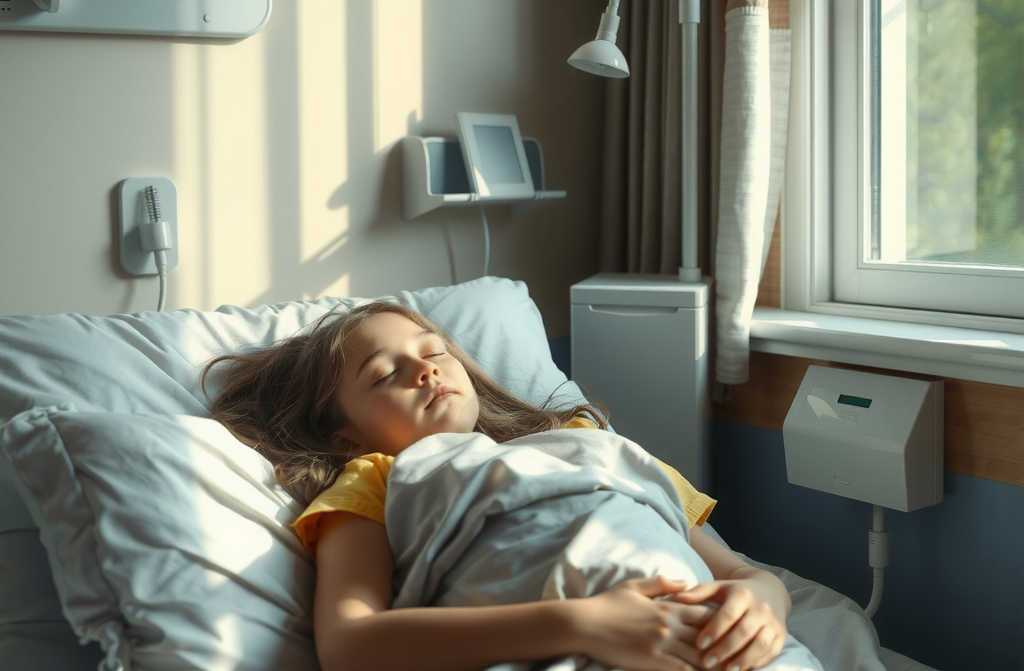
Hospital bed where childhood vanished
She was twelve, the age when the world grows both larger and more mysterious. But her childhood ended neither on the green behind her house nor in the echo of a noisy classroom.
It ended on the stiff sheets of St. Agness Charity Hospital.
December, 1902, in Manchester. The ward unadorned and cold, grey light angling in, linen rough as bark, the astringent touch of carbolic acid mingling with anothers trembling dread. Emily Green lay there wrapped in a body not nearly tall enough, not nearly strong enough for what was about to happen.
Labour endured for sixteen hours.
Sixteen hours that hung not between life and birth, but between life and its unravelling. None of the staff had wished to see a child suffer childbirth and they knew it. The truth wavered in her slender wrists, her faltering shoulders, the way each new pain seemed to subtract a little more of her breath, a little more of her.
Emily clung to her blanket. Her eyes wide and watery stared far past the cracked ceiling, into a realm inside herself that was somehow steadier, somehow less painful than this harsh, antiseptic reality.
I do not know how much my husband earns; it sits quietly with me, as if inside a locked drawer. But my mother squints at me, not as a proper married woman, but as a naive child, swindled by the grown-up world.
My soon-to-be mother-in-law, prim with suspicion, once led a former convict into my fiancés flat the eve before our wedding, determined to catch me in the dust of disgrace. But the morning after, the story belonged to no ones plan.
Three years I told neighbours my husband was a tradesman, but the real tale wriggled out like a crumpled petrol station receipt and an ancient Nokia phone from his jackets pocket.
My mother-in-law gave me gold earrings for my thirtieth pretty, expensive. Only, piece by piece, she took them back: not with the help of a jeweller, but with every awkward luncheon, every sigh, every sideways glance.
In this scene, there was no heroism.
Only survival, knotted and raw.
And a silence that could not manage empathy.
It was the silence of embarrassment humiliation ferried to the weakest shoulders.
Her pregnancy had not been an accident, nor a choice. It was the betrayal of an adult she ought to have trusted. At eleven, her body had been commandeered.
When the truth surfaced, the man evaporated like a spectre
No explanations.
No consequences.
As if slipping through the citys flickering gaslights could polish all stains away.
That left Emily, her mother,
and a city that judged wronged children more harshly than the guilty: it watched, muttered, recoiled.
Emilys mother tried to shield her in the manner she knew not loudly, not well, but desperately.
She pulled Emily from school, hid her from neighbours, drew curtains, spun stories.
Not for Emilys guilt
but because the world seldom protected wounded children. It mostly asked that they vanish.
For a while, the secret half-held.
Then Emilys body gave her away. Bodies are unskilled liars: they grow, reshape themselves, spill the truth even buried under a thousand excuses.
Her stomach would not be hidden.
The neighbours whisperings could not be muffled by glass.
The familys solution, when nowhere was safe, was the hospital.
But St. Agness was no shining institution; it was for those without shillings or strategies only faint hope a stranger might be able to save you.
Thats how Emily ended up here.
Her pain crested in waves. The doctors acted with a clipped urgency, as if a misplaced syllable might jar their frail balance. The night stretched not forward, but sideways like a corridor with no door at the end.
Every new hour was a threshold.
Her mother stood beside her, at a loss for what to do with her own hands. Every fibre longed to pick Emily up, carry her home, erase all this. But there was no away left nowhere time could unravel.
Emily didnt scream, not as it happens in stories. Often, she couldnt even muster air enough to cry out. Cropped noises slipped from her lips, then silence not peacefulness, but the silence of needing to retreat inside to survive.
At last, when the birth arrived, the ward seemed to contract, the air thickening. People moved more quickly, but not frantically this was the hush of urgency shaped by precarious hope. A mistake could tip everything.
And then the whimper of a baby.
Thin, but certain.
A boy.
Someone exhaled sharp relief was it possible? The child was alive.
But Emily she remained, pale and stripped, her face too large for her thin, wavering self. Doctor and nurse did not celebrate. It was far too early.
One doctor met her mothers eyes, and the silence between them uttered what words would not:
We dont know if shell last the night.
Her mother nearly collapsed, grabbing the beds edge as Emilys breath fluttered, a lace thread easily snapped.
As the infant was wrapped in grey wool and bundled for examination, her mother saw Emilys eyes close.
Not like sleeping.
Like slipping out of the room out of being.
Emily she whispered. No more words would come.
Doctor lunged forward, nurse muttered, shadows lengthened as hands and steel filled the air.
And Emilys mother understood: the worst part of the night wasnt the fact her daughter had just become a mother.
It was realising her daughter might not live to see the morning light.
There is a vast chasm between seeing a child become a mother and contemplating she may not survive to become a woman.
Part 2: Facebook Comments
Emily survived but the cost was never settled that night.
There was no going back to how things were not for Emily, her mother, or the baby. The birth did not stitch the wound; it simply made it visible, forever.
An excerpt:
When Emily opened her eyes, daylight had already crawled across sooty Manchester roofs, pressing into the hospital. She seemed not to know where she was, for a moment. Her mother stroked her brow the way you touch a feverish child gently, with the guilt of having no cure.
Hes alive, her mother whispered. A boy.
Emily did not smile. Did not weep. She stared up as if the words would not lodge inside her, as if nothing belonged anymore.
It was soon obvious to everyone: Emily was too young to be raising a child. Her mother took the infant for herself and named him Henry. As for Emily, she tried to retrace her steps, to return to the childhood that had already been snatched away.
But her mothers mind churned with one question: when someone asks, Whose boy is this? what truth could possibly be uttered that wouldnt shatter Emily a second time?
Part 2: WordPress
In a city where gossip darted swifter than kindness, Emilys mother quickly learned: now she must protect not just the flesh, but the living soul from other people.
Henry came home, and the house once a small, slightly hopeful haven felt suddenly cramped, jammed with the babys wail, Emilys damp silences, and the exhaustion of a woman who had to hold the family together and shield her child from the pitiless eyes of the street.
The decision was simple, inevitable:
Emily would not raise Henry.
Not for lack of wanting,
but because Emily was a child herself, one whod survived a trauma no one should. She needed mending, safety, time. The worlds gaze would have scraped away what little hope remained, had she also been forced into motherhood.
So her mother adopted Henry as her own.
And to the outside, Emily was to be just a normal girl again.
But childhood is not a date on the calendar. Its the feeling that your body is your own, that the future stretches wide, and mistakes are permitted as teaching, not as curses.
Emilys birthright to these things had been seized by force.
When she returned to school, it was not a return to normal more like entering a room where everyone pretends nothing happened, while knowing full well. Glances clung longer than necessary. Attempts at kindness sounded hollower than tin. Whispering was worse than insult for it stuck to you, dust that wont be scrubbed away.
Still, Emily tried her best.
She sat her desk, wrote essays, answered when called upon, smiled at the moments that demanded it. It was like donning someone elses clothes they never fit quite right. Not because Emily was odd, but because the world would not accommodate the simple truth: a wounded child is not automatically guilty.
The price was more than shame or fear.
Her body remained fragile. Hidden aftershocks struck in secret: fatigue, stabbing pain, weakness without warning. A body made for growing was instead pressed into burdens it was never built to bear. Such things do not just pass away.
Her schooling, over time, quietly dissolved.
No grand enough. No official pronouncement. Just a slow constriction survival became the curriculum, not dreams. In the end, education was a luxury neither Emily nor her family could afford.
Emily grew up quickly but never as girls are meant to.
She grew by endurance rather than anticipation, learning: keep going, not keep hoping.
She married early.
Not like a love story, more like the expected script: marriage for respectability, for closing questions, for making oneself unseen. It stopped the gossip for a time.
Later, she had other children.
Fate twisted cruelly her body never became sturdy. The thing that first happened at twelve left a scar over every corner of her life; each pregnancy was harder, more dangerous.
Meanwhile, Henry grew.
He was protected by a story built for safety: his grandmother raised him as her own, presented him to the world with a version they could survive. And so Henry grew up thinking that Emily was his sister.
This was not a lie of convenience; it was a fragile shield. It sought to save the child from branding, Emily from renewed devastation every time the question was asked.
For years, it worked.
Families learn quickly which things to mention, which to leave buried. Henry, like all children, adapted to the strange rules, never seeing their roots.
Emily lived with double exhaustion:
She was a young woman carrying an unspoken trauma,
and also a mother who watched her son grow up calling her sister.
Some pain never howls. It just becomes the landscape of your days.
We cannot know what Emily whispered in the night, or how her sorrow sounded in an empty room. But the weight never seemed to lighten.
And then, at twenty-two, Emily died in the very act that once nearly took her: childbirth again, another bed, another flurry of doctors and nurses, the bodys eternal struggle.
Twenty-two.
Today barely the start of adulthood; for her, a finish line crossed on sheer stamina. Death arrived as if to repeat the same fateful play.
The truth about Henry shimmered out, not in a headline, but almost gently, as something that could no longer remain hidden in the back of the drawer.
Henry learnt Emily was not his sister.
She was his mother.
And her story was not a family tangle, but a consequence of violence and broken trust things no child should ever carry.
The whole house had been built on a scaffolding of silence.
Imagine, if you can, reweaving the entire fabric of memory, swapping roles, understanding suddenly what could never be asked. Yet among all the confusion, one thing rang clear: Emily was never at fault.
She was a child, robbed of the chance to grow at her own pace.
Her story isnt merely a curiosity left in the archives its a reminder that behind every clinical note and date stands a real child.
Societys view of the victim finds shape in the small stuff: in who is allowed to disappear, who is left to carry shame, and who learns to make a life out of endurance.
Emily survived the birth of 1902 against every prediction.
But survival never returned her childhood, her schooling, her open sky.
It only gave her more of life a life that kept closing in around her.
And perhaps the most bitter truth: not every story ends well just because someone survives.
Sometimes life itself is the price.
Remembering Emily Green matters for this: every historical case is a real child.
And no child should pay with their life, their very selfhood, for evil they never chose.
Because on that December night, Emily wasnt a miracle.
She was twelve.
A child.
And she should have been sheltered, long before anyone called her extraordinary for simply living through it.





