
The Invisible Glass Wall
A Storm Ten Years Ago
That evening, the sky over Manchester was the colour of leadjust like my mum Susan Prices face.
In this house, we follow my rules! Her voice, used to ringing out across school corridors and playgrounds, thundered through our flat.
Your rules are a straitjacket, Mum! I shouted back, tossing my gym bag to the floor. Youre smothering me. Im not your rough draft you keep rewriting until its perfect!
Then go and find some other air to breathe! She pointed to the door, her finger steady and unwavering. Leave. And dont bother coming back until youve learnt to appreciate whats been done for you.
I stared at herthere was a cold fire burning in her eyes. Without another word, I picked up my bag, stepped over the threshold, and disappeared into the lashing rain outside. Susan Price stood by the living room window, certain I would return within the hour, if not by morningsoaked, starving, and sheepish.
But I never came back. Not the next morning. Not the next week. Not in ten years.
I became what Id always dreamtan architect, Edward Price. My buildings were like me: all glass, concrete, and steel. Striking, efficient, but cold as winter. I had a flat on the fortieth floor, a polished car, and I made a habit of never looking back. Yet, in this perfect world, an old council flat in the outskirts haunted me like a black holean address I tried, year after year, to forget.
Mr. Price, your project handover is tomorrow, my assistant reminded me. And on Saturdaywell, you marked it on your calendar. Your mums birthday.
I froze, staring at the sprawling city beyond my window. Ten years. I hadnt called. She hadnt searched. Every year Id buy her a present, leave it in the boot of my car, then send it to charity in the end. Yet this time, something inside me shifted. Maybe Id finally realised that concrete was a rubbish shield against loneliness.
Saturday. The old estate greeted me with the scent of blooming lilac and the groaning of rusty swings. My luxury SUV looked absurd parked among battered hatchbacks, like a spaceship landed in a scrapyard.
Getting out, my legs felt heavyas though I was dragging shackles with each step. The flats entrance smelled of damp and frying onions. I climbed to the second floor. Number 14.
I raised my fist to knock. My knuckles hovered, trembling, an inch from the battered old door.
What could I say? Hi, I just popped round after a decade? Or: Sorry I didnt come home by breakfast? My thoughts tangled, choking my breath.
Meanwhile, Susan stood on the other side of that door. Shed seen me pull up from the window. Her heart, long convinced it was made of granite, thudded wildly in her chest. She pressed both hands to her lips, fighting the urge to cry out.
She peered through the spyhole, seeing my blurry silhouette: her boy. Now a grown man, wearing an expensive coat and a stone-cold expression.
Just open it, she begged herself. Just grab the handle. Say the kettles on. Say you waited every evening for those footsteps in the hallway.
But her hand wouldnt move. Pride, cultivated by years of solitude, whispered: Hes just here out of spite. Or curiosity. Hes not called in ten yearswhy should I be the first one to open the door?
We stood there for five minutesfive minutes that felt interminable. I could feel the warmth behind the door. I knew she was there. I could hear her shaky breath.
Mum I whispered, pressing my forehead lightly to the cold door.
Susan Price flinched. On her side, my voice echoed like a ghost from another lifetime.
I dont know how to say sorry, I continued, still speaking to the closed door. You always taught me to be strong. Unbending. Proud. Ive designed hundreds of buildings, Mum. But theres never been room for me in your home.
Susan closed her eyes. A tear trickled down her wrinkled cheek.
I built this wall, she whispered back, knowing I wouldnt hear. I pushed you out, expecting youd crawl home. But instead, you learned to fly away. And now Im scared that if I open the door, youll see just how small and frail I am without my anger.
I raised my hand again, almost touching the handle. She was on the other sideher hand already resting on the latch. Only a few thin inches of metal and wood kept us apart.
One nudge, and the wall would topple. One movement, and a decades winter would thaw.
But I let my hand fall.
She wont open. Shes still angry. She doesnt want to see me, I told myself.
Susan felt the handle go still, sensed my hesitance.
Hes leaving. He never even knocked. I suppose he just doesnt care, she thought, shoulders sagging.
Turning away, I fished in my coat for a small boxa silver brooch shaped like a lilac branch. The first thing I wanted to buy her, ages ago, with my first proper pay cheque.
I placed it gently on the mat outside number 14.
Happy birthday, Mum, I said, louder, my voice trembling. Sorry I turned out exactly like you wanted.
I started back down the stairs, my footsteps echoing sharply in the empty hall.
Susan couldnt wait any longer. She yanked off the chain; her keys clattered to the floor. The door burst open.
Edward! she called into the echoing stairwell.
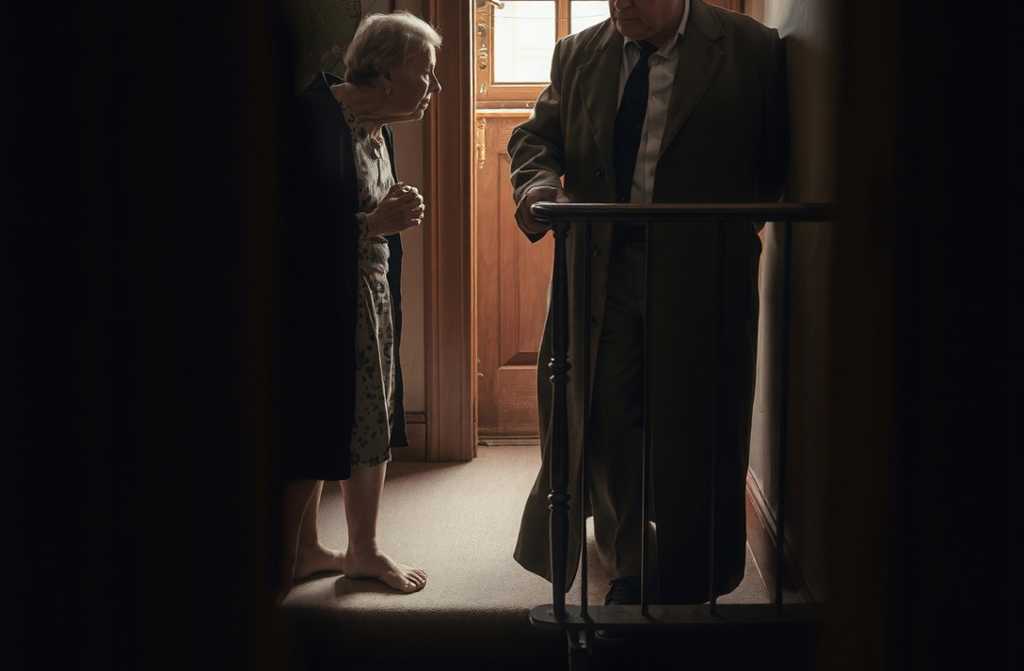
I stopped, halfway to the ground floor, and turned. She stood framed in the light of her flata small, grey-haired woman. She looked nothing like the fierce headmistress I remembered. She was delicate, like a fragile piece of antique china.
She was clutching the brooch.
We stared at each other across the stairwell.
Going? she asked, her voice breaking. Leaving again, without waiting for an answer?
You didnt open the door, I replied, walking back up one step.
And you never knocked, she retorted, stepping out onto the landing. You just stood there, silent. I thought you were here just to see if Id finally died of my own pride.
I climbed three more stairs. Now there was barely a stride between us.
I was afraid youd say, Why have you come?
And I was afraid youd say, I came to tell you I dont need you anymore.
We fell into silence. The heavy air in the hallway finally lifted.
The brooch is beautiful, Mum whispered. But the lilacs in the courtyard still smell nicer. The kettles boiled, Edward. Ten years ago I put it onand it must have boiled dry by now. But Ive filled it again.
I walked up to her. I towered over herbigger, stronger, a successful architect. Yet in that moment, I was just a boy again, clutching my old bag. Gently, I hugged her. She smelt of medicine and those old lilacs.
Mum, I wont come in if youd rather I didnt
Oh, hush, she said, pressing her face against my shoulder. Enough with the walls. Just come and have some tea.
We went inside. The door to number 14 closednot with a bang, but a gentle click, sealing us from the cold city outside.
Neither of us ever mastered graceful words. We were both prickly and stubborn at heart. But that evening, I finally understood: The hardest project of my life was done. Id rebuilt a home from a cracked foundation. And at last, there were no invisible glass wallsjust light.
Personal lesson: Sometimes, the toughest walls we build are invisible. It takes more courage to take them down than it does to put them up. And sometimes, all you need is to open the door.





