
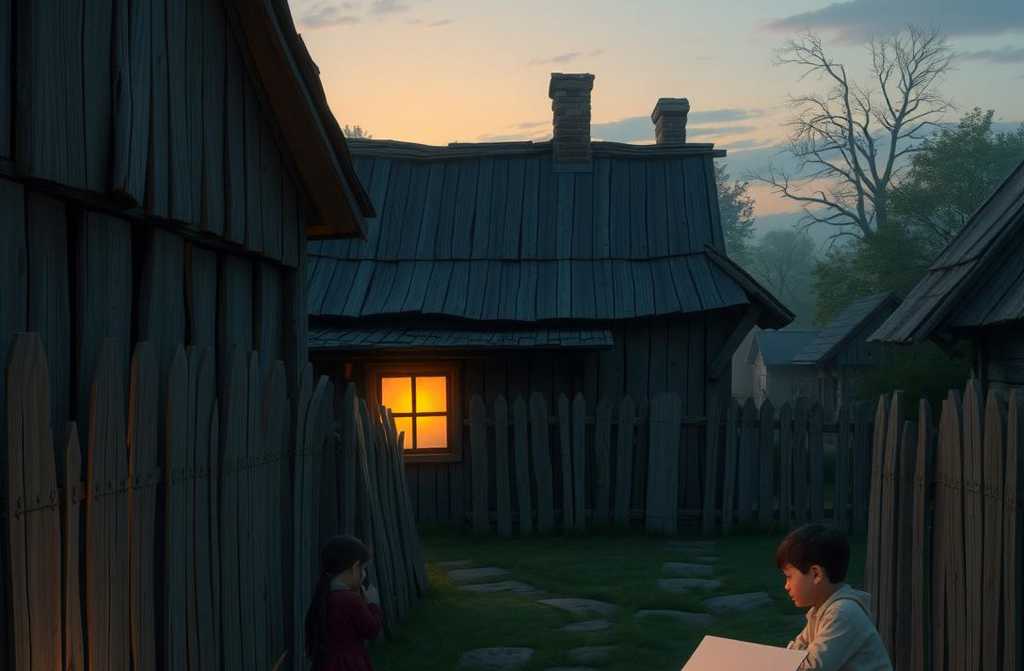
In the quiet village of Stonemere, tucked away in the rolling fields of Yorkshire, nobody had much love for old Lydia. To say she kept to herself would be generous—she downright loathed people, and the villagers agreed unanimously on that. Built like a plough horse, broad-shouldered and towering over most of the local men, she made them crane their necks just to meet her gaze. Not that anyone sought it—she never returned greetings, just muttered under her breath and stomped past, eyes fixed somewhere in the distance. Or rather, not even fixed—just naturally looking down on everyone else.
Lydia lived in the heart of the village, in an old cottage that, as the elders remembered, had been built by her father. A tall, solid fence surrounded it, so high that few dared peek over. She wasn’t one to tolerate nonsense. One summer evening, a few curious lads, fortified by ale, clambered up for a look at the reclusive woman’s life. Spotting them through the window, Lydia stepped onto the porch with her father’s old hunting rifle, and without a word, fired a warning shot over their heads. After that, her yard was left well alone.
Her small farm was nothing to scoff at—chickens, geese, rabbits, and two goats. The villagers whispered, “Why does she need so much? Her pension would do, but she’s just greedy.” She butchered the animals herself, carted them to the market in the nearest town, and sold them all in a day. The money went straight into her apron pocket before she retreated back to her fortress of solitude. The goat’s milk she turned into cheese—an old family recipe, apparently sought after in the city. Her birds were plump, her rabbits well-fed, her eggs large—no cheating there. She never haggled, but folks bought willingly.
When talk of her came up, the old-timers recalled Lydia had always been sour-faced. Her mother died when she was still crawling, leaving her with her father—a hulking, silent man. A few years later, he brought home a stepmother from the next county, but the woman fled within a month, suitcase in hand. Some muttered Lydia had driven her off. Father and daughter stayed alone. Then, when Lydia was grown, her father went into town to trade and vanished—whether murdered or chasing after his runaway wife, no one knew. Lydia was left behind. Permanently.
She never married. “Who’d put up with the likes of her?” the villagers gossiped. Years passed, people died, new ones were born, but Lydia seemed frozen in time. Even grey hairs avoided her—she always wore a scarf, beneath which only a heavy chin, a hooked nose, and thick black eyebrows, sharp as flint, could be seen.
One winter’s night, the neighbours’ cottage caught fire. Without a word, Lydia appeared with an iron bar and helped douse the flames before the fire brigade arrived. She hauled burning beams so deftly that the house was later rebuilt from the same wood—barely anything had burned. The neighbours thanked her, but she just grumbled and walked off without looking back.
When Lydia died, the director of Elmridge Children’s Home, Margaret Whitmore, arrived with three carers and a dozen kids in tow. The villagers, more curious than mournful, crowded into her yard. Inside, they found perfect order—the chicken coop, rabbit hutches, goat shed—all tidy as a picture from a farming magazine. The cottage itself was spotless but barren—a table, a chair, a rusted iron bed with a sagging frame, a crooked dresser with a single cracked plate, spoon, knife, and a mug missing its handle. By the window, a worn bench, polished by years of use, and on the stove, neatly folded clothes. That was it.
On the table lay an envelope, addressed in firm handwriting: *To Margaret Whitmore, from Lydia Grace Holloway.* The director opened it and read a sheet torn from a notebook. Later, she told them—for twenty years, Lydia had sent the children’s home money every month. Not small sums either—it had been a lifeline. The note read: *”The cottage, the farm, everything—I leave to Elmridge Children’s Home. The children aren’t to blame.”*
The villagers stood silent, staring at the empty house. Someone remembered young Lydia sitting by the river, staring at the water as if waiting for someone. Another whispered that perhaps her father hadn’t just disappeared—maybe he’d run off, leaving her behind. And all her life, she’d carried that weight, locking her heart away. Only to children—strangers, innocent—did she give everything she had.





