
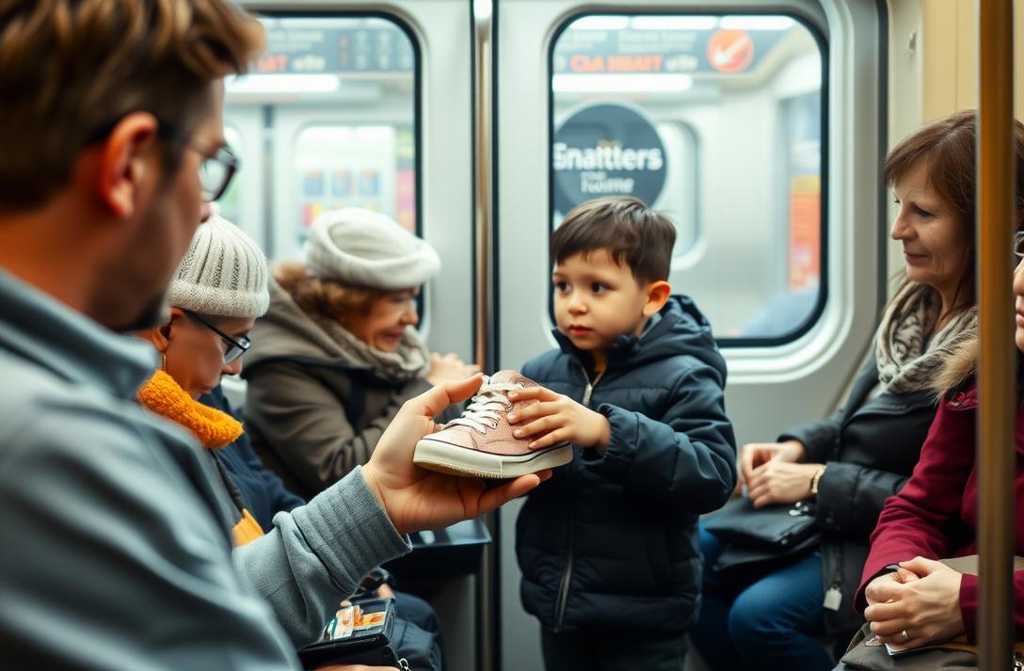
**A Barefoot Boy on the Tube – And What He Left Behind**
It was just another evening on the Underground after a long day at the office. The sort of journey where you keep to yourself, headphones in, letting the rhythm of the train carry you into that odd limbo—not quite home, but no longer trapped in the grind of the day.
The fluorescent lights flickered faintly as the carriage rattled forward, and commuters around me were lost in their own routines. Some scrolled mindlessly on their mobiles, others gazed blankly at adverts for budget holidays. The air was thick with that familiar, weary silence.
Then, the train slowed at the next stop, and something changed.
A boy stepped on. At first glance, he was unremarkable—maybe fifteen, lanky build, messy brown hair, a battered rucksack draped over one shoulder. But then I saw his feet.
One was bare. The other had a sock—worn thin, mismatched. In his hands, he clutched a single trainer, its sole barely clinging, scuffed and filthy. He shuffled in, eyes down, and tucked himself into a seat between strangers, curling in like he wanted to disappear.
People noticed—of course they did—but did what Londoners do best: pretended not to. A few flicked glances at his feet and swiftly looked elsewhere. A bloke in a suit nudged his briefcase aside. A young woman opposite chewed her lip and stared fixedly out the window. An unspoken agreement hung in the air: *Don’t make it awkward. Don’t interfere.*
They all obeyed.
Except the man sitting beside the boy.
I spotted him because he kept looking down—first at the boy’s feet, then at the shopping bag by his own polished brogues. He had the look of a bloke in his forties who’d likely coach his kid’s football team or help a mate fix a leaky tap. There was something steady about him.
For a while, he stayed quiet. But I could see him wrestling with it—shifting slightly, weighing his next move.
Then, as the train slowed for the next station, he leant toward the boy and spoke softly.
“Alright, mate,” he said, “bought these for my lad, but he’s got plenty. Reckon they’d suit you better.”
The boy jerked his head up. His eyes—wide, wary—darted between the man’s face and the bag. He didn’t speak, but his whole body tensed, like he was waiting for the catch.
The man didn’t press. He just reached in and pulled out a pair of brand-new trainers—navy, pristine, tags still on.
He held them out with an easy smile.
The boy hesitated. Glanced at the wrecked shoe in his lap, then back up, stunned.
Finally, he toed off the old trainer and slipped on the new ones.
They fit. Spot on.
“Ta,” he mumbled, barely audible.
“No bother,” the man said. “Just pass it on when you can.”
And that was that. No fuss. No grand speech. Just a quiet bit of decency between strangers.
The mood in the carriage shifted instantly. The invisible weight lifted. A woman a few seats away shot the man a warm smile. An older chap gave a approving nod. Even I felt it—a crack in the day’s grey monotony.
The boy sat differently now. Shoulders looser. Every so often, he’d look at his new trainers like they were magic.
Maybe to him, they were. Not just shoes—proof someone *saw* him.
As the train rumbled on, I wondered about his story. Was he on the streets? Had he bolted from home? Or just hit a rough patch? I’d never know. But those trainers weren’t just footwear—they were a bit of hope.
When his stop came, he stood, pausing at the doors.
“Cheers,” he said, voice wobbling. “Proper decent of you.”
The man just smiled. “Remember it. Hand it on.”
The doors opened, and the boy vanished into the crowd.
But the moment lingered. No one dove back into their phones straight off. We all sat in that rare, shared quiet, reminded of something we usually rush past.
And I kept thinking—what if we all acted a bit more like that bloke?
Weeks rolled by. Autumn crept in.
Life returned to its usual pace—work, Tube, sleep. But that moment stuck like a pebble in my shoe.
Then, one drizzly evening, it happened again.
I boarded a packed train, damp from the rain. As I scanned for space, I saw her—an elderly woman in a wheelchair near the doors. Fine grey hair peeked from under a headscarf, her hands struggling to keep her handbag from slipping. No one moved to help.
I nearly turned away. Nearly told myself it wasn’t my business.
Then I remembered the boy’s face—the way he’d stared at those trainers.
So I stepped forward. “Let me give you a hand.”
She blinked up, then smiled. “Ta, love. Some days, everything feels a bit much.”
I steadied her bag and asked if she needed anything else. We chatted—about the miserable weather, how noisy the city’d got. She told me about her late husband, how they used to ride the Tube on Sundays just to see new spots. Her kids lived up north now, so most days were quiet.
Before her stop, she patted my hand. “You’ve no idea how much this meant,” she said softly. “Been a lonely week.”
Then, as the doors opened, she pressed a folded note into my palm.
I didn’t read it till I got home.
Inside, in neat cursive:
*“Your kindness brightened my day. Here’s a voucher for a café my husband and I loved. Hope it brings you a bit of joy.”*
The café was just round the corner from my flat. I’d walked past it a hundred times but never gone in.
Next morning, I did.
The place was cosy, smelling of fresh bakes and proper coffee. I ordered their special—tomato soup with crusty bread—and sat by the window. No distractions. Just the warmth of the meal and the quiet hum of the place.
It wasn’t just the food. It was the reminder—of her, of the boy, of the man with the trainers.
Of how kindness weaves its way back.
A pair of shoes. A helping hand. A meal shared across time.
You never know who’s watching. Never know how far a small good might travel.
So next time you’ve the chance—take it.
Be the one who steps in. Who sees.
Because one day, someone might tell a story that started with you.





